
In 20 years in RevOps, I’ve seen this argument in every QBR: the sales leader says attainment is 78%. Finance says it’s 71%. The CRO presents a blended number that satisfies nobody.
The board asks which reps missed and why, and the conversation dead-ends because nobody agrees on whether ramping reps count, which deals should have been recognized in Q3 versus Q4, or whether attainment is measured against the original quota or the revised one from week seven. The argument is never really about attainment. It’s about what the model underneath it is counting.
The Bridge Group’s 2024 SaaS AE Metrics Report found that only 51% of account executives hit quota in 2024, down from 66% in 2022. That decline tracks with a broader trend: quotas have increased faster than market conditions support, and many capacity plans have not been rebuilt from the bottoms-up to reflect new ramp curves, segment mix shifts, or ACV compression.
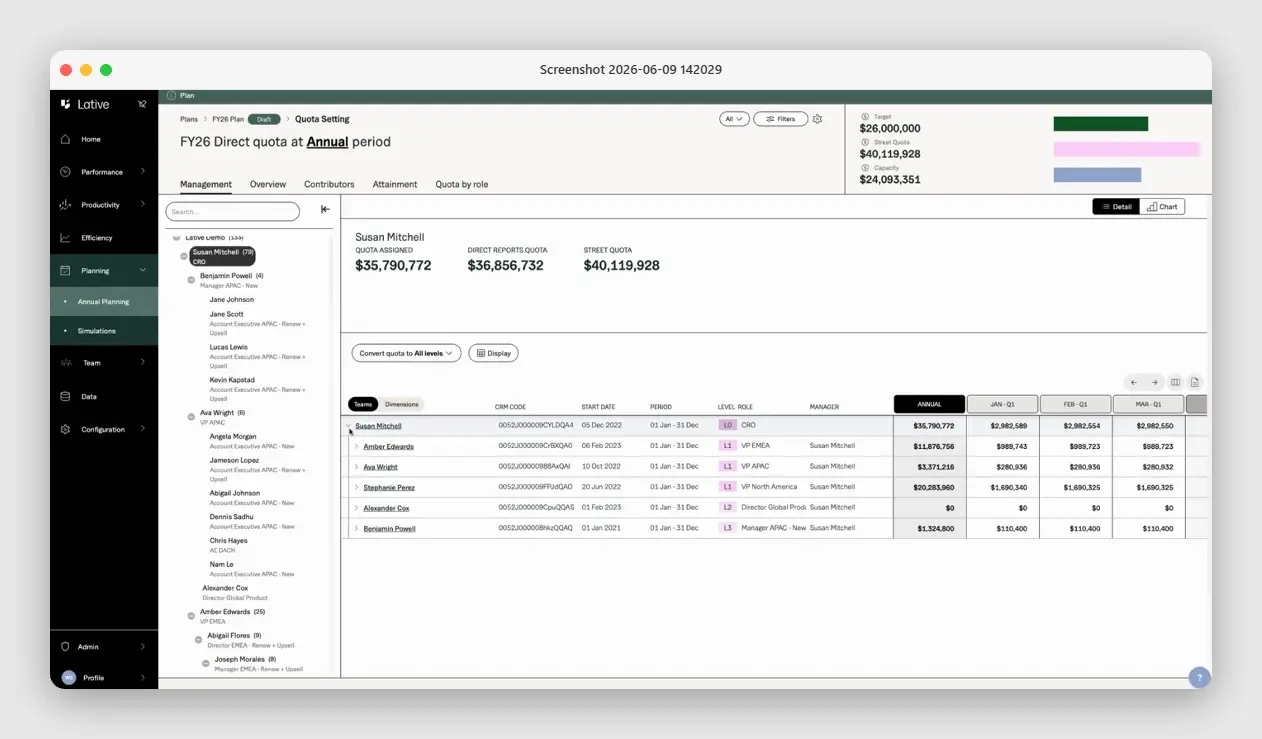
Lative’s Sales Capacity Planning module surfaces quota attainment by rep cohort, tenure band, and segment, using the same Salesforce data your CRO runs. When the attainment calculation is grounded in one data model, the QBR argument resolves into a plan correction instead of a sourcing debate.
What is quota attainment
The answer to what is quota attainment shapes how every capacity plan gets built.
Quota attainment is the percentage of a sales rep’s or team’s assigned quota that was closed in a defined period. It is the primary measure of individual and team sales performance. A rep who closes $240,000 against a $300,000 quarterly quota has attained 80% of quota. A rep who closes $360,000 against the same quota has attained 120%.
Quota attainment is an output metric: it tells you what happened. Its value as a diagnostic tool depends entirely on whether the quota itself was grounded in productive capacity math, ramp curves, historical conversion rates, territory quality, and ASP, or set from a top-down number that the investor model required.
How to calculate quota attainment
The formula:
Quota Attainment (%) = (Actual Revenue Closed ÷ Quota Target) × 100
A rep carries a $300,000 Q2 quota. She closes $252,000 in new ARR by quarter end. Her quota attainment is 84%.
For a team or segment, the formula is the same with the inputs summed: Team Quota Attainment (%) = (Total Revenue Closed by All Reps ÷ Total Team Quota) × 100. The team number and the individual numbers tell different stories. A 72% team figure can hide a top rep at 140% carrying three reps at 40%, which is why cohort-level attainment, not the blended team average, is the version that actually drives capacity decisions.
Three inputs create ambiguity in practice:
- “Actual revenue closed”: Can mean signed contracts, invoiced revenue, cash collected, or bookings recognized under ASC 606. Your finance team and your sales team are often using different definitions.
- “Quota target”: Was it adjusted mid-quarter? Is it the original plan-of-record quota or the revised one? Are ramping reps included at full quota or prorated?
- Team versus individual: Team attainment averages out high performers and misses. Individual attainment by cohort, broken down by tenure band and segment, is where the diagnostic value lives.
Quota attainment benchmarks by company stage
The Bridge Group’s 2024 SaaS AE Metrics Report (170+ B2B SaaS companies) found 51% of AEs hit quota in 2024, down from 66% in 2022. What healthy looks like varies significantly by funding stage:
- Seed / Pre-Series A: Formal quota attainment tracking is premature before product-market fit and repeatable deal motion. Track win rate and pipeline volume; use quota attainment as a signal once you have 8–10 quarters of deal history.
- Series A ($1M–10M ARR): High variance is expected. A healthy benchmark at this stage is 60–70% of reps hitting quota, with the understanding that both the quota and the ICP are still being refined.
- Series B ($10M–30M ARR): The target is 70–80% of reps at or above quota. Below 50% consistently signals a quota-setting problem or a productivity issue compounding with headcount growth.
- Series C+ ($30M+ ARR): At scale, 70–80% attainment is the operating norm for high-performing SaaS organizations. Companies consistently below 60% at this stage are typically carrying a quota model that was never rebuilt from the bottoms-up after the last go-to-market motion change.
Why quota attainment matters for capacity planning
Quota attainment is where the capacity model meets reality. Every assumption in your Sales Capacity Planning model, the 4 Knobs of volume, conversion rates, velocity, and ASP, produces a quota target and a predicted attainment rate. When actual attainment diverges from the model, one of the Knobs is wrong.
If you planned for 75% team attainment and landed at 58%, you have not failed to execute. You have identified that one or more inputs to the model were wrong, ramp time was longer, conversion rates were lower, territory quality was uneven. Those are capacity planning corrections, not performance management conversations.
Lative’s Sales Capacity Planning module connects attainment data to the underlying capacity assumptions so your CRO and RevOps team can see which Knob moved. Its Quota Modeling view shows attainment, quota capacity, and net quota capacity by role side by side, so a shortfall reads as a specific input that moved rather than a blended miss.
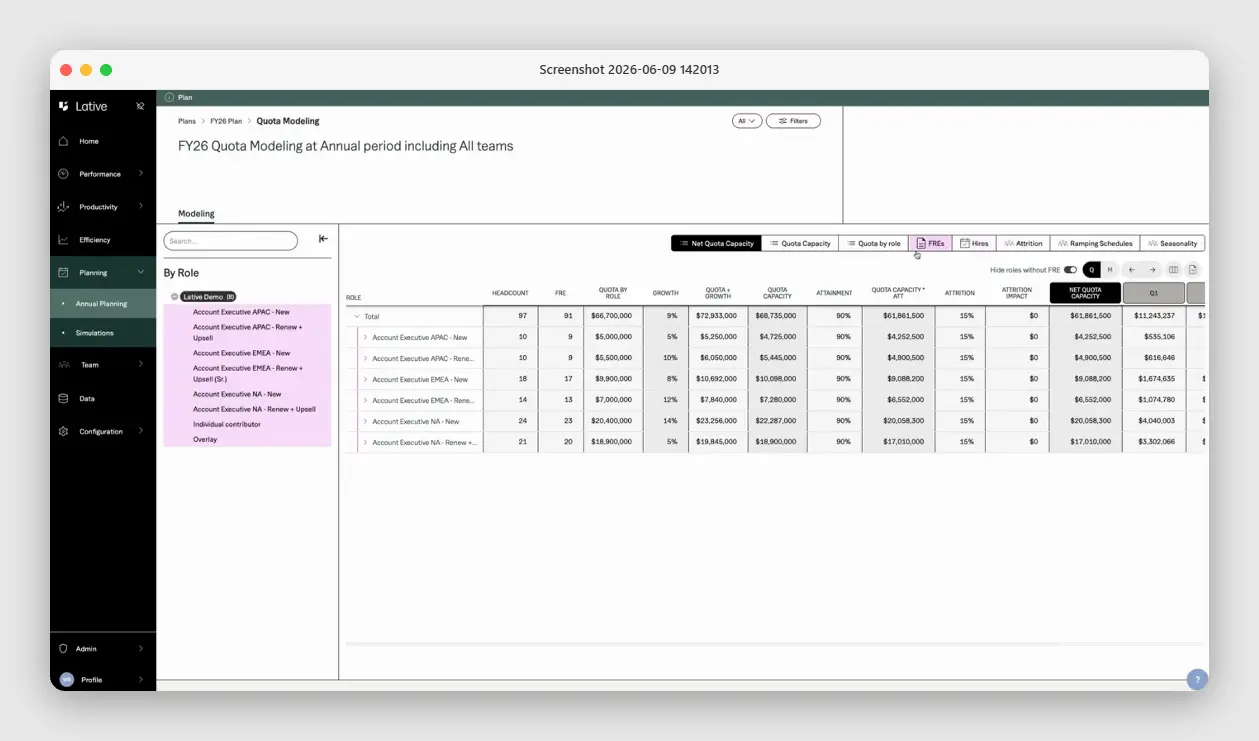
A 17-point attainment shortfall looks different when it is concentrated in ramping reps in a new territory versus distributed across all tenures and segments.
The model tells you which is true. That distinction determines whether your response is a hiring adjustment, a territory redesign, or a quota reset, and getting that diagnosis right before the next planning cycle is what separates a plan correction from a recurring miss.
Common quota attainment mistakes
Most attainment problems are built into the planning cycle, not the execution cycle.
Treating attainment as a performance signal without checking the quota
When 45% of your reps miss quota, the instinct is to ask what is wrong with the reps. The more useful question is whether the quota was attainable given current market conditions, ramp time, and ICP.
An attainment rate below 50% is almost always a quota-setting problem, not a talent problem. I was part of the problem early in my career, we built the quota from the investor model and then managed performance against a number the team had no realistic path to hit.
Averaging attainment across the team without cohort breakdown
Team attainment is 72%. Sounds healthy. But your three most-tenured reps are at 120–140% and your seven reps hired in the last two quarters are at 30–45%. The average is a governance metric.
Cohort-level attainment by tenure band is the diagnostic tool. If your ramping reps are consistently underperforming the model, the ramp curve assumption in your capacity plan is wrong, and the next headcount hire will not solve the problem.
Blended team average
- A top rep at 140% hides three reps at 40%
- Reads as healthy while a cohort is missing
- A governance metric, not a diagnostic
Cohort attainment by tenure
- Shows exactly where the shortfall sits
- Flags a wrong ramp assumption before the next hire
- Points to a hiring, territory, or quota fix
Using attainment rate without adjusting for comp plan design
A comp plan with uncapped accelerators at 100% and no meaningful upside above 80% produces a clustering of attainment around 78–85%. That attainment distribution tells you something about comp plan design, not sales capacity.
When you are using attainment data to validate your capacity model, strip out the comp plan incentive effects or you will build the wrong ramp assumptions into the next cycle.
Key takeaways
- Attainment is an output: its diagnostic value depends entirely on whether the quota under it was grounded in capacity.
- A blended team number hides the distribution; cohort attainment by tenure is where the signal lives.
- Below 50% is a quota-setting problem, not a talent problem; start with the model, not the people.
- When attainment diverges from plan, one of the 4 Knobs moved; the model tells you which.
Frequently asked
What is a good quota attainment rate?
At Series B and beyond, 70–80% of reps hitting quota is the healthy benchmark. Below 50% consistently is a quota-setting signal. Above 90% may indicate quotas are set too conservatively relative to productive capacity.
What is the difference between quota attainment and quota achievement?
Both describe the same calculation: actual closed revenue divided by quota target, expressed as a percentage. “Quota attainment” is the standard RevOps term.
How does quota attainment connect to capacity planning?
Attainment is the output that validates or invalidates your capacity model inputs. When attainment falls short, the model tells you which Knob, volume, conversion rate, velocity, or ASP, moved. That diagnosis drives the planning correction.
Why did quota attainment rates drop across SaaS from 2022 to 2024?
Quota growth outpaced market growth. Teams hired aggressively in 2021–2022 and set quotas against a demand environment that reversed in 2023. Ramp, conversion, and ACV benchmarks built in a high-growth period were not rebuilt for a slower market.
What should you do when quota attainment falls below 50%?
Start with the model, not the people. Audit the quota-setting assumptions: ramp curve, win rate by segment, historical conversion, territory quality. If those are stale or were set top-down, the shortfall is a planning problem with a planning solution.
If your last board review had a different quota attainment number in every slide, that disagreement has a data model answer. See how Lative’s Sales Capacity Planning module gives your CRO and CFO a shared number. Book a demo.
Werner Schmidt is the CEO and Co-founder of Lative, with over 20 years of experience in Revenue Operations with companies including Forcepoint, Aruba Networks, Citrix, and Sage.