

Anaplan vs Lative for SaaS is a build-versus-buy question. Anaplan can model SaaS sales capacity, ramp, and quota, but you design and maintain that logic on a general modeling platform. Lative ships it: ramp-adjusted capacity and quota are native objects, live in weeks. For a SaaS revenue team, the real decision is whether you want a platform to build in or a product that already knows the job.
Anaplan gives you the horsepower to model capacity precisely; it does not decide the quota for you, and precision on the wrong number is still a miss.
One disclosure up front: Lative is our product, so read this with that in mind. We will be clear about where Anaplan is the better fit.
The verdict, up front
Short version. Pick Anaplan if you have a dedicated planning team and sales capacity is one model among finance, workforce, and operations. Pick Lative if the specific job is SaaS sales capacity and quota, you want it live in weeks, and you would rather RevOps own it than build and maintain a model. If you want modern modeling without Anaplan’s weight, Pigment is the middle option.
- Best when capacity is one model among many: Anaplan
- Best for SaaS capacity and quota, live in weeks: Lative
- Best middle ground on build effort: Pigment
Anaplan vs Lative for SaaS at a glance
| Anaplan | Lative | |
|---|---|---|
| Best for | Enterprise multi-domain modeling | SaaS capacity-first quota |
| Setup | Months, needs a modeling team | Weeks, RevOps-owned |
| Ramp-adjusted capacity | Build it yourself | Native object |
| Top-down and bottom-up | Model it | One live model |
| Modeling breadth | Broadest, multi-domain | Capacity and quota |
| Pricing | Custom quote | Custom quote, no per-user |
| Standout | Model almost anything | Quota in ramped equivalents |
Both are custom-quote; confirm current pricing with each vendor.
How we compared them
We compared them on the SaaS sales-capacity job specifically: is ramp-adjusted capacity native or built, how long to live, who owns it, and how much modeling breadth comes with it? Anaplan wins on breadth and flexibility; Lative wins on time to value and on shipping the capacity logic rather than making you build it. The question is whether you are buying a platform or an answer.
See our primer on what a sales capacity model is.
How they differ, tool by tool
1. Anaplan: the enterprise modeling platform

Anaplan will model a SaaS capacity plan properly. Ramp cohorts, segment-level productivity, attrition assumptions, territory coverage: all of it fits inside the modeling engine, and it connects to the finance model sitting next to it.
The work is that you build every piece of it. Someone has to decide how a ramp curve is represented, how partial-quarter hires roll up, and what the model does when segment definitions change in March. That is a modeling function, and it is a permanent one. For most SaaS teams the question is not whether Anaplan can do it. It is whether they have a modeler to own it for the next three years.
2. Lative: the SaaS capacity-first tool
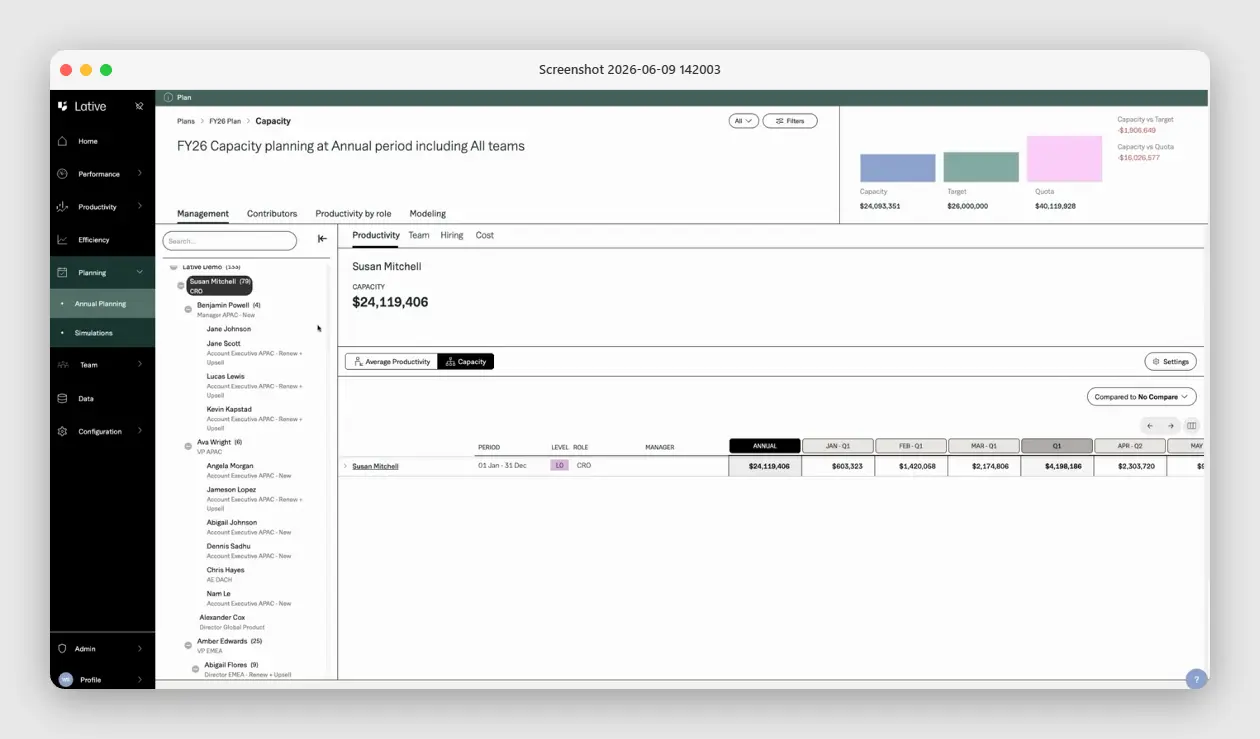
Full disclosure: Lative is our product, so weigh this with the appropriate skepticism. The honest way to read this comparison is as a staffing question rather than a feature question. Anaplan assumes a modeling function exists. Lative assumes RevOps does.
The objects a SaaS capacity plan needs, ramp curves by cohort, productive selling months, attrition drag, and productivity by segment, are already in the product. Setup is loading your data and agreeing on assumptions rather than designing a schema, which is why teams are usually live in weeks instead of quarters.
Anaplan is the deeper platform when capacity is one model among many. Lative is narrower and faster when the job is specifically SaaS sales capacity and quota, expressed as net quota capacity in fully ramped equivalents. It is not a multi-domain modeling platform, and it will not replace Anaplan for finance-wide planning.
3. Pigment: the modern middle option

Pigment is what SaaS teams look at when Anaplan feels heavy but a purpose-built tool feels narrow. The modeling is finance-grade, the build experience is far cleaner than the legacy suites, and scenario work is quick enough that RevOps can run it without a specialist on standby.
It is still a canvas. Ramp cohorts and productivity math are structures you design, so you get most of Anaplan’s freedom with less of its weight and the same standing question about who maintains the model. It is the middle of this comparison in the literal sense: less build than Anaplan, more build than a product that ships the logic.
Which should you choose
Choose Anaplan when planning is a staffed discipline and SaaS sales capacity is one model inside a much larger, multi-domain map. Choose Lative when the job is specifically SaaS sales capacity and quota, you want it live in weeks, and you want RevOps to own it without building the model.
If you want modern modeling flexibility without Anaplan’s weight but are not ready for a purpose-built tool, Pigment sits in the middle. Many SaaS teams run Anaplan or Pigment for finance-wide planning and Lative for the sales-capacity layer. See how they connect on our sales capacity planning hub.
Frequently asked
Is Anaplan good for SaaS sales capacity planning?
Anaplan can absolutely model SaaS sales capacity, ramp, and quota; its flexibility is the draw. The catch is that you design and maintain that logic on a general platform, which usually needs a dedicated planning function. It is powerful but not productized for the SaaS capacity job specifically.
Why choose Lative over Anaplan for SaaS?
Speed and ownership. Lative ships ramp-adjusted capacity and quota as native objects, so it is live in weeks and RevOps can own it, rather than a modeling team building and maintaining the model in Anaplan. For the specific SaaS capacity-and-quota job, that is less work for the same outcome.
Is Lative a replacement for Anaplan?
For sales capacity and quota, it can be. For finance-wide, multi-domain modeling across budgeting, workforce, and operations, it is not; that is Anaplan’s territory. Many teams run both: Anaplan for the broad model, Lative for the sales-capacity layer.
Which is faster to implement?
Lative is typically faster for the capacity-and-quota job because the logic is productized rather than built. Anaplan’s time to value depends on how much of the model you construct, which for a rich SaaS capacity model can run into months.
What about Pigment?
Pigment is a modern modeling platform that sits between the two: more flexible than a purpose-built tool, lighter and cleaner to build in than Anaplan. Like Anaplan, though, the ramp-adjusted capacity logic is yours to build, so it is a platform choice rather than a productized answer.
See it in action. Book a Lative demo and see how it ships the SaaS capacity and quota model you would otherwise build and maintain in Anaplan.
Werner Schmidt — Werner Schmidt is the CEO and Co-founder of Lative, with over 20 years of experience in Revenue Operations with companies including Forcepoint, Aruba Networks, Citrix, and Sage.