
Capacity planning for SaaS is not one model. It changes shape at every ARR stage, because what limits growth at $5M is not what limits it at $100M. The teams that get this right treat each stage transition as a rebuild trigger; the teams that get it wrong carry a seed-stage spreadsheet into a Series C planning cycle and wonder why the forecast keeps missing.
The stakes scale with the company. High Alpha’s 2025 SaaS Benchmarks Report (n=800+ operators) found that beyond roughly $20M ARR, expansion revenue becomes the dominant growth engine, with companies above $50M ARR generating about 60% of new ARR from existing customers.
That shift alone invalidates a new-logo-only capacity model. This guide walks through what to build, what breaks, and what to fix at each stage, as an operational checklist rather than theory. For the deeper analysis of why the model changes, see sales capacity planning for SaaS by ARR stage.
Why SaaS capacity planning is its own discipline
Three structural facts make SaaS different from other sales models. Growth compounds, so a capacity gap this year shrinks the base for next year’s plan. Ramp is long relative to planning cycles: a mid-market rep at five to seven months to full productivity means hires made after Q1 barely touch the current year.
And headcount is the dominant growth lever and the dominant cost line at once, which puts the capacity model in the middle of every CFO conversation. Attainment data shows how badly the discipline is needed: The Bridge Group’s 2024 SaaS AE Metrics Report (170+ B2B SaaS companies) found only 51% of AEs hit quota in 2024, down from 66% in 2022.
$5M to $25M ARR: build the first honest model
At this stage the capacity model is one person’s spreadsheet, and that is fine. What matters is honesty about three inputs:
- Separate founder-led from rep-led performance. A founder closing through board connections in 45 days is not a benchmark for a rep running an inbound motion in 120 days. If the ramp assumption is built from founder-era data, every new rep will look like an underperformer for two quarters, and the model, not the rep, is wrong.
- Use actual conversion rates, not aspirational ones. The rate you believe the product deserves after the next release is not an input. The trailing three-quarter actual is.
- Count attrition. At 20 to 25% first-year rep attrition, one hire in four is a replacement. A six-rep plan that ignores attrition is a five-rep plan with better marketing.
Stage checklist: a ramp-adjusted sales capacity model in one sheet, attainment tracked by rep tenure, one segment modeled (because you probably only have one), and a monthly thirty-minute review with the founder and whoever owns finance.
What breaks here: treating ramping reps as fully productive. With a team of five, one optimistic ramp assumption swings the whole plan by 20%.
$25M to $100M ARR: the spreadsheet breaks
This is the stage where most capacity planning failures happen, because three things compound at once: you are hiring in cohorts, you are opening a second and third segment, and the plan now has multiple owners. The single-tab model stops fitting reality in specific, predictable ways:
- Segments diverge. By $25M ARR most SaaS companies sell into at least two segments with different win rates, deal sizes, cycle lengths, and ramp curves. A blended model hides which segment is under-covered. Separate models per segment stop being optional.
- Version control fails. Finance keeps a copy, RevOps keeps a copy, the CRO keeps a copy. They diverged at the last planning cycle and nobody knows which is current. The planning meeting becomes an argument about whose export is fresher.
- Cohort hiring outruns the ramp model. Hiring six reps a quarter means the ramp assumption is now the largest single variable in the plan. Cohort-level ramp tracking, what did the January class actually produce by month, becomes mandatory. Gong’s 2025 onboarding research found ramp is measurable and repeatable once tracked; the failure is not tracking it.
Stage checklist: per-segment capacity models with their own conversion and ramp inputs, cohort ramp curves refreshed quarterly, a single shared system of record for the plan, scenario runs for hiring slips and attrition spikes (see sales scenario planning), and quota set from capacity rather than divided from the target.
What breaks here: the reconciliation layer. When keeping three copies of the model in sync takes longer than planning, the model has failed regardless of how good the math is. This is the stage where teams move to dedicated software, because the cost of a wrong capacity number is now measured in millions.
$100M+ ARR: capacity becomes a board input
At enterprise scale the capacity model is a set of models: one per segment, often one per geography, and separate models for new logo and expansion, because past $50M ARR roughly 60% of new ARR comes from existing customers and expansion capacity behaves differently from hunting capacity.
The planning conversation moves up a level: capacity versus headcount budget versus efficiency targets, with the CFO and CRO required to operate from one number.
Stage checklist: separate new-logo and expansion capacity models, geo-specific ramp curves where motions differ, an owner and refresh SLA for every model, capacity reconciled to the headcount budget every month, and an audit trail for assumption changes, because at this scale someone will ask who changed the ramp curve and why.
What breaks here: the finance-sales disconnect. Finance plans heads and cost; sales plans capacity and coverage. When the two run on different models, the company over-hires into segments that are already saturated and starves the ones with whitespace. The fix is structural, one model both sides trust, not better meeting hygiene.
A worked example: the $30M blend problem
Take a hypothetical $30M ARR company with twelve mid-market reps and five enterprise reps. The blended model says: 17 reps, $620K average productive capacity, $10.5M of annual capacity against a $12M target, a manageable 13% gap. Run the same roster as two segment models and the picture changes.
Mid-market: twelve reps at 68% trailing attainment on $700K quotas, about $5.7M of capacity against a $6M segment target, nearly covered. Enterprise: five reps at 44% attainment on $1.4M quotas, about $3.1M against a $6M segment target, a 48% gap that the blend was hiding inside the average.
The decisions that follow are different too. The blended model says hire two reps anywhere. The segment model says the mid-market team needs pipeline, not people, while enterprise needs either three more ramped reps it cannot get this year or a win-rate program and a target conversation now. Same roster, same data, opposite plans. That is what segment-level modeling is for.
The transition triggers
Stage labels are fuzzy; triggers are not. Rebuild the model when any of these happen: a second segment passes 20% of new bookings, a hiring class exceeds four reps, expansion revenue passes a third of new ARR, planning requires more than one person to maintain the spreadsheet, or the CFO and CRO present different capacity numbers in the same meeting.
Each trigger means the current model’s assumptions no longer describe the business.
How Lative carries the model across stages
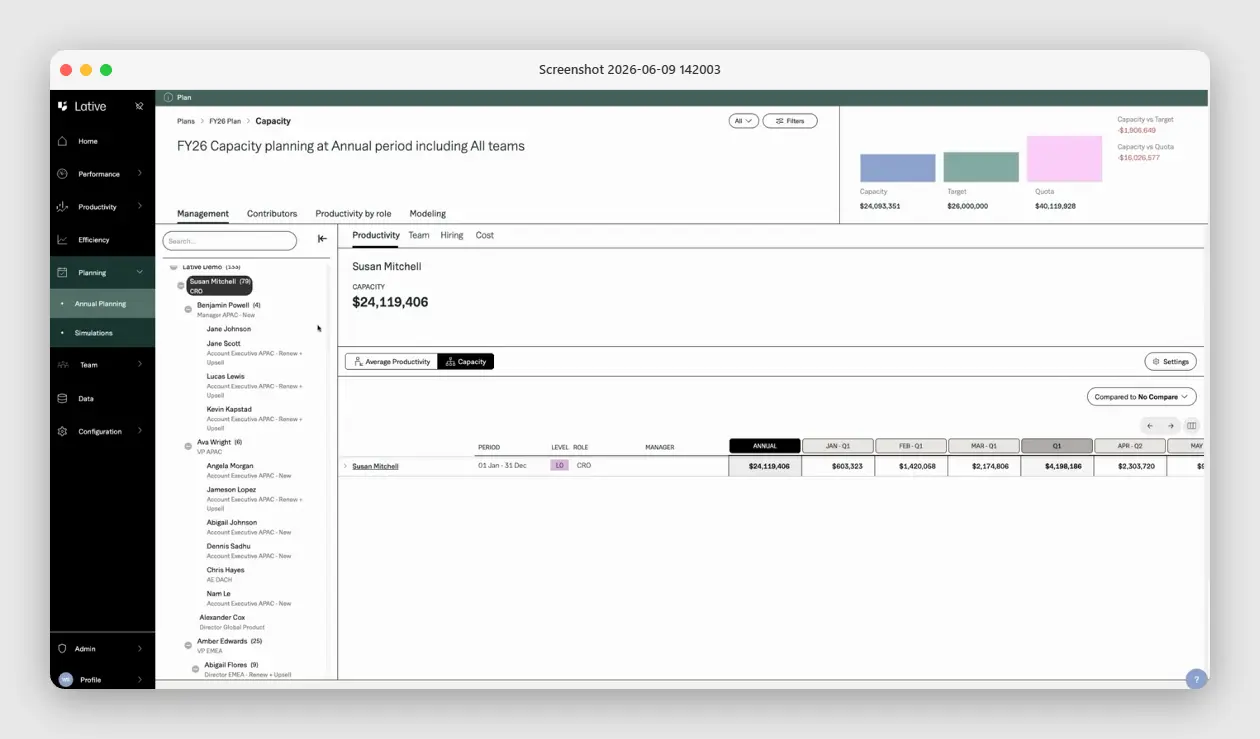
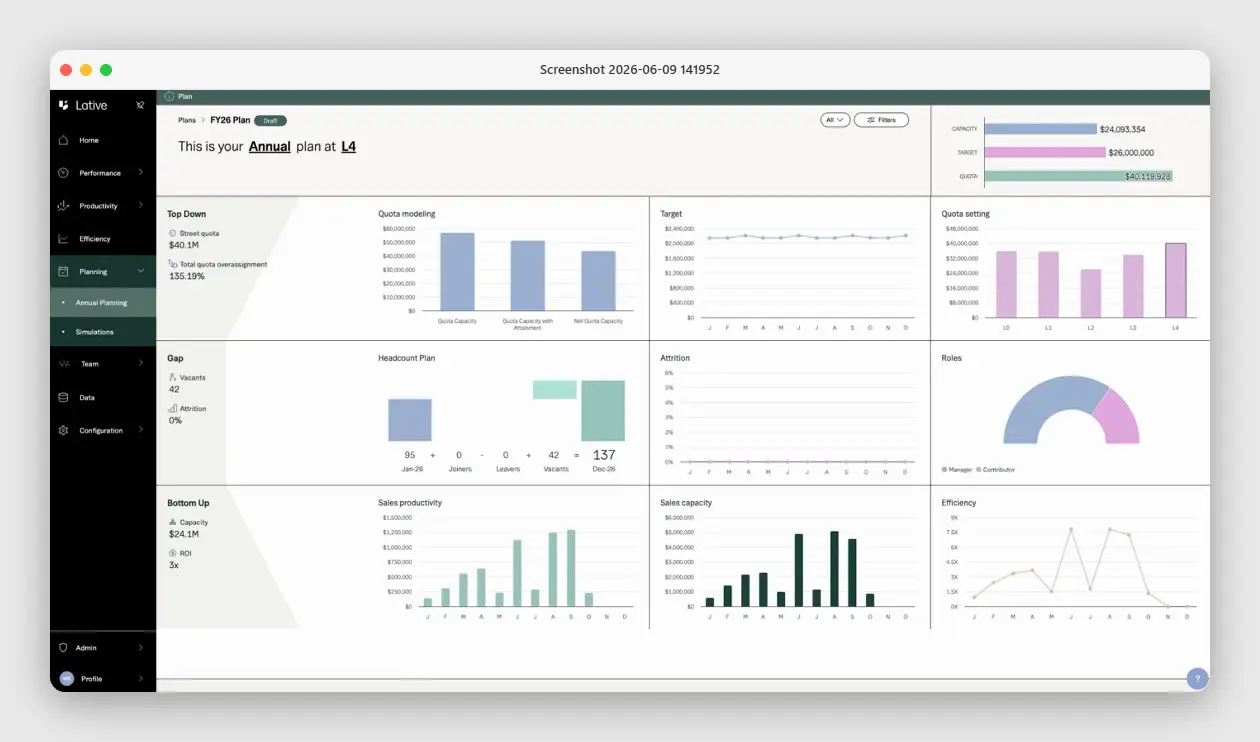
Lative is built so the capacity model survives these transitions instead of being rebuilt from scratch at each one. The Productivity module computes production per rep by segment, product line, and opportunity type, so adding a segment is a dimension, not a new spreadsheet. Average Ramping Time tracks days to full productivity per cohort and per rep, keeping the ramp input honest as hiring scales.
The Capacity view sums ramp-adjusted productive capacity per rep and team, Annual Planning reconciles it against top-down target and quota with hiring and attrition in the gap, and Simulations runs the what-ifs, a hire in January versus June, a 4% initiative lift, against a long-range plan. One model, one version, every stakeholder reading the same number, which is precisely the thing that breaks between $25M and $100M.
FAQ
How is capacity planning for SaaS different from other industries?
Compounding growth, long ramp relative to planning cycles, and headcount as both the main growth lever and the main cost line. Together they make ramp-adjusted, continuously updated planning essential rather than optional.
When should a SaaS company move capacity planning off spreadsheets?
Usually between $25M and $100M ARR, when cohort hiring, multiple segments, and multi-owner planning make a static sheet impossible to keep current. The practical signal: reconciling versions takes longer than planning.
What is the most common SaaS capacity planning mistake?
Ignoring ramp. New hires get counted at full productivity, the plan overstates capacity, and the gap surfaces in Q3 when it can no longer be closed.
Should new-logo and expansion capacity be modeled separately?
Yes, once expansion passes roughly a third of new ARR. The two motions have different cycle lengths, win rates, and coverage requirements, and blending them hides which engine is underperforming.
Who owns capacity planning in a SaaS company?
RevOps maintains the model, the CRO owns the capacity number, and finance validates the assumptions against budget. The model fails when each keeps a separate copy.
Whatever your stage, the model should look different at $30M than it did at $10M. See the full sales capacity planning guide, or book a demo to see your roster as a stage-appropriate capacity model.