
I’ve watched this play out in hundreds of QBRs. The CRO walks in with one number. The CFO has a different number. Finance built the quota from the top-down target.
Sales built it from bottoms-up capacity math. Neither team agrees on how many productive reps were actually in seat for the full quarter. By the time someone asks whether the quota was even attainable, the board has already moved on to headcount decisions built on the same broken foundation.
The Bridge Group’s 2024 SaaS AE Metrics Report found that only 51% of account executives hit quota in 2024, down from 66% in 2022. That decline traces to quota-setting, not talent: targets built without a shared model for what productive capacity actually looks like at the start of a period.
Lative’s Sales Capacity Planning module surfaces quota attainment in real time against the same Salesforce data your CRO uses, not a spreadsheet copy made two weeks ago. When quota, ramp, and pipeline data share one foundation, the QBR argument stops being about whose number is right.
What is a sales quota
A sales quota is the revenue, activity, or pipeline target assigned to a sales rep or team for a defined period, typically monthly, quarterly, or annually. The answer to what is a sales quota matters most not at the time of assignment, but at the end of the quarter when attainment is measured against it.
It functions as the performance baseline: the minimum threshold a rep must reach to be considered on track. Quotas are set by sales leadership and finance, and they feed directly into compensation plans, capacity models, and board-level revenue forecasts.
Types of sales quotas
Not every quota measures the same thing, and the type you assign changes what your capacity model has to predict. Five show up most often in B2B SaaS:
- Revenue (or bookings) quota: a dollar target of new or total ARR a rep must close in the period. This is the most common quota in SaaS and the one that feeds directly into the productive-capacity math.
- Volume quota: a target number of units, deals, or new logos closed, regardless of deal size. Useful when you are pushing a specific product or a land-and-expand motion.
- Profit (or margin) quota: a target measured after the cost of the sale rather than top-line revenue. Common where discounting or attached services drag margin and you want reps optimizing for profitable deals, not just large ones.
- Activity quota: a target number of inputs, calls, meetings booked, demos run, rather than outputs. Most useful for ramping reps and new outbound motions where pipeline has to be built before bookings can land.
- Combination quota: two or more of the above stacked, for example a revenue quota with an activity floor underneath it. Used when a single number on its own drives the wrong behavior.
The type matters for capacity planning because each one converts into productive capacity differently. A revenue quota maps straight to the model. An activity quota tells you nothing about what a rep will close until you apply conversion rates and ASP. Mixing types across a team without normalizing each back to expected revenue is how an aggregate capacity number quietly stops meaning anything.
How to calculate quota attainment
The standard formula:
Quota Attainment (%) = (Actual Revenue Closed ÷ Quota Target) × 100
A rep carries a $300,000 quarterly quota. She closes $225,000 in bookings by quarter end. Her quota attainment is 75%.
The calculation is simple. The complexity is in the inputs. “Actual revenue closed” can mean signed contracts, invoiced revenue, collected cash, or bookings recognized under ASC 606. Quota targets can be gross ARR, net new ARR, or expansion ARR. Before you can debate attainment, you have to agree on what you are counting, and most organizations do not, at least not formally.
Sales quota benchmarks by company stage
What “good” looks like shifts significantly across funding stages. The Bridge Group’s 2024 SaaS AE Metrics Report (170+ B2B SaaS companies) found 51% of AEs hit quota in 2024, an aggregate that masks wide variation by stage:
- Seed / Pre-Series A: Quota expectations are informal or absent. Early reps operate against pipeline targets, not bookings quotas. Formal quota-setting before product-market fit produces noise, not signal.
- Series A ($1M–10M ARR): Teams begin setting individual quotas. Expect high variance. A healthy rate at this stage is 60–70% of reps hitting quota, acknowledging that the quota model itself is still being calibrated.
- Series B ($10M–30M ARR): The process matures. 70–80% of reps hitting quota is the target. Below 50% at this stage signals either a quota-setting failure or a productivity problem that will compound as you scale headcount.
- Series C+ ($30M+ ARR): High-performing SaaS organizations at scale maintain 70–80% attainment rates. Companies falling below 50% are typically those where quota was set top-down from the investor model without a bottoms-up capacity check.
How to set a sales quota: top-down vs. bottoms-up
There are two ways to arrive at a quota, and the gap between them is the whole game. The top-down approach starts with the board’s revenue target and divides it down to a per-rep number. It is fast, it aligns cleanly to the investor model, and it is wrong far more often than not, because it never checks whether the team can actually produce the number.
The bottoms-up approach starts with the reps you have, their trailing attainment, their ramp stage, and their territory quality, and builds up to what they can realistically close. The right process runs both and reads the gap between them as a fact to be closed with hiring, pipeline, or conversion improvement, not a number to be negotiated. Set the quota top-down without the bottoms-up check and you are measuring attainment against a target that was never grounded in capacity.
Top-down only
- Board target divided down by headcount
- Aligns to the investor model, not the team
- Never checks whether the number is attainable
Run both, read the gap
- Builds up from reps, ramp stage, and territory quality
- Reads the gap as a fact to close, not a number to negotiate
- Quota grounded in productive capacity before the period starts
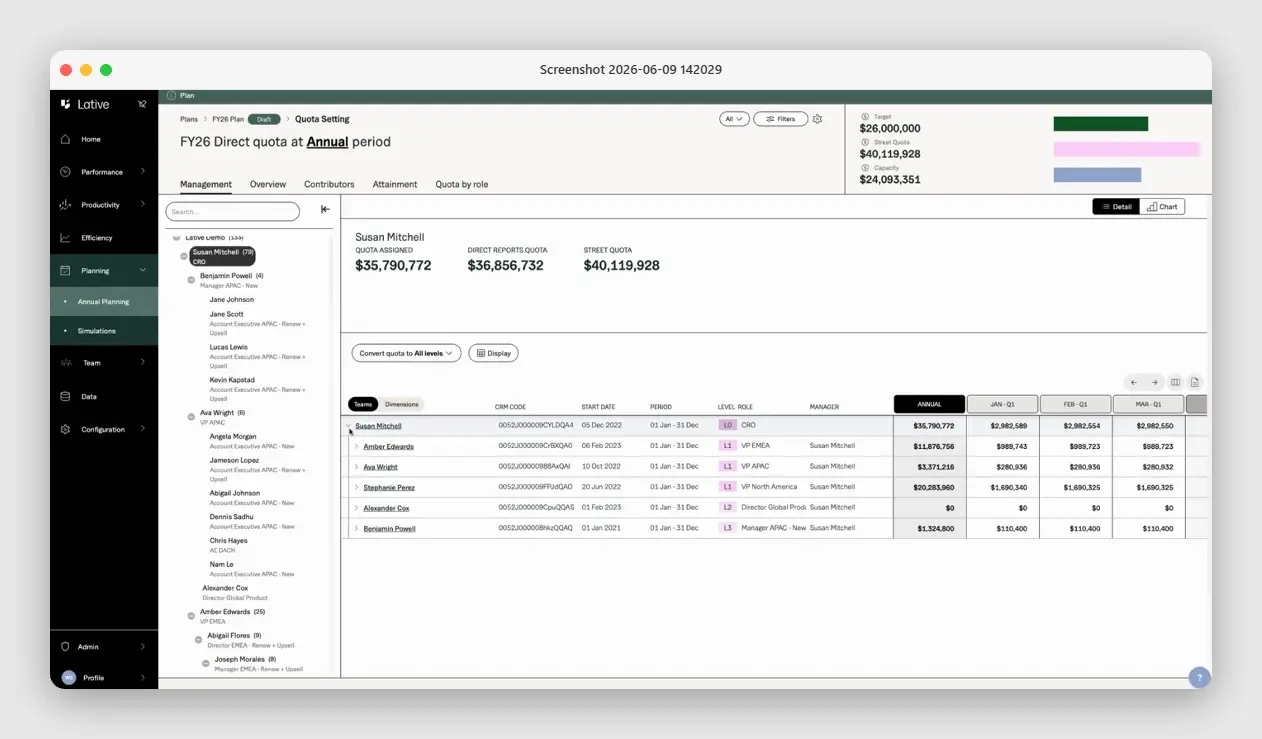
When you roll the agreed number out, Lative’s Quota Setting view automates the allocation across the org and compares assigned quota against capacity, distinguishing quota assigned, direct-reports quota, and direct quota for each leader so over- or under-assignment is visible before the period starts.
Why sales quota matters for capacity planning
Quota is the load-bearing beam of your capacity model, not a compensation mechanism layered on top of it. Every decision in the Sales Capacity Planning framework runs through it, the 4 Knobs of volume, conversion rates, velocity, and ASP all feed into what a rep can reasonably close in a period. Set the quota wrong and you have misaligned every downstream forecast.
If your quota assumes a rep at full ramp closes $300K per quarter but your actual ramp time is six months and your average ACV just dropped 15%, the quota is wrong before the quarter starts. You are measuring attainment against a target that was never grounded in productive capacity math.
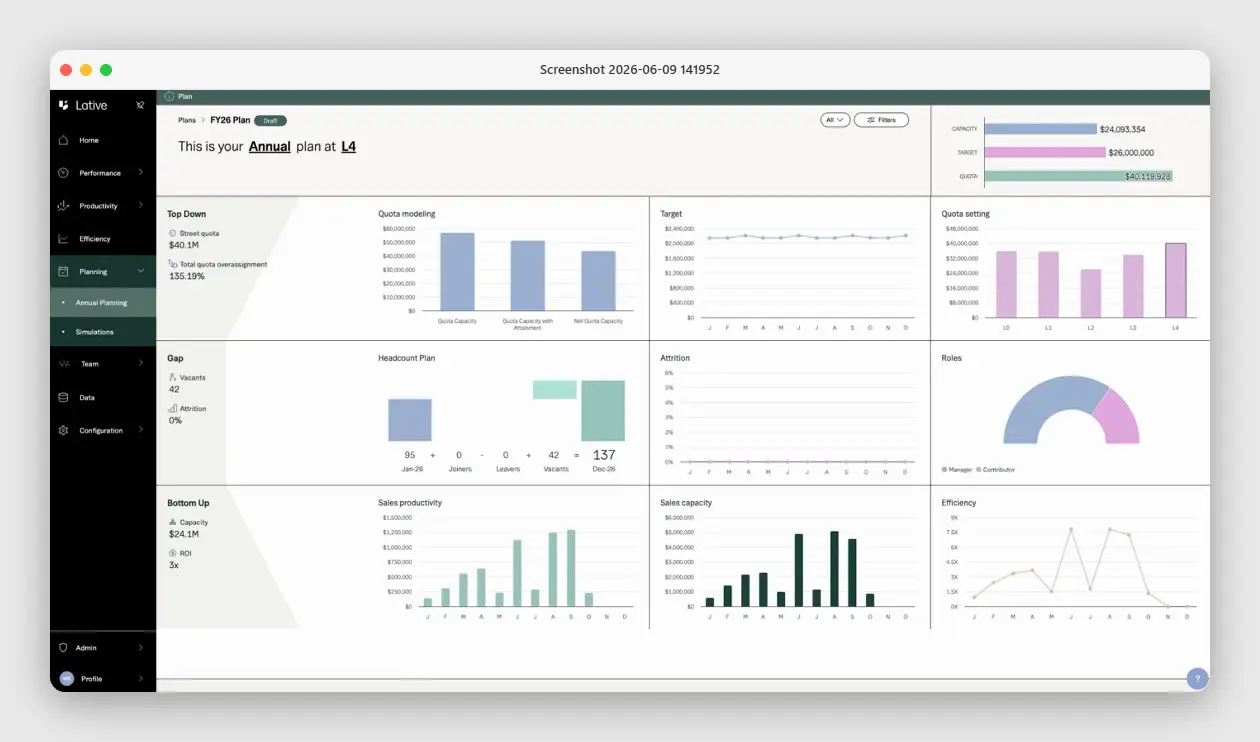
Lative’s Sales Capacity Planning module calculates quota targets from the bottoms-up. Its Quota Modeling view rolls ramp schedules, seasonality, attrition, and quotas by role into net quota capacity, expressed in fully ramped equivalents, so you see the real deliverable number after ramp and attrition drag rather than the headline quota.
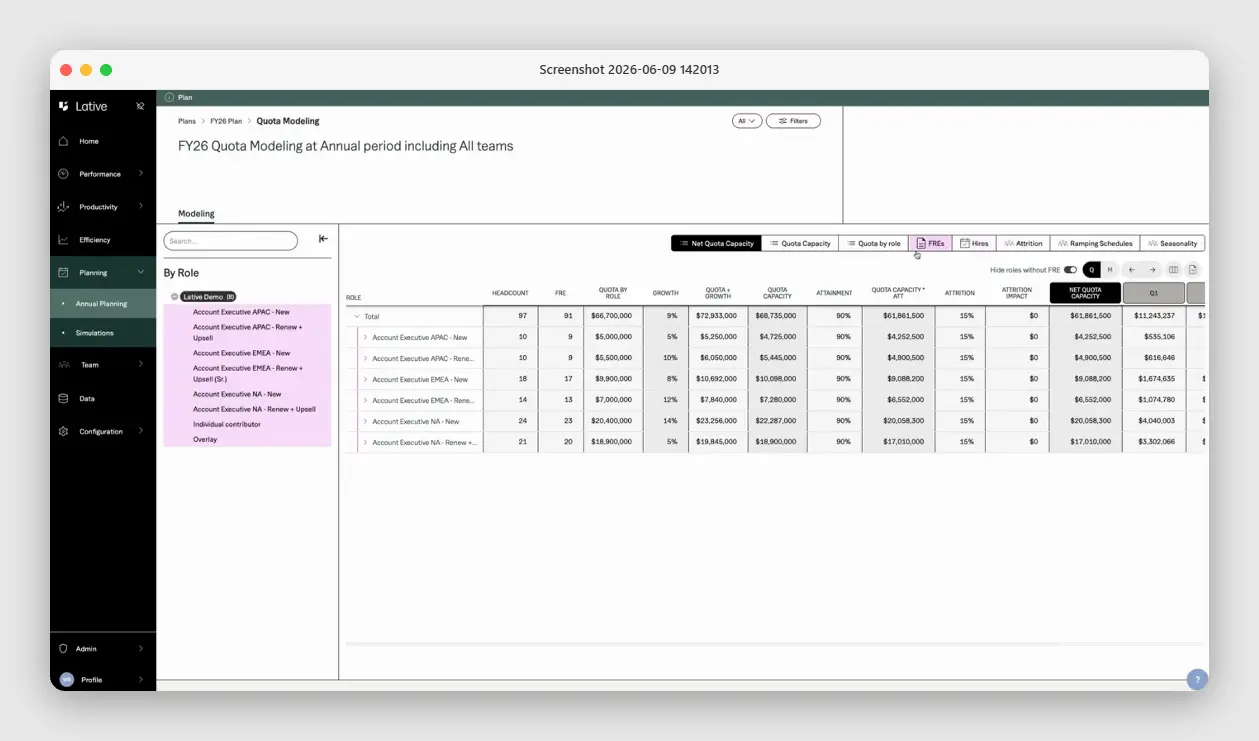
When the quota is grounded in that model, attainment becomes a signal you can act on. When it is not, attainment is just a number that changes every QBR depending on who is presenting it.
Common quota-setting mistakes
Most quota problems are not execution problems. They are modeling problems built into the planning cycle before the quarter even opens.
Setting quota from the top-down target without a capacity check
The CFO needs $4M in new ARR to hit the investor model. Divide by headcount. That is everyone’s quota. This produces targets that look clean on a spreadsheet and fail in practice. The model does not account for ramp time, territory quality differences, or segment mix. Reps carrying a quota built this way are not underperforming, they are carrying an unattainable number.
Ignoring ramp time in the attainment calculation
A rep hired in month two of a quarter carries a prorated quota, but the proration logic varies by organization, and it is often wrong. If your capacity plan treats a ramping rep as producing at 50% of full productivity when they are actually at 25%, your attainment calculation flatters your coverage and misleads your forecast.
Productive capacity is the only number that matters. Headcount on paper is a distraction.
Using last year’s attainment rate to validate this year’s quota
Finance looks at last year’s attainment rate, say 72%, and uses it to validate the new quota. But that rate was produced under different market conditions, a different team tenure mix, and a different ICP.
Using historical attainment as quota validation confuses an output metric with an input assumption. Revenue operations exists to break this loop, to rebuild the quota from current capacity data, not from last year’s result.
Key takeaways
- A quota is only as good as the capacity model under it: set it without a bottoms-up check and you are measuring against a number that was never attainable.
- Healthy attainment runs 70–80% from Series B onward; below 50% is a planning failure, not a talent one.
- Run top-down and bottoms-up together and treat the gap as a fact to close with hiring, pipeline, or conversion.
- Net quota capacity, after ramp, seasonality, and attrition, is the real deliverable number, not the headline quota.
Frequently asked
What is a realistic quota attainment rate?
At Series B and beyond, 70–80% of reps hitting quota is considered healthy. Below 50% indicates a quota-setting or capacity planning problem, not a talent problem.
What are the main types of sales quotas?
The most common are revenue (or bookings) quotas, volume quotas, profit/margin quotas, activity quotas, and combination quotas. Revenue quotas are standard in B2B SaaS because they map directly to the capacity model; activity quotas are most useful for ramping reps and new outbound motions.
What is the difference between quota attainment and quota achievement?
They describe the same metric, actual closed revenue divided by quota target, expressed as a percentage. “Quota attainment” is the more common term in RevOps and sales operations contexts.
What is the difference between a sales quota and a sales target?
A sales target is the top-line number the business commits to, usually set at the company or segment level. A sales quota is that target broken down and assigned to an individual rep or team for a specific period. Targets are what the board wants; quotas are how you distribute the work of hitting them across the people who can actually close.
Should quota be set as a stretch target?
Quotas set as aggressive stretch targets depress attainment rates and distort your capacity model. Best practice is to set quota at a level where 70–80% of your productive reps can hit it in a normal quarter, then layer performance incentives above that threshold.
How does quota feed into the capacity model?
Quota per rep, multiplied by productive headcount, determines your expected closed revenue for a period. If either input is wrong, quota set too high, productive headcount overcounted, the model produces a revenue forecast that will not close.
What causes a declining quota attainment rate across the team?
The most common causes: quota increasing faster than market conditions support, a shift in rep tenure mix with more reps in ramp, a change in ICP or ACV not reflected in the plan, or pipeline coverage declining without a corresponding quota adjustment.
If your last board review had a different quota attainment number in every slide, that disagreement has a data model answer. See how Lative’s Sales Capacity Planning module gives your CRO and CFO a shared number. Book a demo.
Werner Schmidt is the CEO and Co-founder of Lative, with over 20 years of experience in Revenue Operations with companies including Forcepoint, Aruba Networks, Citrix, and Sage.