

The Series B company had an enterprise conversion rate of 12% sitting in their capacity model. That number came from their best-performing quarter, driven by three large deals that closed through a single champion relationship.
Their SMB conversion rate was 34%. When they hired for enterprise expansion, the model used the 12% enterprise conversion rate as if it applied uniformly to every new territory.
It did not. Sales capacity planning for SaaS companies breaks exactly here: the assumption that a conversion rate from one cohort applies to a new one. The new enterprise reps were selling into cold territories with a different buyer profile.
The real conversion rate was 5%. They had over-hired by six account executives and were 8 months into a coverage number that could never be hit by the team they had built.
The 2025 SaaS Benchmarks Report by High Alpha (n=800+ respondents) found that beyond roughly $20M ARR, expansion revenue becomes the dominant growth engine, with companies above $50M ARR generating approximately 60% of new ARR from existing customers.
That shift changes the capacity model fundamentally. The inputs that drove growth from $5M to $25M are not the inputs that drive it from $25M to $100M. New logo capacity planning and expansion capacity planning are separate problems, and mixing them in a single model is where most SaaS companies lose accuracy at scale.
Lative’s Sales Capacity Planning module is designed to adapt as your GTM motion changes at each stage. It tracks separate ramp curves, separate conversion rates, and separate coverage ratios by segment, so when the model that worked at $10M ARR stops working at $30M ARR, you see the divergence in the data before you see it in a missed quarter.
The core SaaS capacity formula
Before the stage-by-stage architecture, the underlying math is the same at every ARR band. Sales capacity planning for SaaS rests on two equations:
Productive Capacity = Ramped Reps x Quota x Average Attainment
Reps Needed = (Revenue Target − Current Productive Capacity) ÷ (Quota x Expected Attainment)
Everything that follows, the segment splits, the ramp curves, the expansion-versus-new-logo divide, is a refinement of these two. What changes as you scale is not the formula but how many times you run it: once at $10M ARR, several times in parallel at $100M. Treat it as financial modeling, not a sales spreadsheet, because the output drives hiring spend, cash runway, and the revenue number the board commits to.
The sections below cover how the capacity model must change at each ARR threshold. The variables stay the same, the architecture does not:
- $5M to $25M ARR: Single-segment model, blended conversion rates, founder-driven selling still influencing the numbers
- $25M to $100M ARR: Multi-segment split required, expansion motion separates from new logo model, ramp curves diverge by segment
- $100M and above: One model per segment, one for new logo, one for expansion, geo-specific models in mature markets
$5M to $25M ARR: the seed-stage capacity model
At this stage, the capacity model is usually one person’s spreadsheet. That is not necessarily wrong, the model does not need to be sophisticated when the sales team is 3 to 8 reps and the motion is still being discovered. What it does need is honesty about what you know and what you are assuming.
What works at this stage
A simple bottoms-up model works well from $5M to $25M ARR. You know your current headcount, you have 6 to 18 months of conversion rate history, and your ASP is relatively stable.
The model has maybe four or five inputs and produces a single number: the productive capacity the current team can generate next quarter. The most important discipline at this stage is separating your actual conversion rate from your aspirational one.
I have seen more early-stage companies blow their capacity plan by using “what we think the conversion rate should be once we fix the product” rather than “what the conversion rate actually was over the last three quarters.”
What breaks at this stage
The most common failure mode at $5M to $25M ARR is not distinguishing between founder-led sales and rep-led sales in the capacity model. Founders close deals through relationship density and company credibility that new reps cannot replicate.
A founder closes a $50K deal in 45 days through a board connection. A new rep is given the same ICP and takes 120 days through a standard inbound motion. If the ramp assumption is built from founder-led historical data, every rep will look under-performing for their first 6 months. The model is wrong. The reps are not.
Named mistakes
Three mistakes I see repeatedly at this stage. First: using total bookings target as the sole input to headcount math, skipping the productive capacity calculation entirely.
Second: not accounting for rep attrition in the model. At 20 to 25% first-year attrition, one hire out of every four is a replacement, not an addition to capacity.
Third: treating pipeline generation and sales capacity as the same problem when they are sequential problems. You cannot close what has not been generated, and a rep with no pipeline is a cost with no output regardless of their ramp timeline.
$25M to $100M ARR: the scaling inflection point
This is the stage where the capacity model stops fitting on one spreadsheet tab and the problems from $5M to $25M compound into something more expensive.
You now have multiple segments, multiple geographies, multiple products in some cases, and a revenue target that requires all of them to work simultaneously. The single-model approach breaks here because the inputs for each segment are different enough that averaging them produces numbers that are wrong for everyone.
Segment models diverge
By $25M ARR, most SaaS companies are selling to at least two distinct segments, often SMB and mid-market, sometimes mid-market and enterprise. The conversion rates, ASPs, sales cycles, and ramp times are different for each.
A single blended model hides which segment is performing and which is under-covered. Separate capacity models by segment is not optional at this stage, it is the mechanism by which a VP of Sales can walk into a board meeting and say “we are 2.3x covered in SMB for Q3 and 1.6x covered in mid-market” rather than “we are 2.1x covered overall” and then miss the mid-market number without warning.
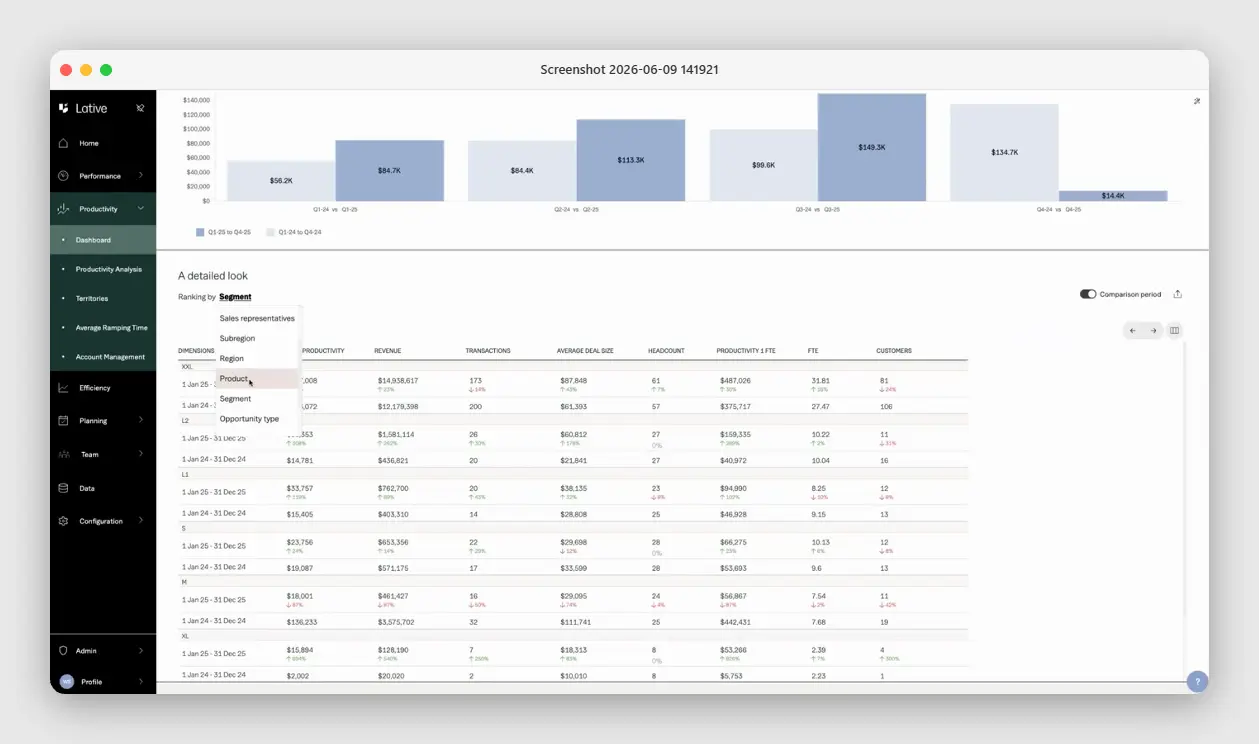
In Lative this lives in the Productivity module, which breaks production out by segment, product line, and opportunity type rather than a single blended pool, so each segment carries its own conversion rate, ASP, and coverage ratio.
When the model stops fitting in a spreadsheet
Look. The moment you have more than one person editing the capacity model, you have a version control problem. Finance has a copy. Sales ops has a copy.
The CRO has their own. They diverged at the last planning cycle and nobody knows which one is current. The spreadsheet is not the problem, the architecture is.
A capacity model that requires manual reconciliation between three teams every planning cycle will always produce the situation described in the intro: two different numbers, no single source of truth, and a board meeting that ends with “let’s align offline.”
Aiven: a real-time example
Aiven connected marketing-influenced pipeline data to capacity planning inputs in real time using Lative. The practical effect: when pipeline generation in a specific segment shifted, the capacity model updated immediately rather than waiting for the quarterly planning cycle.
The team could see a mid-market coverage gap developing in month 2 of the quarter and adjust pipeline generation targets before the gap became a Q3 revenue miss. That is the operational version of what “sales capacity planning SaaS” actually means, not a static model, but a live connection between what the demand engine is producing and what the sales team can close.
$100M and above: the enterprise model architecture
At $100M ARR and above, the capacity model becomes a set of models: one per segment, one per geography in some cases, one for new logo and one for expansion. The mistake I see at this stage is applying the same planning cadence and the same model architecture that worked at $50M. The inputs have changed, the motion has changed, and the model needs to reflect both.
Separate ramp curves per segment
An enterprise rep selling $200K+ ACV deals has a ramp curve of 9 to 12 months. An SMB rep selling $8K ACV deals has a ramp curve of 3 to 4 months. Using one ramp assumption across both segments at this scale produces a capacity calculation that is structurally wrong.
Separate ramp curves per segment is the minimum architecture requirement at $100M ARR. Companies that do not have this are running a capacity model that cannot explain why their SMB attainment is 95% and their enterprise attainment is 71%, because the model treats those two outcomes as the same type of miss.
Demand Council as a weekly operating cadence
The Demand Council is a weekly cross-functional cadence that keeps the capacity model current between planning cycles. Marketing, Sales, and RevOps meet weekly to review pipeline generation against the coverage requirements in the model.
When pipeline in a segment is under-generating, the Demand Council identifies whether the gap is a demand problem (not enough pipeline entering the top of funnel), a conversion problem (pipeline is entering but not advancing), or a capacity problem (not enough reps to work the existing pipeline).
Each diagnosis produces a different response. Without the weekly cadence, the diagnosis happens in the QBR, when the quarter is already half over.
Intercom and EDB: scale in practice
At companies like Intercom and EDB operating at scale with multiple segments and complex GTM motions, the capacity planning challenge is not building the model, it is keeping it current as the GTM motion evolves.
New segment definitions, new territory structures, new product lines, and leadership changes all require the model to be recalibrated. A capacity planning infrastructure that requires a RevOps analyst 40 hours to recalibrate after a GTM change is a planning infrastructure that stays stale between recalibrations.
The operating discipline at this stage is treating the capacity model as a live system, not an annual artifact.
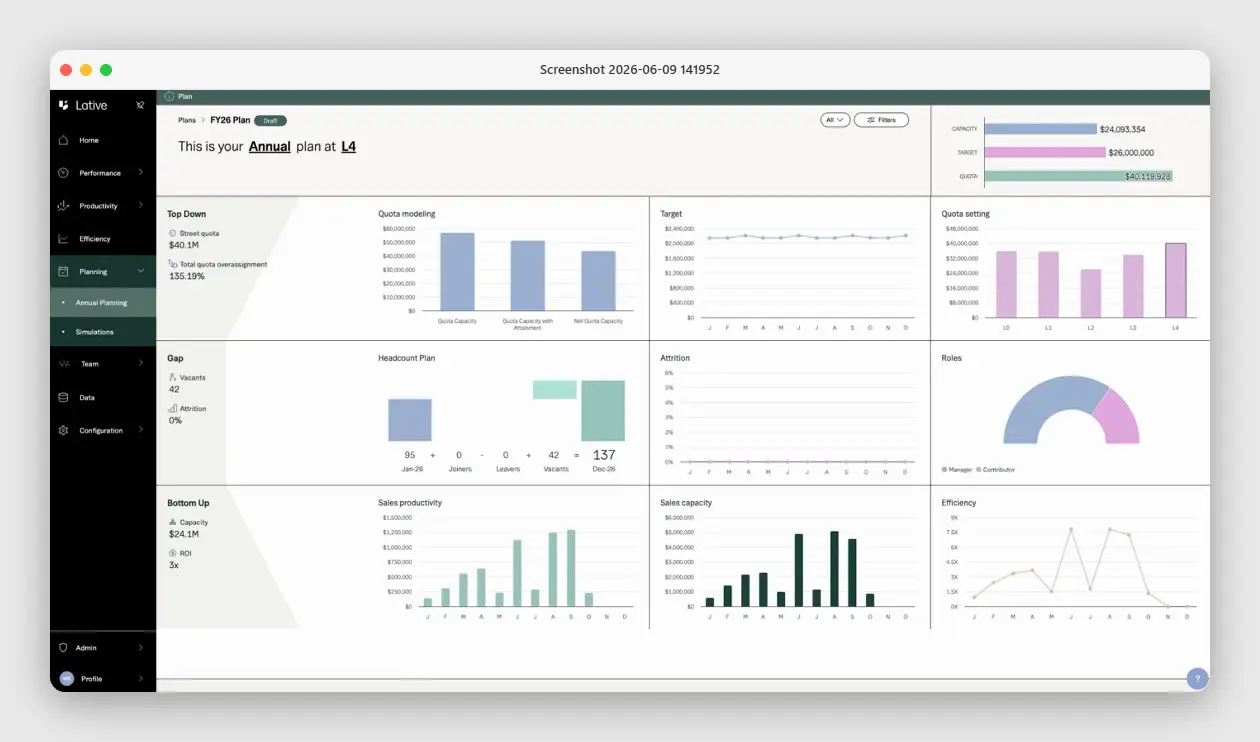
Your capacity model should look different at $30M ARR than it did at $10M, and different again at $75M.
See how Lative’s Sales Capacity Planning module adapts to your GTM stage with segment-specific models, live ramp tracking, and demand engine math your board can verify. If you want to see how sales capacity planning for SaaS companies works in Lative at each ARR stage, for the pipeline math that feeds the model, see the net pipeline paradox. Request a demo.
Werner Schmidt is the CEO and Co-founder of Lative, with over 20 years of experience in Revenue Operations with companies including Forcepoint, Aruba Networks, Citrix, and Sage.