

The budget meeting is two hours in. The CRO has a slide showing the team needs 14 net-new account executives to hit next year’s number. The CFO has a model showing the company can afford 8.
Neither trusts the other’s inputs. The CRO built from pipeline coverage ratios and conversion rates. The CFO built from headcount cost as a percentage of revenue. Both are right about their own math. Neither is working from the same underlying model. By the end of the meeting, they agree to “align offline.” That offline conversation never produces a single shared number.
The gap is structural, not a communication problem. OnlyCFO’s 2024 analysis of common headcount planning failures found that the most recurring mistake is building the sales headcount plan from cost assumptions rather than from capacity math. Finance optimizes for burn rate, Sales optimizes for coverage, and neither model connects directly to the revenue output both are trying to hit.
Lative’s Sales Capacity Planning module is built specifically for this gap. It gives the CFO and CRO a shared bottoms-up model that starts from productive capacity, not headcount count, and produces a board-ready output both functions can defend from the same data.
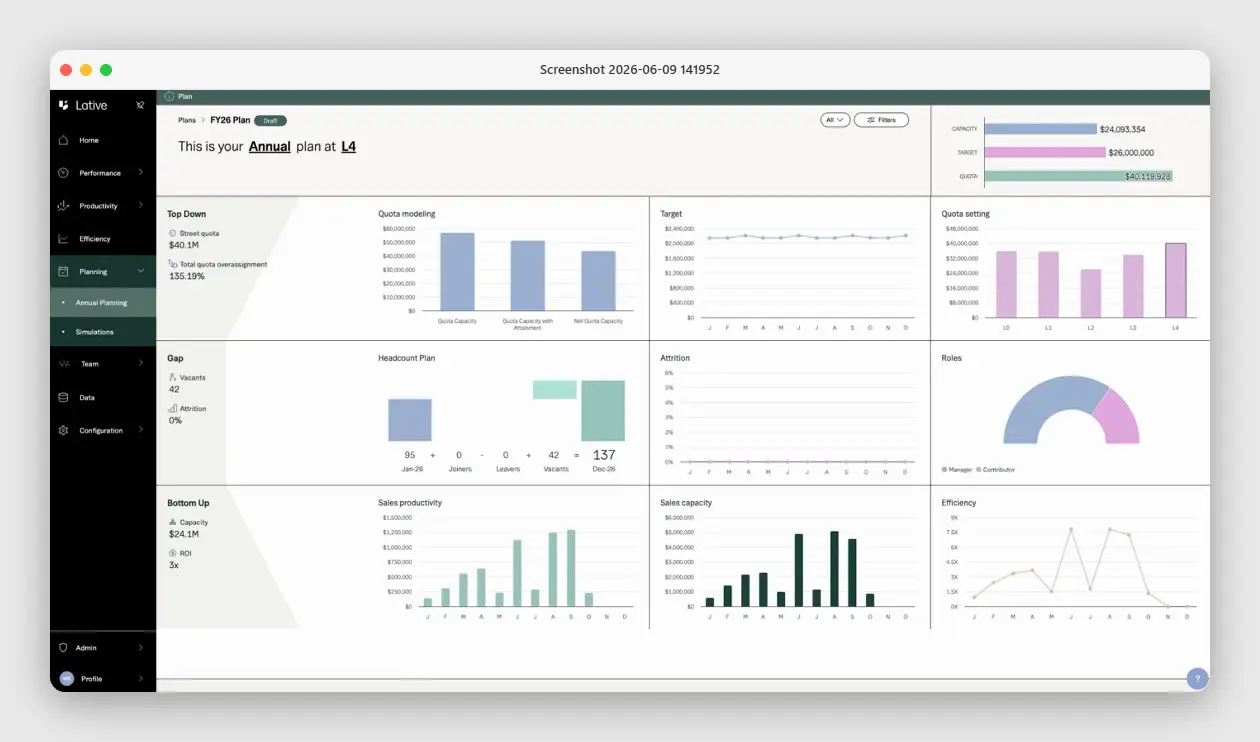
Why CRO and CFO headcount models never agree
I have sat in this meeting at more than 50 SaaS companies. The disagreement is almost never about ambition or competence. It is about the inputs each function has access to and the time horizon each is held accountable for. When you understand the structural gap, you stop trying to negotiate it in a room and start trying to close it at the model level.
Different inputs
The CRO’s model starts with pipeline. Twelve months of conversion rate data, an average sales cycle of 87 days, an ASP sitting at $42K, and a territory coverage map showing three regions under-served. From those four numbers, the CRO derives a headcount number that feels like a conservative ask.
The CFO’s model starts with last year’s headcount cost as a percentage of revenue and applies a growth multiplier. The inputs are not connected. There is no mechanism by which a change in pipeline conversion rate updates the CFO’s affordability model, and no mechanism by which a change in gross margin targets updates the CRO’s coverage model.
They are solving different equations and calling it the same answer.
Different time horizons
The CFO is planning 12 to 18 months ahead and is primarily managing cash runway and board commitments. The CRO is planning 6 to 9 months ahead and is primarily managing quota coverage for the next two quarters.
A rep hired in January in the CFO’s model is a salary line item from day one. In the CRO’s model, that same rep is non-productive for 4 months and then ramps to 60% productivity by month 6. The CFO’s model counts heads. The CRO’s model counts productive capacity. They are not measuring the same thing.
Different success metrics
The CFO is measured on Rule of 40 and efficiency ratios. New sales rep headcount is the largest single lever on the efficiency side of that equation. Every head added is a direct hit to the metric.
The CRO is measured on revenue attainment and pipeline coverage. Under-hiring is as dangerous as over-hiring because a coverage gap in Q3 cannot be recovered in Q4.
Both positions are rational responses to different accountability structures. Giving both functions a single model that quantifies the trade-off between coverage and efficiency explicitly, so the debate shifts from “how many heads” to “what is the cost of under-coverage in Q3.”
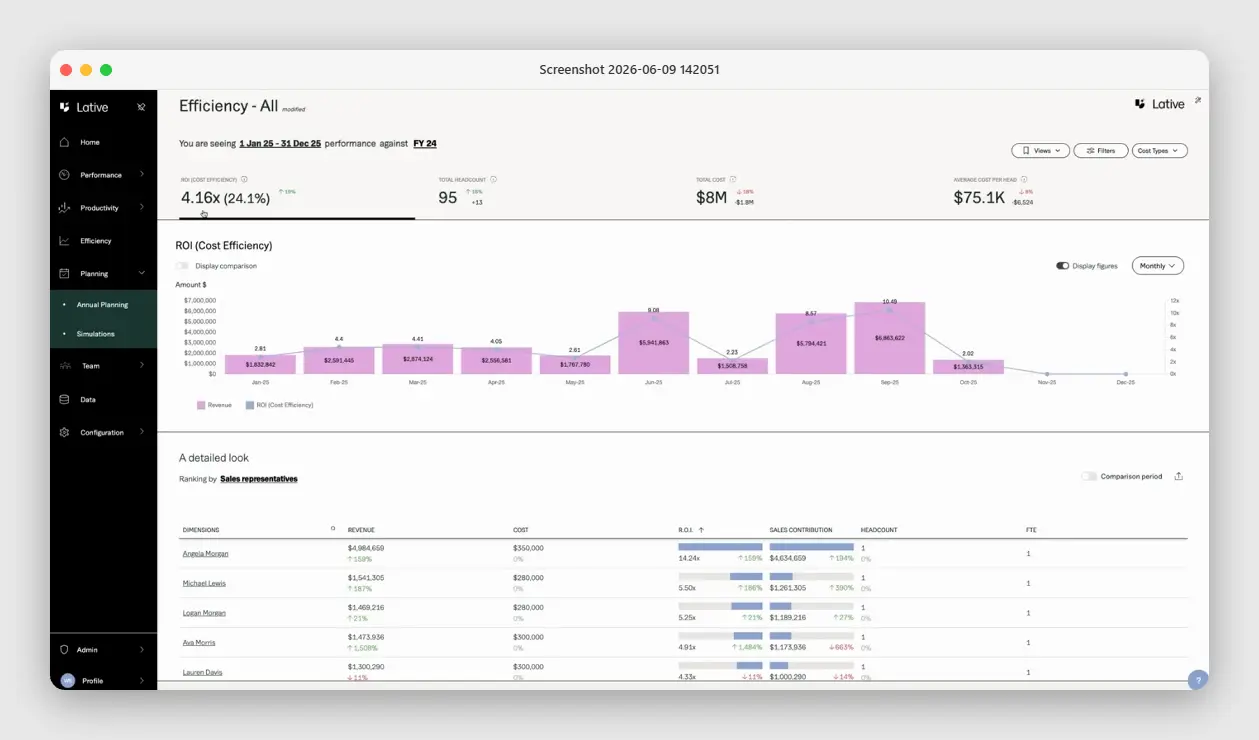
Lative’s Efficiency view puts the CFO’s side of that trade-off on screen directly: return per dollar of sales spend, team cost, and cost per rep, broken down by segment so you can see where each added head actually earns its cost back.
The shared model architecture
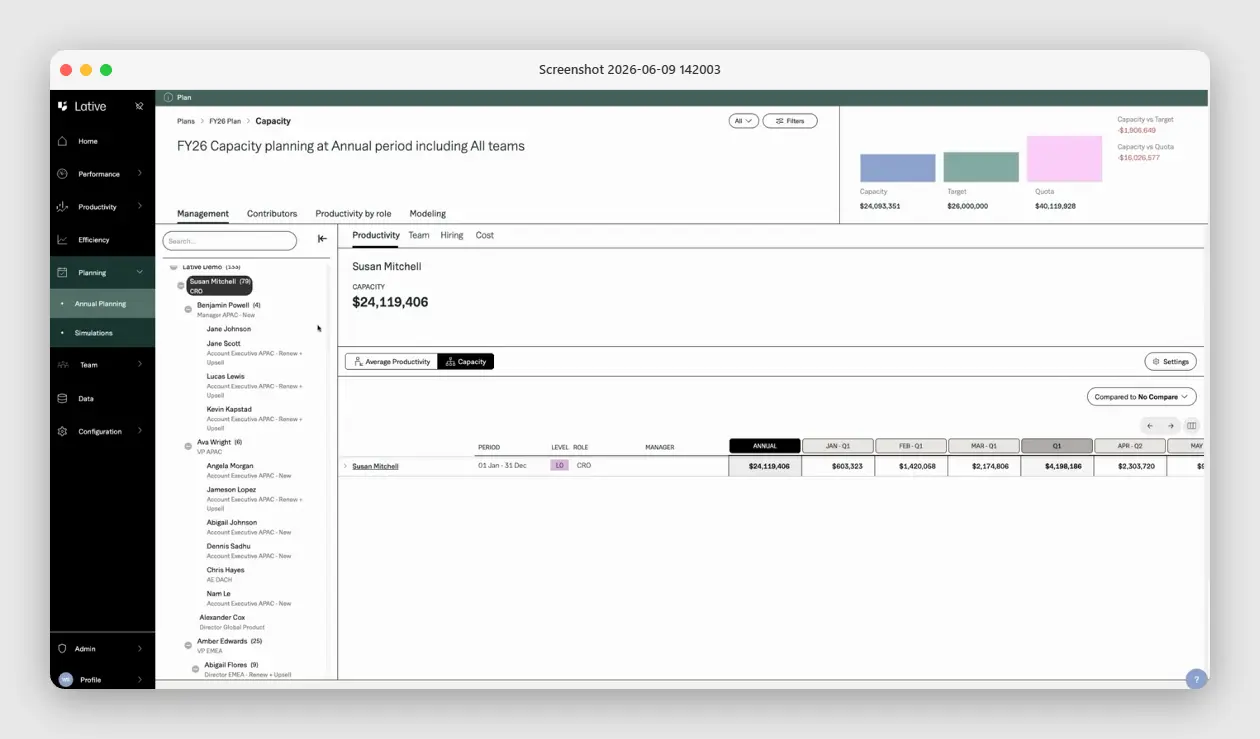
A shared headcount model works when it is built from productive capacity as the central variable, not headcount count. Every input the CFO cares about and every input the CRO cares about connects to productive capacity. When you build from capacity, both functions are working on the same foundation.
Two separate models
- CFO counts heads and cost as a percent of revenue
- CRO counts pipeline coverage and conversion rates
- Neither input ever updates the other
One shared capacity model
- Both functions start from productive capacity
- Ramp and attrition adjust every headcount number
- One board-ready output both can defend
Capacity inputs
The model starts with three capacity inputs: current headcount by tenure band, ramp curve by segment, and attrition rate by tenure cohort. A rep in months 1 to 3 contributes zero productive capacity.
A rep in months 4 to 6 contributes 30 to 50% of quota. A rep past month 9 contributes full quota. Attrition hits differently across tenure bands, first-year attrition at many B2B SaaS companies runs 20 to 25%, while reps past the 18-month mark typically drop to single-digit attrition.
Every headcount number in the model must be adjusted for these curves before it produces a productive capacity figure that either the CRO or the CFO can use.
Ramp assumptions
Ramp assumptions are where most shared models break down. Finance often uses a flat ramp assumption, “reps are at full productivity after 90 days,” because it simplifies the model.
Sales knows this is wrong but cannot always produce a data-backed alternative. The bottoms-up model uses actual cohort productivity data: what did your last three cohorts of net-new hires actually produce in months 1 through 9?
That data exists in your CRM. It rarely gets extracted into the planning model. When it does, the ramp assumption becomes a fact rather than an estimate, and Finance can stress-test it without the CRO feeling like their credibility is being questioned.
Quota coverage math
The final layer is quota coverage math. Given a revenue target, a win rate, a pipeline conversion rate, and an ASP, you can calculate the pipeline coverage needed each quarter.
Given a pipeline coverage requirement and a productive capacity figure by quarter, you can calculate the headcount you need to hire and when you need to hire them.
This is the math that makes the CFO’s affordability model and the CRO’s coverage model talk to each other. The CFO can now see that delaying three hires by one quarter creates a coverage gap in Q3 worth $X in missed revenue.
The CRO can see that over-hiring by two positions does not materially improve coverage but does compress the efficiency ratio. The conversation becomes a trade-off analysis, not a negotiation over gut-feel numbers.
Build more than one model
A single headcount model is a single guess. The teams that plan well build at least three: a base case on current ramp and attainment, a conservative case where ramp slips or attrition runs hot, and an aggressive case where hiring lands on time and ramps to plan. Each produces a different hire count and a different cost curve. Presenting the range, rather than one number, is what lets the CFO and CRO negotiate the trade-off between coverage risk and burn instead of arguing about whose single forecast is right.
Territory coverage belongs in every version of the model. A hire plan that ignores how accounts are distributed across territories will staff regions that are already saturated and starve the ones with open whitespace, producing reps who cannot ramp because there is nothing in their patch to close. Headcount math that stops at “how many” without answering “where” is only half a plan.
How to run the CFO-CRO alignment conversation
The model architecture is the prerequisite. The conversation process is what makes it stick. I have seen companies build a good shared model and still produce two separate headcount plans because the process for using the model was broken. Here is what works.
The bottoms-up first rule
Start with the truth, not the target. Build the bottoms-up capacity model from current headcount, actual ramp curves, and actual attrition before you introduce a revenue target.
This gives you a baseline: “Based on current headcount and historical ramp, here is the revenue we can produce in the next four quarters with zero additional hires.” That number is almost always lower than the board target.
The gap between the baseline and the target is the productive capacity deficit you are trying to close with hiring. Framing it this way eliminates the argument about whether the headcount ask is too aggressive. The ask is whatever it takes to close the deficit. The debate shifts to whether the deficit is acceptable given the cost of the hires needed to close it.
Handling the gap
When the bottoms-up baseline lands well below the board target, and it will, do not negotiate the headcount number immediately. Identify the four inputs that move the number: volume (pipeline generation), conversion rates, velocity (cycle time), and ASP.
These are the 4 Knobs of the demand engine. Each one can be adjusted independently. A 10% improvement in win rate and a 15% improvement in pipeline velocity may close the same gap as two additional account executives at half the cost.
The CFO prefers that trade. The CRO prefers to know where the win rate improvement has to come from before agreeing to it. The model makes both visible at the same time.
The “Oh Sh*t” meeting pattern
Every company has an “Oh Sh*t” meeting. It is the meeting in Q2 or Q3 where someone pulls up the pipeline coverage data and realizes the second half is under-covered.
In companies without a shared model, this meeting produces a reactive hire wave, expensive, slow to ramp, and almost always too late to affect the current fiscal year.
In companies with a shared model, the “Oh Sh*t” moment happens in the planning cycle, not in Q3. The model shows coverage shortfalls 6 to 9 months before they become revenue misses.
The meeting becomes a planning conversation, not a crisis response. That shift is the entire value of the architecture. You are not trying to predict the future perfectly. You are trying to see problems early enough to have options.
What the output looks like
A board-ready headcount plan has four components. I have seen versions of this output work at companies from $15M ARR to $400M ARR. The specifics change with scale, but the structure does not.
- Productive capacity by quarter: Current headcount adjusted for ramp and attrition, showing revenue-generating capacity in each quarter without additional hiring.
- Coverage deficit by quarter: The gap between productive capacity and the revenue target, expressed both as a number of deals and as a dollar figure.
- Hiring plan with hire dates: Net-new hires required by segment, with the quarter they need to be in seat to be productive when they are needed.
- Sensitivity analysis on the 4 Knobs: A one-page view showing how a 10% change in pipeline volume, conversion rate, velocity, or ASP affects the hiring requirement. This is the CFO’s favorite page because it quantifies the trade-off between headcount investment and investment in pipeline quality or enablement.
Key takeaways
- The CFO-CRO gap is structural: two models, two sets of inputs, two time horizons, no shared variable.
- Build the plan from productive capacity, not headcount, and both functions reconcile on one number.
- Adjust every headcount figure for ramp and attrition before it means anything.
- Surface coverage deficits 6–9 months out so the crunch happens in planning, not in Q3.
Frequently asked
How many sales reps do I need to hit my revenue target?
Start from productive capacity, not headcount. Build the bottoms-up number your current team can produce after ramp and attrition, then size hiring to close the gap to target by the quarter each hire needs to be productive.
Why do Finance and Sales headcount plans never agree?
They solve different equations. Finance builds from cost as a percentage of revenue; Sales builds from pipeline coverage and conversion. Without a shared model that connects both to productive capacity, the inputs never reconcile.
How does ramp time change a headcount plan?
A rep is non-productive in months 1–3 and only partially productive through month 6, so headcount and capacity are not the same number. A plan that counts heads instead of fully-ramped equivalents overstates what the team can carry.
How far ahead should sales hiring be planned?
Far enough that hires are productive when coverage is needed. Because ramp runs several months, a shared model should surface coverage shortfalls 6–9 months out, in the planning cycle rather than in a Q3 crisis.
What is productive capacity in headcount planning?
The revenue your team can realistically close once ramp curves, attrition, and territory coverage are applied to raw headcount. It is the single variable both the CFO and CRO can plan against.
If your last headcount planning cycle ended with Finance and Sales in separate spreadsheets, that problem has a structural fix. See how Lative’s Sales Capacity Planning module gives your CFO and CRO a shared model built from productive capacity. For context on the demand engine math that feeds the capacity model, see how to build a world-class demand engine. Request a demo.
Werner Schmidt is the CEO and Co-founder of Lative, with over 20 years of experience in Revenue Operations with companies including Forcepoint, Aruba Networks, Citrix, and Sage.