
Look, I’ve spent 20 years in RevOps and I’ve been part of the problem. At more companies than I can count, the demand engine got built the same way: CRM first, marketing automation platform second, sales engagement tool third, and every architectural decision made implicitly, in a hurry, by whoever happened to be closest to the tooling. Nobody sat down and designed the thing. It accumulated.
Two years later, someone in a planning meeting is trying to explain why marketing’s pipeline attribution numbers do not match what lives in the CRM. Nobody in the room can agree on a fix that does not require tearing out half the infrastructure. The problem was always structural. It was just invisible until the business got big enough for the gaps to cost real money.
This guide covers the structural decisions that prevent that outcome. Not which tools to buy, but how to build the operational model that makes those tools produce trustworthy, unified GTM data.
Lead-based or account-based? Both assumptions are incomplete
Forrester’s B2B buying research found that 94% of B2B sales involve buying groups of three or more people. Scoring individual contacts in isolation and handing the highest scorer to sales ignores the organizational context that actually determines whether a deal closes. Account-Based Marketing emerged from that insight as a legitimate critique of lead-based thinking.
The implementation problem is that ABM does not replace the need for lead-level operational processes. When a new contact submits a demo request, something has to capture that contact, route it to the right SDR, and track what happens next. ABM handles the account-level strategy. It does not handle the lead-level mechanics.
The right architecture is a hybrid: lead-level processes for sourcing, routing, and qualification; account and opportunity-level tracking for pipeline management, coverage analysis, and revenue attribution.
Someone has to be the first contact at an account. That someone is a lead. The decision they are part of is made by a buying committee. Build for both from the start.
The three core systems and where they fail
Every demand engine runs on a CRM, a marketing automation platform, and a sales engagement system for SDRs. The decision about which vendor to use for each matters less than the decision about how data flows between them. Here is where each one typically breaks down.
CRM
The CRM failure mode is missing data, not bad data.
CRMs capture the state of a record at the moment someone updates it. They do not capture the trajectory. When an opportunity moves from Stage 2 to Stage 3 and back to Stage 2 in the same month, the CRM shows the current stage. The movement, the timing, and the pattern that predicted the backslide is gone unless someone built a custom snapshot field in advance.
Treating the CRM as the analytical foundation for pipeline velocity analysis requires configuration that most teams skip because it is not urgent when the system is new. By the time it is urgent, the historical data does not exist.
Marketing automation platform
The marketing technology landscape topped 14,106 solutions by 2024, and the average B2B team runs on a dozen or more of them. Marketing automation is usually the anchor system, but campaign data, intent data, event data, and content engagement data all live in separate platforms that route into it imperfectly. The failure mode is the silo.
You can tell which campaigns generated the most leads. Your CRO can tell which opportunities closed. But no one can tell you which campaigns generated the opportunities that closed. That disconnect is where most marketing-sourced pipeline disputes start, and where you can see the campaign attribution gap most clearly.
Lative’s Marketing Intelligence closes this gap by connecting campaign-level data directly to opportunity records in a shared GTM data model. The CMO and CRO attribute pipeline from the same source rather than reconciling separate systems at quarter-end.
Sales engagement platform
SDR activity data that stays inside the sales engagement platform and never makes it back to the CRM or marketing automation system produces a fundamental blind spot: you cannot measure what converts a lead into a meeting or a meeting into a qualified opportunity.
Every SDR cadence adjustment, every sequence test, every template experiment produces data that should feed back into how marketing qualifies leads and sets SDR targeting. When that data is siloed, both sides make calibration decisions without the feedback loop that would tell them whether they are right.
Every channel is a different machine
Here is something that sounds obvious but breaks every capacity model I have reviewed: inbound, outbound, events, and paid search are not variations of the same machine. They are different machines. Each has its own conversion rates, its own average sales cycle, its own average deal size, and its own pipeline coverage requirement.
A webinar lead that took seven touches over 45 days before requesting a demo is a fundamentally different pipeline input than a paid search click that converted in two hours.
Running both through the same MQL scoring model guarantees you are wrong about at least one of them at all times. A single pipeline coverage ratio across all channels will systematically mislead your capacity plan.
When you build the demand engine architecture, model each channel separately. Inbound gets its own conversion rates, velocity benchmarks, and pipeline coverage requirement. Outbound gets its own. Events get their own. Enterprise and mid-market run at different velocities with different ASPs. The unified model keeps the channel-level segmentation visible all the way through to the revenue outcome.
Marketing qualification: the MQL is not a marketing problem alone
The MQL is the algorithm the RevOps team runs to prioritize leads for SDR engagement. It should be jointly owned by marketing and sales because it is the interface between them, and every dispute about lead quality is ultimately a dispute about how the algorithm is configured.
Most of those disputes go unresolved because the scoring model sits inside marketing’s system and sales only sees the output.
Two operational requirements apply from day one:
- Track lead sources as channels versus content. Channel is where the lead came from: paid search, content syndication, and partner referral. Content is what they engaged with within that channel. Conflating them is one of the most common setup mistakes and one of the most expensive to untangle. When a campaign appears to be underperforming, you need to know whether the channel is weak or the specific content is not resonating. Merged source fields make that analysis impossible.
- Timestamp every stage transition. The velocity of the demand engine, from first touch to MQL, MQL to SDR acceptance, acceptance to meeting held, is diagnostic information that cannot be reconstructed if it was not captured in real time. This is the most common thing that gets skipped in a hurry to get the system live.
Sales acceptance: the handoff that breaks the most often
When an SDR accepts an MQL, it becomes a Sales Accepted Lead, the gating event for lead-to-opportunity conversion. That acceptance event needs to be timestamped and pushed back to both the marketing automation platform and the CRM. Without that data, you cannot measure SLA compliance, calculate time-to-acceptance as a pipeline velocity input, or tell marketing whether the leads it generates are getting worked quickly or sitting in a queue.
SDRs are converting the marketing message into 30-second phone calls and three-line emails. They are getting real-time, unfiltered feedback on whether the positioning lands. A RevOps team not engaged with SDR outreach performance is operating blind to the most direct signal available about whether the messaging works.
SDR conversion rates from MQL to booked meeting are a marketing metric, not just a sales metric. Build the feedback loop that connects SDR performance data back to marketing qualification criteria, and you close the loop that most demand engines leave open.
Opportunities: the BANT problem
BANT (Budget, Authority, Need, Timing) is the most widely cited opportunity qualification framework, and it has been criticized by practitioners for good reason: buyers rarely confirm budget before they have decided they want something, authority is hard to establish in complex buying committees, and timing is a trailing indicator that prospects manipulate.
The real problem is inconsistency in how the framework is applied. When opportunity creation is left to individual AE discretion, every rep has a different threshold, and the CRM fills with opportunities that range from genuine revenue probability to optimistic entries created to show activity.
Pipeline numbers that cannot be trusted produce coverage analysis that cannot be trusted, which produces capacity decisions that are wrong, which produces a missed revenue target that surprises everyone except the one RevOps analyst who was watching the conversion rates.
Multi-Threading as a Structural Qualification Requirement
An April 2025 analysis of 1.8 million deals found that selling teams on closed-won deals are 67% larger than selling teams on lost deals at comparable deal sizes. The pattern is consistent: deals that close involve more people on both sides of the table.
Requiring a discovery call with two or more stakeholders is the minimum structural condition for the multi-threaded engagement that predicts close.
Build the qualification criteria into CRM data entry requirements. Three inputs that filter out pipeline inflation:
- A confirmed budget contact
- A scheduled discovery call with two or more stakeholders
- A documented use case
Pipeline Reviews Become Analysis, Not Negotiation
Those three requirements turn every pipeline review from a negotiation into an analysis.
The RevOps-led demand waterfall: lead-to-opportunity by stage
The architecture in the previous sections produces the raw signal. The demand waterfall is how RevOps turns that signal into a quantified plan. Most teams skip this step and run the demand engine off a target pipeline number that nobody can defend in a board review. The waterfall fixes that by sizing every stage backwards from the revenue target.
Start with the ARR goal for the quarter. Divide by average deal size to get the closed-won count. Divide that by the historical opportunity-to-close rate to get the opportunity count. Apply the lead-to-opportunity conversion rate by stage and channel to get the qualified lead count. Then apply MQL-to-SAL and inquiry-to-MQL to get the top-of-funnel demand volume marketing actually owes the business. That chain is the demand waterfall. Every stage has its own conversion baseline and pipeline coverage ratio, and every stage is owned by a named function.
Three operational tests separate a real demand waterfall from a slide:
- ICP fit scoring is part of qualification, not just lead capture. A high-volume channel that produces leads outside the ICP inflates the top of the waterfall and produces a coverage ratio that lies. Score for fit at MQL, not at form fill.
- Conversion rate by stage is segmented by motion. Inbound, outbound, partner, and event channels each get their own row. A single blended rate hides the channel that is failing and overweights the channel that is carrying the model.
- Marketing-sourced pipeline is defined by source-of-first-touch, not by last-click. The opportunity object anchors the attribution, but the lead-level source field is what determines whether marketing or sales gets credit. Pin that definition down before the quarter starts, not after.
The waterfall is also where the four knobs in the next section get their numerical baselines. Without the waterfall, volume targets, velocity assumptions, and coverage ratios float free. With it, every quarterly planning conversation starts from a model the CRO, CMO, and CFO can all read from the same page.
The four knobs: what you are actually tuning
Once the architecture is in place, the demand engine becomes a model with exactly four variables:
- Volume: how much demand enters the funnel at each stage
- Conversion rate by stage: what percentage moves from each stage to the next, by channel and segment
- Velocity: how long each transition takes, from first touch to close
- ASP and pricing mix: the average deal size and composition that turns pipeline into revenue
Every time your quarter-end forecast is off, the root cause lives in one of those four places. Either volume was lower than planned, a conversion rate shifted, velocity slowed, or the deal mix changed.
The architecture described in this post exists to make all four of these visible, in real time, by channel and segment, so you can diagnose the problem before the quarter ends instead of explaining it after the miss.
This is also what makes AI meaningful in a demand engine. AI changes the inputs to the four knobs. AI-assisted outbound changes volume and conversion rates. Faster lead scoring changes velocity. AI-augmented pipeline hygiene changes the quality of the data underneath all four. The architecture has to exist first for AI to improve anything.
The unified model and the weekly cadence that keeps it honest
Every stage described above produces data that is only useful if it connects to the stages before and after it. An MQL that cannot be traced to the campaign that generated it tells you nothing about what marketing should do differently. An opportunity that cannot be traced to the MQL and SDR activities that preceded it tells you nothing about which part of the demand engine to invest in or fix.
The unified GTM model, where the opportunity object anchors the full customer journey from first marketing touch through close, is what connects those stages.
It requires lead-level and account-level data from marketing automation alongside opportunity and revenue data from the CRM, maintained as time-series and stage-transition records so that pipeline velocity analysis, coverage forecasting, and campaign attribution are all possible from the same source.
The Demand Council: Weekly Cadence Keeps the Model Honest
The architecture produces the data. What you do with it weekly is the other half. A cross-functional Demand Council, marketing, BDR, sales, and CS leaders meeting weekly, MC’d by RevOps, is the operating mechanism for GTM alignment and how the four knobs get reviewed against the plan.
Not a data readout. A summary, the hotspots, and the action items. That weekly rhythm is what turns capacity planning from an annual event into a continuous process. The plan breathes with the business instead of going stale by February.
When AskNicely‘s team needed a demand engine that gave marketing, sales, and finance a shared view of the same pipeline, they rebuilt on this foundation with Lative’s Marketing Intelligence. They cut cost per opportunity by 30% in one quarter. The architecture was the change. Everything else followed from it.
Further Reading: Hybrid Demand Engine and Attribution
For a deeper look at how the hybrid lead-and-account demand engine works at the operational level, that post covers the dual-lens model and why tracking only one unit of measurement systematically misleads the capacity plan.
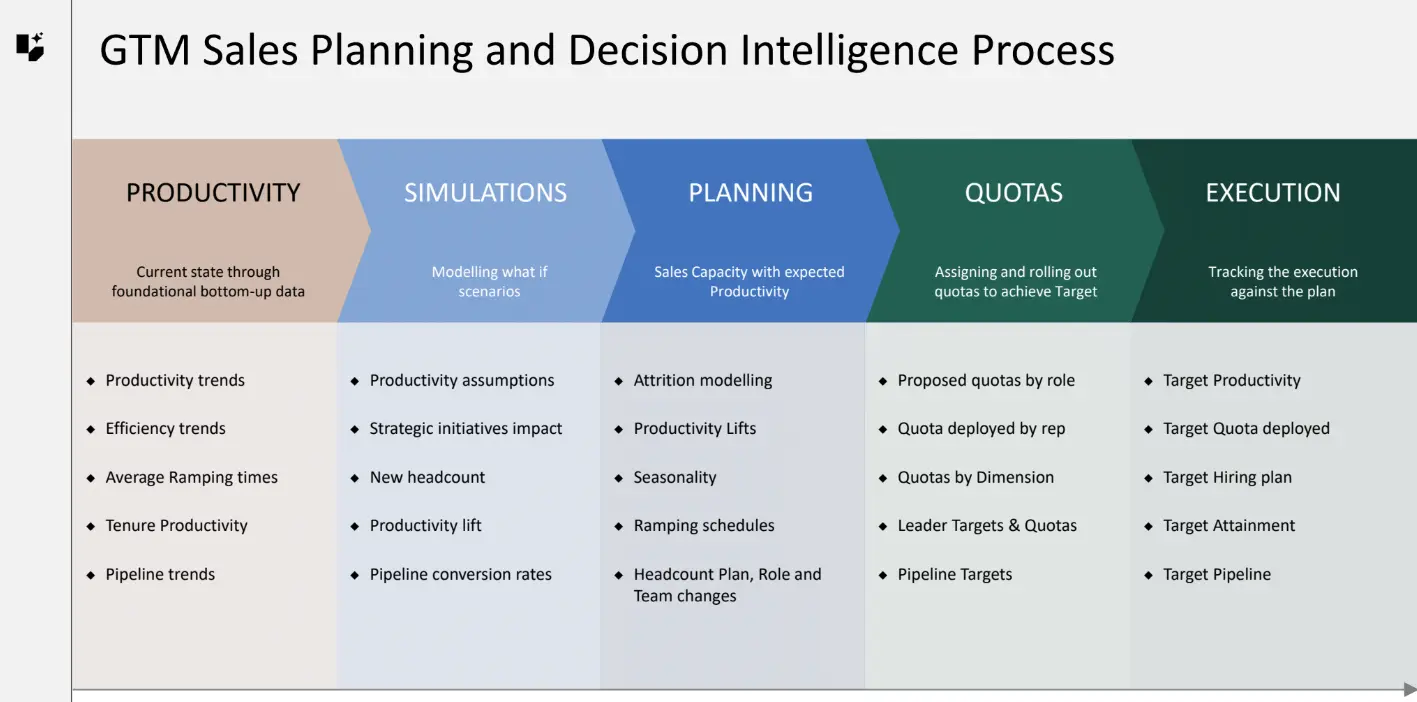
The same four-knob demand-engine math feeds Lative’s sales capacity planning, so the pipeline you design is matched to the capacity that closes it.
If your demand engine cannot trace the campaigns that generated the opportunities that closed last quarter, the architecture is the gap. See how Lative maps your demand engine’s conversion chain across all four knobs, by channel and segment.
Werner’s Five Rules for a GTM Demand Engine That Holds
- Design the architecture before you buy the tools. The CRM, MAP, and sales engagement stack will accumulate either way. The only question is whether the data model was deliberate or implicit. Deliberate wins.
- Build hybrid from day one. Lead-level mechanics for sourcing and routing, account-level tracking for coverage and revenue attribution. Picking one and renaming the other does not work at scale.
- Model every channel separately. Inbound, outbound, events, and paid search have different conversion rates, velocities, and pipeline coverage requirements. A single blended model is the fastest path to a wrong forecast.
- Timestamp every stage transition in real time. Lead-to-opportunity conversion, MQL-to-SAL, opportunity stage movement. If you do not capture it as it happens, you cannot reconstruct it, and you cannot diagnose where the engine is breaking.
- Run the Demand Council weekly. GTM alignment is not a quarterly offsite. It is a 60-minute meeting on the four knobs, with named owners and action items. The plan breathes with the business or it goes stale.
FAQ: Building a GTM Demand Engine
What is a GTM demand engine?
A GTM demand engine is the operational architecture that connects marketing investment to qualified pipeline and closed revenue. It is not a martech stack. It is the data model and the operating cadence that make the stack produce trustworthy numbers. The core components are a CRM that captures stage-transition history, a marketing automation platform that connects campaign data to the opportunity record, a sales engagement system that feeds SDR activity back into qualification, and a unified GTM data layer that ties the three together so marketing-sourced pipeline and lead-to-opportunity conversion can be measured from the same source.
How is a GTM demand engine different from demand generation?
Demand generation is the set of programs that create and capture interest. The GTM demand engine is the operating system those programs run on. Demand gen produces leads, content, and events. The engine routes, qualifies, attributes, and measures them. A team can run good demand gen on a broken engine and still miss the number, because the conversion rate by stage data is unreliable and the coverage ratio cannot be trusted. Fix the engine first, then optimize the programs.
Who owns the GTM demand engine?
RevOps owns the architecture and the definitions. Marketing owns demand creation and the top of the waterfall. Sales owns acceptance and opportunity progression. Finance owns the revenue target the waterfall is sized against. The Demand Council, with all four functions in the room weekly, is what keeps the operating model in GTM alignment and prevents the engine from drifting back into siloed reporting. No single function owns the engine. The cadence is the owner.
Werner Schmidt — Werner Schmidt is the CEO and Co-founder of Lative, with over 20 years of experience in Revenue Operations with companies including Forcepoint, Aruba Networks, Citrix, and Sage.