
In every annual planning cycle I’ve been part of, the sales scenario planning happens in a spreadsheet with assumptions someone last updated in Q3 of the previous year.
By the time the board approves the plan, the assumptions are already stale. I’ve watched companies model a “hiring delay” scenario that assumed a 26% SMB conversion rate, a number that was accurate eighteen months ago, when the original model was built. The business was running at 19%. That scenario wasn’t stress-testing the plan; it was protecting a fiction.
In 20 years of capacity planning reviews, I’ve never seen a company that updated its scenario assumptions more than once between annual planning cycles.
The assumptions go in during the October planning sprint, the board approves in January, and by April the business looks nothing like what was modeled. The scenarios don’t fail because the math was wrong. They fail because the inputs were wrong before the ink dried.
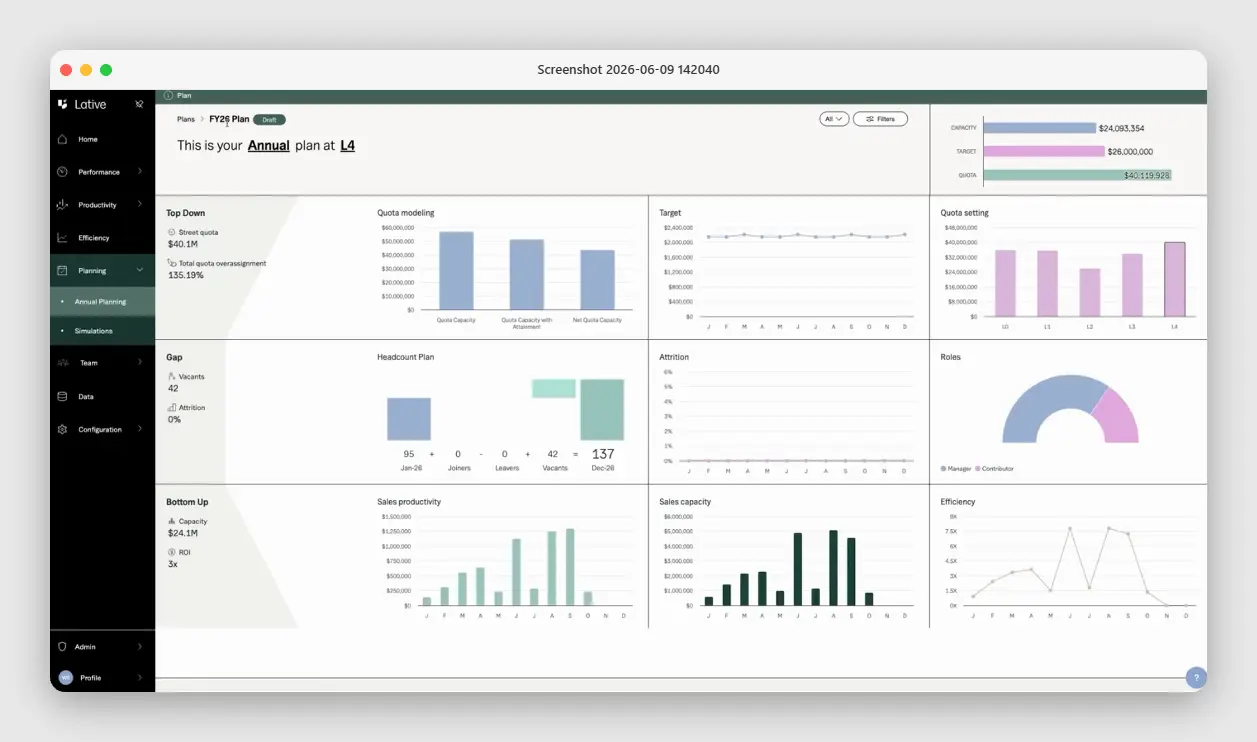
Lative’s Planning module runs scenarios on your trailing actuals from Salesforce, not on a static assumptions sheet. When your SMB conversion rate changes in Q2, the scenario model reflects that without someone manually updating a cell. That’s the structural difference this post is about.
What is sales scenario planning
Sales scenario planning is the practice of modeling how your revenue and capacity change under different conditions, a hiring delay, a conversion-rate drop, a faster ramp, before they happen, so you can decide what to do while you still have options. It is not forecasting, and conflating the two is the first mistake most teams make.
A forecast commits to a single number you expect to hit. A scenario maps a range of plausible outcomes and the specific input that drives each one. The forecast answers “what do we think will happen?” The scenario answers “what happens to the number if X changes, and what do we do about it?” A sales team that only forecasts is flying on a single point estimate. A team that runs scenarios knows, before the quarter starts, which variable will break the plan and how much room they have when it moves.
What scenario planning actually requires (vs. what most teams do)
Most teams build scenarios around outputs, not inputs. They model “what if we miss by 20%” but they never define which input changes to produce that miss. The sections below cover the two requirements that separate a scenario worth presenting from one that just fills a slide deck.
The inputs that make scenarios meaningful
A scenario is only as good as its inputs. The inputs that matter for sales capacity aren’t the ones most teams use. Last year’s conversion rate by segment. Pipeline volume from 14 months ago. A ramp assumption that was calibrated on a cohort of reps who onboarded before you changed your sales methodology. These aren’t assumptions, they’re historical artifacts dressed up as assumptions.
The inputs that actually make scenarios meaningful are:
- Trailing conversion rates by segment, what your SMB, mid-market, and enterprise pipelines are actually converting at over the last 60–90 days, not last year’s average
- Current ramp cohorts, how long reps hired in the last two quarters are actually taking to reach full quota, not a historical ramp assumption from a different hiring environment
- Pipeline by source and stage, where deals are sitting right now, not a coverage ratio calculated against a target that was set in October
- Segment shape, whether your deal mix is shifting toward or away from the segments that carry your model
None of these require a data warehouse. They require honest reads from Salesforce. The problem is that most sales scenario planning tools sit outside the CRM and require someone to export, paste, and manually recalibrate. By the time the model is updated, the actuals have moved again.
Why static assumption sheets fail by Q2
The drift problem is predictable. Assumptions are set in October. The plan is approved in January. By April, conversion rates have shifted, a top-performing segment has changed shape, and two of the four planned Q2 hires are delayed.
Nobody goes back to update the scenario model, that would require two days of RevOps work and a fresh board deck. So the scenarios that were supposed to guide decision-making are running on assumptions that no longer describe the business.
Your SMB conversion rate dropped from 28% to 21% in Q3. Your capacity plan still shows 28%. Every hiring scenario, every coverage model, every pipeline target in that plan is now wrong, and it has been wrong for months.
This is the core failure of static scenario planning: it treats assumptions as fixed inputs rather than as live readings of how the business is actually behaving. The model becomes a mirror of what you hoped would be true, not what is true.
Scenario planning frameworks, and which ones matter for sales
Walk into the scenario-planning literature and you hit the corporate-strategy toolkit: SWOT, PESTLE, Monte Carlo simulation, sensitivity analysis, trend analysis. Most of it was built for ten-year strategic bets, not for whether your sales team hits Q3. Two of them earn their place in sales scenario planning:
- Sensitivity analysis: change one input, win rate, ramp time, ASP, and watch what it does to the number. This is the workhorse. It tells you which of the 4 Knobs is the binding constraint and how much a given move is actually worth.
- Trend analysis on trailing actuals: build the base case from what the business is doing over the last 60 to 90 days, not last year’s average. This is what keeps the scenarios honest.
The rest, SWOT, PESTLE, a full Monte Carlo simulation, are mostly theater for a sales capacity plan. PESTLE matters when you are deciding which market to enter in 2030. It does not help you decide whether a delayed Q2 hire opens a coverage gap. Keep the framework as light as the decision requires: name the variable, define the magnitude, model the impact, decide the response. Everything past that is sophistication for its own sake.
Three scenarios every capacity plan should model
I use a base / conservative / bull framework. Not because it’s novel, but because those three labels force honest conversations. Base is what the trailing actuals say will happen if nothing changes. Conservative models a specific headwind. Bull models a specific tailwind. Each one should be named after the variable it’s testing, not after a mood.
Scenario 1, Hiring delay
The old way: a spreadsheet with a hiring assumption of four AEs starting Q2, and a note in the model that says “assumes 90-day ramp.” The scenario is never actually run. The plan just shows the revenue target and someone checks whether headcount math gets there.
The Lative Planning module output: if four AEs planned for Q2 start in Q3 instead, the model shows a coverage gap of roughly $1.2M in productive capacity for that quarter, based on your current rep average quota, current ramp duration (pulled from the actual cohort data in Salesforce), and current pipeline conversion rate.
It doesn’t tell you what you want to hear. It tells you what the delay costs, in real numbers, calibrated to how your team is actually performing right now.
That number changes every time the underlying data changes. If your team ramps faster in Q2 than Q1, the cost of the delay adjusts. You’re not re-running the scenario. It recalculates.
Scenario 2, Segmentation shift
The old way: the plan assumes enterprise conversion holds at 22%. Someone flags in a planning meeting that it feels lower. Nobody updates the model because that would require rebuilding the pipeline coverage table, which someone built manually in Q4.
The Lative Planning module output: if enterprise conversion drops from 22% to 18%, the model shows you need $3.4M more in pipeline to hit the same revenue number, and it shows the headcount implication: two additional AEs, or a 14% increase in marketing-sourced pipeline, or both.
The four knobs (volume, conversion rates, velocity, ASP) are all visible, and the model shows which combination of adjustments closes the gap.
Enterprise conversion has been running at 18% for six weeks. You’ve been planning to 22%. The gap isn’t a forecast error, it’s a signal that something in your enterprise motion has changed.
The scenario doesn’t just quantify the shortfall. It forces the conversation about whether the conversion drop is temporary or structural, and what the capacity response looks like under each assumption.
Scenario 3, Ramp acceleration
The old way: onboarding improvements are tracked by enablement, not connected to capacity planning. Nobody updates the ramp assumption in the capacity model until the annual planning cycle. Two quarters of faster ramp go unmodeled, and the productive capacity gain is invisible to the CRO and CFO.
The Lative Planning module output: if onboarding improvements cut ramp from 5 months to 3.5 months, the model shows a productive capacity gain equivalent to 1.4 full-quota reps per cohort of six, without any new hires.
For a team hiring two cohorts per year, that’s roughly 2.8 additional productive rep-equivalents annually. The gain is modeled in dollars, not months, because the underlying conversion and ASP data comes from Salesforce actuals.
This scenario matters for a specific reason: it gives the CRO a stronger position in a headcount conversation. “We don’t need two more AEs if we can accelerate ramp by six weeks” is a real trade-off, but only if you can quantify it. A static model can’t. A model running on live actuals can.
How to structure the scenario planning conversation with the board
The board conversation about scenarios is a constraint negotiation, not a data review. The CFO and CRO are aligning on which assumptions are acceptable and which require a contingency plan. How you frame the scenarios determines whether the conversation moves toward a decision or loops back to the data.
What the CFO needs to see
The CFO doesn’t want a point estimate. A single revenue number is a statement of optimism, not a plan. What the CFO needs is a probability-weighted range: base case at current conversion and hiring velocity, conservative case at a specific headwind, bull case at a specific tailwind.
Each case should show revenue coverage, cash implication, and the one or two variables that most determine which scenario materializes.
What the CFO can’t do with a static spreadsheet is stress-test the plan in real time. If the board asks “what happens if enterprise conversion drops 4 points?” the answer shouldn’t require a two-day RevOps sprint to recalculate. It should be a live read from the model. That’s only possible if the model is connected to actuals, not to a cached assumptions tab.
What the CRO needs to see
The CRO needs segment-level sensitivity. Not “revenue goes up or down” but “which knob is the binding constraint right now.” If conversion rates are the binding constraint, headcount is the wrong answer.
If pipeline volume is the constraint, conversion improvements won’t move the number. The scenario model should surface which of the four knobs, volume, conversion rates, velocity, ASP, has the biggest impact on the plan, so the CRO knows where to focus.
The bottoms-up model gives you this. When the plan is built from rep-level actuals rather than a top-down revenue target, the CRO can see exactly which segment or motion is underperforming and what adjusting it would do to the overall number.
Werner’s base / conservative / bull framework
Here’s how I run each scenario meaningfully:
- Base: trailing actuals, no changes. What the business produces if every current trend continues. This is the honest read, not the plan you want to show the board, but the plan the data actually supports.
- Conservative: one named headwind at a defined magnitude. Not “things go worse.” Specifically: “enterprise conversion drops 4 points” or “Q2 hiring is delayed 8 weeks.” The scenario should be named after the risk it models, and the board should be able to evaluate the probability of that risk materializing.
- Bull: one named tailwind at a defined magnitude. Specifically: “ramp compresses by 6 weeks” or “SMB pipeline velocity improves 15%.” The bull case should be achievable, not aspirational. If the board has to assume everything goes right simultaneously, it’s not a scenario, it’s a wish.
The point of naming each scenario after a specific variable is that it forces a conversation about causality, not just outcomes. The board can debate whether enterprise conversion is likely to hold or drop. They can’t usefully debate “bull vs. bear.”
Scenarios in a static spreadsheet
- Assumptions set once in October, approved in January
- Nobody re-runs the model until the next annual cycle
- The model mirrors what you hoped, not what is true
Scenarios on live actuals
- Inputs are live reads from Salesforce, not a cached tab
- Recalculates as conversion, ramp, and mix move
- Stress-test in real time, not a two-day RevOps sprint
What AI-native scenario planning changes
The structural problem with every scenario planning tool I’ve seen is that it requires a RevOps person to update the assumptions on a quarterly cadence, and that cadence is too slow. By the time the assumptions are updated, the scenarios are already describing a business that existed 60 days ago.
Lative’s Planning module recalculates scenarios automatically as the underlying Salesforce data changes. The model doesn’t need an export. It doesn’t need a manual sync.
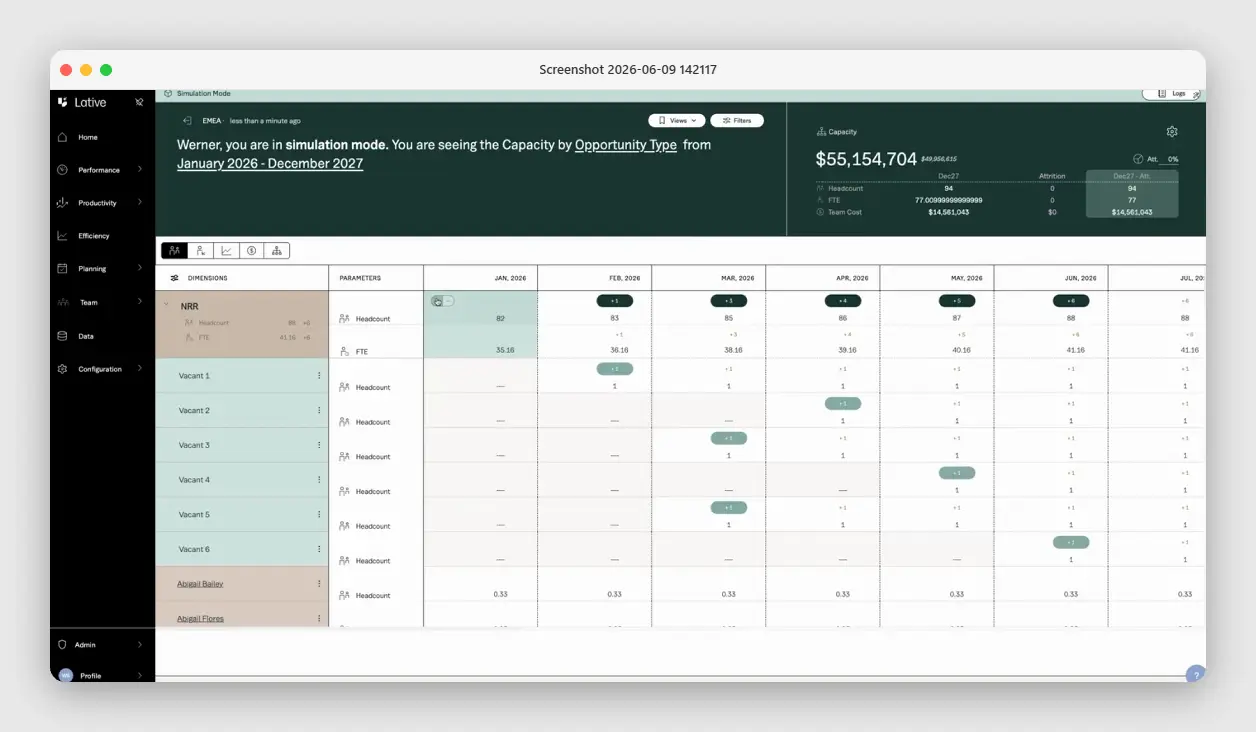
Its Simulations view runs these what-ifs against a long-range capacity plan by opportunity type: drop a hire into January or June and the capacity impact updates immediately, or model a strategic-initiative lift and see the per-rep productivity each month it would take to hit it.
It runs on the same Salesforce instance your CRO uses to check pipeline every morning. When conversion rates shift, when a new hire cohort starts ramping faster than the previous one, when a segment changes shape mid-quarter, the scenarios update to reflect what’s actually happening. The assumptions aren’t inputs you set once. They’re live readings from your CRM.
This changes what scenario planning is for. It stops being an annual exercise you run in October and present in January. It becomes the operating layer for every headcount conversation, every pipeline review, every board question about what the business can actually produce.
That’s what “start with the truth, not the target” means in practice: the model is always describing the business as it is, not as it was when someone last updated a spreadsheet.
You can explore how Lative’s Sales Capacity Planning works and see how scenario planning connects to the full revenue supply chain.
Key takeaways
- Scenario planning maps a range of outcomes and the input driving each; a forecast is a single point estimate.
- A scenario is only as good as its inputs — build from trailing 60–90-day actuals, not last year’s averages.
- Use base / conservative / bull, each named after a specific variable at a defined magnitude.
- Static spreadsheets go stale by Q2; scenarios on live CRM data recalculate as the business moves.
Frequently asked
What is sales scenario planning?
Modeling how revenue and capacity change under different conditions — a hiring delay, a conversion drop, a faster ramp — before they happen, so you can decide what to do while you still have options. It is not forecasting.
What is the difference between scenario planning and forecasting?
A forecast commits to a single expected number. A scenario maps a range of outcomes and the specific input driving each. Forecasting answers what will happen; scenario planning answers what happens if an input changes and what you do about it.
Which scenarios should every capacity plan model?
A base / conservative / bull framework: base on trailing actuals, conservative on one named headwind at a defined magnitude, bull on one named tailwind. Name each scenario after the variable it tests, not a mood.
Which scenario-planning frameworks matter for sales?
Sensitivity analysis (change one input and watch the number) and trend analysis on trailing 60–90-day actuals. SWOT, PESTLE, and a full Monte Carlo are mostly theater for a sales capacity plan.
Why do spreadsheet scenarios go stale?
Assumptions get set in October and approved in January; by April conversion, segment shape, and hiring have moved, and nobody re-runs the model. Scenarios built on live CRM actuals recalculate instead of needing a manual update.
If your last scenario planning exercise required someone to manually update 40 cells in a spreadsheet, there’s a structural problem. See how Lative’s Planning module runs scenarios on your live CRM data at lative.ai/demo.
Werner Schmidt is the CEO and Co-founder of Lative, with over 20 years of experience in Revenue Operations with companies including Forcepoint, Aruba Networks, Citrix, and Sage.