

Pigment vs Workday Adaptive is a choice between two planning philosophies. Workday Adaptive Planning is finance-first, governed, and natural for teams already running Workday. Pigment is the modern modeling platform with a cleaner build experience and strong scenario work. Both are capable places to run a sales plan, and both approach it from finance rather than from the sales floor.
A finance-shaped plan can be perfectly governed and still hand reps a quota that was never sized to their real capacity.
One disclosure up front: Lative is our product, and it appears here as the sales-capacity-shaped alternative to two finance-shaped platforms. We will say where each wins, including where Lative does not.
The verdict, up front
Short version. Pick Workday Adaptive if finance already runs Workday and wants headcount, opex, and the revenue plan governed in one environment. Pick Pigment if you want modern, flexible modeling and faster scenario work without the legacy weight.
Pick a capacity-first tool like Lative if the specific job is setting quota to ramp-adjusted capacity, which both model generically on top of a finance shape.
- Best if finance already runs Workday: Workday Adaptive Planning
- Best for modern modeling and fast scenario work: Pigment
- Best for sales capacity as a native object: Lative
Pigment vs Workday Adaptive at a glance
| Pigment | Workday Adaptive | Lative | |
|---|---|---|---|
| Best for | Modern modeling | Workday finance shops | Capacity-first quota |
| Setup | Weeks to months, build the model | Governed, Workday-native | Weeks, RevOps-owned |
| Ramp-adjusted capacity | Build it yourself | Modeled generically | Native object |
| Center of gravity | Modeling platform | Finance and workforce | Sales capacity |
| Pricing | Custom quote | Custom quote | Custom quote, no per-user |
| Standout | Clean build and scenarios | Governed finance and workforce | Quota in ramped equivalents |
Both platforms are custom-quote; confirm current pricing with each vendor.
How we compared them
We compared them on where planning starts, how much sales-specific detail is native, time to value, and who governs the plan. Pigment and Workday Adaptive both approach the sales plan from finance: strong on budgeting, headcount, and scenarios, lighter on ramp-adjusted, per-rep capacity, which they model generically.
The gap both leave open is sizing quota to real capacity, which is where this list is judged. See our roundup of the best FP&A software for sales.
How they differ, tool by tool
1. Pigment: the modern modeling platform

Pigment is the platform finance teams pick when they want real modeling power without the legacy-suite experience. Models are visual, versioned, and quick to iterate, and the scenario work is genuinely strong, which is why it turns up in GTM planning about as often as it does in FP&A.
Against a Workday-native option the difference is where the gravity sits. Pigment is stack-agnostic and connects to whatever you already run, so it does not assume your ERP. What it shares with Workday Adaptive is the boundary: ramp curves, productivity by segment, and capacity per rep are things you model yourself, not things the product already knows.
2. Workday Adaptive Planning: the Workday-native finance option

Finance-first planning that extends into workforce and sales. It is the natural pick when finance already runs Workday and wants headcount, opex, and the revenue plan governed inside one environment.
Sales-specific inputs like ramp curves and per-rep attainment are modeled generically rather than natively, so the detail a CRO needs is custom build on top of a finance-shaped model.
3. Lative: the sales-capacity-first alternative
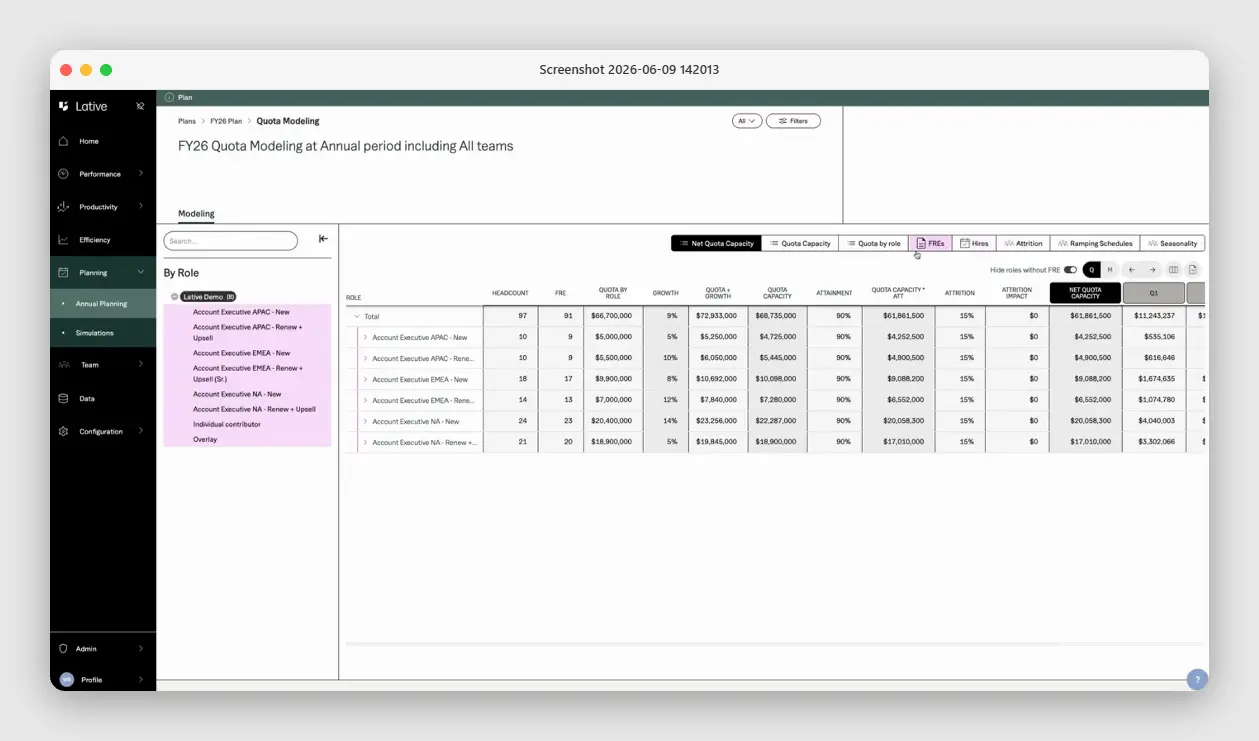
Full disclosure: Lative is our product, so weigh this with the appropriate skepticism. In a Pigment-versus-Workday-Adaptive decision, both are finance-shaped planning platforms. Lative is the sales-capacity-shaped one: it sets quota to ramp-adjusted capacity as a native object, where both of the others model that generically on top of a finance model.
It is not an FP&A or workforce-planning platform; it does not do budgeting, consolidation, or opex. It plans the selling-capacity half and reconciles it to the finance target as net quota capacity in fully ramped equivalents, so you pair it with FP&A for the rest.
Which should you choose
Choose Workday Adaptive when finance runs Workday and wants one governed environment for headcount, opex, and the revenue plan. Choose Pigment when you want modern, flexible modeling and faster scenarios without committing to the Workday stack.
Reach for a capacity-first tool like Lative when the sales plan keeps failing on the quota itself, and you want ramp-adjusted capacity native rather than modeled on top of a finance shape. Many teams run one of the two for finance-wide planning and Lative for the sales-capacity layer. See how they connect on our sales capacity planning hub.
Frequently asked
Is Pigment or Workday Adaptive better for planning?
It depends on your stack and philosophy. Workday Adaptive is the stronger fit for finance teams already on Workday that want governed, integrated planning across finance and workforce. Pigment offers more modern, flexible modeling and faster scenario work for teams that want a fresh platform without the Workday commitment.
Does Workday Adaptive do sales capacity planning?
It extends into workforce and sales planning, but sales-specific inputs like ramp curves and per-rep attainment are modeled generically on top of a finance-shaped model rather than natively. A capacity-first tool such as Lative models ramp and per-rep capacity as native objects.
Is Pigment good for sales planning?
Yes, as a flexible platform. Its scenario modeling and GTM-planning practice are strong. The caveat is the one common to modeling platforms: the ramp-adjusted, per-rep capacity logic is yours to build and maintain rather than productized out of the box.
What is the difference between these tools and Lative?
Pigment and Workday Adaptive are finance-shaped planning platforms; Lative is a sales-capacity-shaped one. Lative sets quota to ramp-adjusted capacity as a native object and reconciles top-down target with bottom-up capacity, then pairs with FP&A for budgeting and consolidation.
Can you use Lative with Pigment or Workday Adaptive?
Yes, and many teams do. Pigment or Workday Adaptive owns finance-wide and workforce planning; Lative owns the sales-capacity and quota layer and feeds the reconciled number back to the finance plan.
See it in action. Book a Lative demo and see how it makes ramp-adjusted capacity a native object instead of something you model on top of a finance plan.
Werner Schmidt — Werner Schmidt is the CEO and Co-founder of Lative, with over 20 years of experience in Revenue Operations with companies including Forcepoint, Aruba Networks, Citrix, and Sage.