

Pigment vs Anaplan vs Lative is a real shortlist for revenue teams choosing where to run sales planning. Anaplan is the enterprise modeling incumbent, Pigment is the modern challenger with a cleaner build experience, and Lative is the capacity-first, purpose-built option. The honest way to choose is to decide whether you are buying a modeling platform or a productized answer to one job.
All three can hold a plan; the question is whether the quota inside it was set to what the team can carry.
One disclosure up front: Lative is our product, so read this with that in mind. We will say where Pigment and Anaplan win, including where Lative is the wrong tool.
The verdict, up front
Short version. Pick Anaplan for the deepest, most flexible modeling when you have a planning team and a multi-domain problem. Pick Pigment for finance-grade modeling with a modern build experience and less legacy weight. Pick Lative when the specific job is setting quota to ramp-adjusted capacity and you want it productized, not built.
- Best for the deepest, most flexible modeling: Anaplan
- Best for finance-grade modeling without legacy weight: Pigment
- Best for capacity and quota productized rather than built: Lative
Pigment vs Anaplan vs Lative at a glance
| Pigment | Anaplan | Lative | |
|---|---|---|---|
| Best for | Modern modeling | Enterprise modeling | Capacity-first quota |
| Setup | Weeks to months, build the model | Months, modeling team | Weeks, RevOps-owned |
| Ramp-adjusted capacity | Build it yourself | Build it yourself | Native object |
| Modeling breadth | Broad, finance and GTM | Broadest, multi-domain | Narrow, capacity and quota |
| Pricing | Custom quote | Custom quote | Custom quote, no per-user |
| Standout | Clean build and UX | Model almost anything | Quota in ramped equivalents |
All three are custom-quote; confirm current pricing with each vendor.
How we compared them
We compared them on modeling depth, time to value, whether ramp-adjusted capacity is native, and who owns it. Pigment and Anaplan are platforms: powerful, flexible, and yours to build in. Lative is a product: narrower, but the capacity and quota logic ships with it. The thing all three are judged against is the job most teams still do in a spreadsheet, setting quota to capacity.
See our primer on what a sales capacity model is.
How they differ, tool by tool
1. Pigment: the modern modeling platform

A modern business-planning platform with finance-grade models and a noticeably cleaner build experience than legacy suites. Scenario work is strong and the GTM-planning practice is growing fast.
It is platform-first rather than domain-specific, so the logic and cohort math are yours to build and maintain rather than productized out of the box. You get a great canvas; you still paint the model.
2. Anaplan: the enterprise modeling incumbent

Anaplan is the platform Pigment was built to compete with, and it earned that position: a decade of enterprise deployments, the largest partner ecosystem in the category, and a modeling engine that will hold almost any structure you throw at it across finance, sales, and operations.
What you pay for that is build time and inertia. Implementations run in months, the model becomes a standing maintenance job, and the domain logic is yours to write and keep rewriting as the business changes. Teams weighing it against Pigment are usually trading proven depth against a build experience that does not need a specialist to touch it.
3. Lative: the capacity-first, purpose-built option
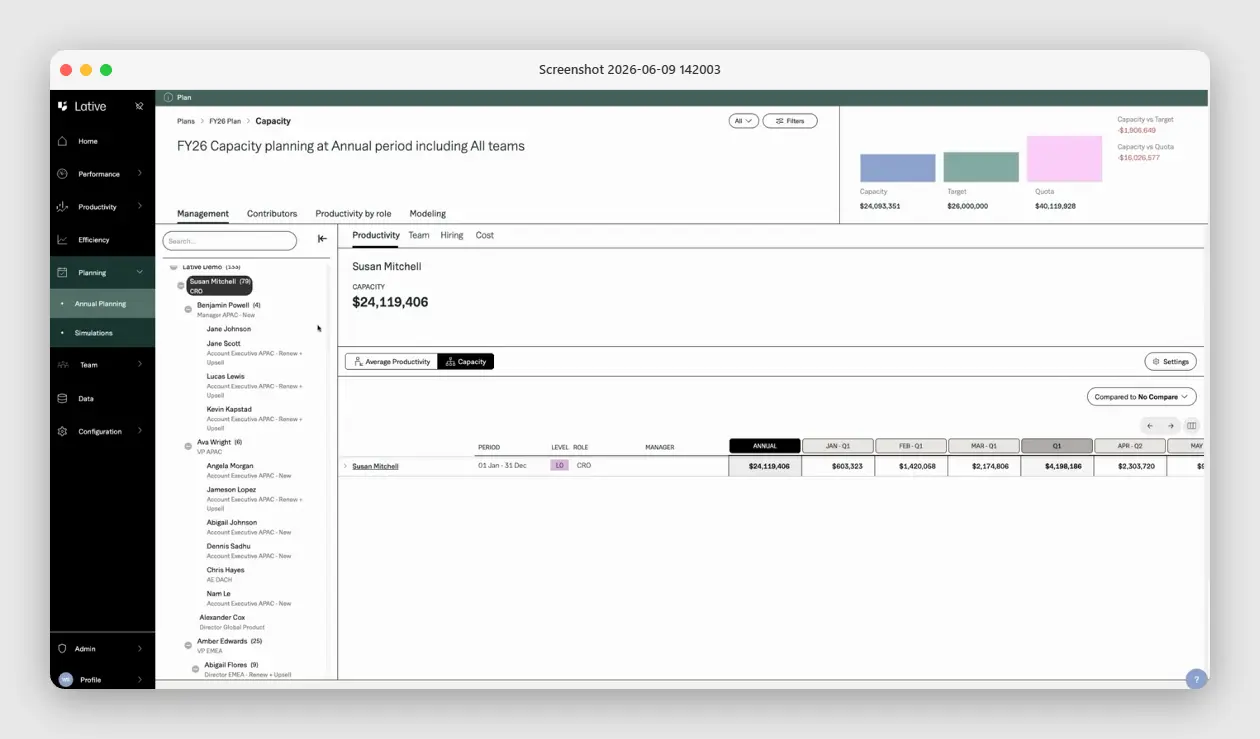
Full disclosure: Lative is our product, so weigh this with the appropriate skepticism. In a Pigment-versus-Anaplan decision, both are modeling platforms you build the plan inside.
Lative is the purpose-built option that productizes the specific job: it sets quota to ramp-adjusted capacity and reconciles top-down target with bottom-up capacity out of the box, rather than as a model you design and maintain.
It trades breadth for depth on one problem. Pigment and Anaplan can model almost anything across finance and GTM; Lative models sales capacity and quota, natively, as net quota capacity in fully ramped equivalents, and stops there. If you need multi-domain planning, one of them is the platform; if you need capacity-first quota fast, Lative is the shortcut.
Which should you choose
Choose Anaplan when planning is a staffed discipline and sales capacity is one model among many. Choose Pigment when you want that flexibility with a modern build experience and faster iteration. Choose Lative when your attainment keeps landing near half the team and you want quota tied to ramped capacity without building and maintaining the model yourself.
Plenty of teams run Pigment or Anaplan for finance-wide planning and Lative for the sales-capacity layer specifically. See how they connect on our sales capacity planning hub.
Frequently asked
Is Pigment or Anaplan better?
Anaplan is deeper and more flexible, with a larger ecosystem, and it suits teams with a dedicated planning function. Pigment matches much of that flexibility with a cleaner, faster build experience and less legacy weight, which appeals to teams that want modern UX without a heavy rollout. Both are modeling platforms you build the logic inside.
Where does Lative fit against Pigment and Anaplan?
Lative is not a general modeling platform; it is a capacity-first planning tool. Against Pigment and Anaplan it trades breadth for a productized answer to one job: setting quota to ramp-adjusted capacity and reconciling top-down target with bottom-up capacity, without building the model yourself.
Do you need Pigment or Anaplan if you have Lative?
Not for sales capacity and quota; Lative covers that natively. If you also need multi-domain financial modeling, workforce planning, or supply planning, a platform like Pigment or Anaplan is the right home for those, and many teams run one alongside Lative.
Which is fastest to stand up?
Lative is typically the fastest for the capacity-and-quota job because that logic is productized rather than built. Pigment tends to be faster than Anaplan to implement, but both are platforms where time to value depends on how much of the model you build.
Which is best for SaaS sales capacity planning?
For SaaS sales capacity and quota specifically, a purpose-built tool such as Lative models ramp, attrition, and per-rep capacity natively. Pigment and Anaplan can do it, but you design and maintain that logic, which is more work than most SaaS revenue teams want to own.
See it in action. Book a Lative demo and see how it productizes the capacity and quota model you would otherwise build in Pigment or Anaplan.
Werner Schmidt — Werner Schmidt is the CEO and Co-founder of Lative, with over 20 years of experience in Revenue Operations with companies including Forcepoint, Aruba Networks, Citrix, and Sage.