
A sales capacity model is how you answer one question with math instead of hope: how much revenue can your sales team actually produce. Most teams cannot answer it.
RepVue’s Q2 2025 Cloud Sales Index, covering roughly 47,000 quota-carrying reps across 246 companies, put average quota attainment at 42.69% that quarter. Attainment that low is rarely a talent problem. It is what happens when the revenue plan was never grounded in what the team could produce in the first place.
This guide covers what a sales capacity model is, the formula behind it, the three model types, the inputs you need, a worked example, how to stress-test the model, and where most models break. By the end you should be able to build a first version in an afternoon and know exactly which assumptions to distrust.
Sales capacity model, defined
A sales capacity model estimates the total revenue your reps can realistically generate over a period, based on how many reps you have, how productive each one is, and how far along the ramp curve each one sits. It is the bridge between headcount and revenue.
That last clause matters. Headcount is not capacity. Ten reps carrying a $1M quota each is $10M of quota, not $10M of capacity. If trailing attainment runs at 60%, the productive capacity of that team is $6M, and every plan built on the $10M number is wrong before the year starts.
Why the model matters
The capacity model is the foundation under every other revenue decision: the quota you assign, the pipeline coverage you demand, the hires you request, and the number you commit to the board. Teams that build this discipline outperform materially.
The Ebsta x Pavilion 2024 analysis of 4.2 million opportunities found that teams running a RevOps-driven planning approach achieved 87% higher win rates and 21% shorter sales cycles than peers without that infrastructure.
The mechanism is not magic. A capacity model forces you to discover, in the planning cycle, the gaps that otherwise surface as a missed quarter: the cohort that ramps two months slower than assumed, the segment whose win rate quietly fell, the territory that never had enough opportunity to support its quota.
The sales capacity formula
At its simplest:
Sales Capacity = Number of Reps x Average Productive Capacity per Rep, adjusted for ramp
Productive capacity per rep is the rep’s quota multiplied by their trailing attainment rate. Many finance models call that attainment factor the sales productivity rate. Same number, different label. A fully ramped rep with a $1M quota and 70% trailing attainment contributes $700K.
A rep in month three of a six-month ramp contributes a fraction of that, typically 20 to 30%, not the flat 50% most spreadsheets assume, because ramp curves front-load pipeline building and back-load closed revenue.
Sum every rep’s ramp-adjusted contribution and you have total capacity. For the segment-level version of this math, including pipeline-required calculations, see how to calculate sales capacity.
The three model types
- Top-down. Start from a revenue target and divide down to teams and reps. Fast, board-friendly, and disconnected from real capacity. Useful only for setting ambition, never for committing a number.
- Bottom-up. Build from each rep’s productive capacity and ramp position, then sum. More accurate, and the model scaling teams should rely on, because it reflects who is actually carrying quota this quarter.
- Hybrid. Set ambition top-down, validate bottom-up, and treat the gap between the two numbers as the plan: close it with hiring, productivity improvement, or a target reset. The strongest approach for most SaaS teams, and the one that gives the CFO and CRO a shared fact to negotiate from instead of dueling spreadsheets.
The five inputs the model needs
A capacity model is only as good as its inputs. Five matter most, and all five live in data you already have:
- Rep roster with start dates. Every quota-carrying rep, their segment, and their hire date. This is what ramp adjustments key off.
- Trailing attainment by segment. The last four quarters of attainment for fully ramped reps, kept separate by segment. The Bridge Group’s 2024 SaaS AE Metrics Report (170+ B2B SaaS companies) found 51% of AEs hit quota in 2024, down from 66% in 2022, which is exactly why last year’s planning assumption cannot be carried forward unexamined.
- Ramp curves from cohort actuals. What your last two or three hiring classes actually produced in months one through nine, by segment. Gong’s 2025 onboarding research found the path to full productivity is measurable and repeatable, but only when you track it. An enterprise rep on a nine-month sales cycle is not closing meaningful revenue in month three, no matter what the onboarding deck promises.
- Attrition by tenure band. First-year attrition at many B2B SaaS companies runs 20 to 25%. One hire in four is a replacement, not added capacity. A model that ignores attrition overstates the back half of the year every time.
- Segment definitions. SMB, mid-market, and enterprise convert, ramp, and attain differently. Blend them and the model describes none of them.
A worked example
Eight reps, full productive capacity of $1M each, but two are mid-ramp at 40%. Capacity is six reps at $1M plus two at $400K, so $6.8M, not the $8M a headcount-times-quota model would claim. That $1.2M difference is exactly what a capacity model exists to surface.
Now extend it one layer, the way a real plan has to. Suppose historical attrition says you will lose one of those eight reps mid-year, and the backfill takes 60 days to hire plus five months to ramp.
The departed rep contributes roughly half a year of capacity ($500K instead of $1M) and the backfill contributes maybe $150K in their partial ramp year. Realistic capacity is now closer to $6.05M. Against a $8M target, you are not 15% short, you are 24% short, and you found out in January instead of October. That is the entire value of the model.
Stress-testing the model
A capacity model you have not stress-tested is a single guess wearing a spreadsheet costume. Strong teams run at least three scenarios:
- Base case: current roster, trailing attainment, validated ramp curves. What happens if nothing changes.
- Bear case: one named headwind at a defined magnitude. Q2 hires slip eight weeks, or attrition runs five points hot, or enterprise attainment drops four points. Name the variable, not a mood.
- Bull case: one named tailwind. Ramp compresses six weeks because onboarding improved, or a segment’s win rate recovers to its two-year average.
Each scenario produces a different capacity number and a different gap against the target. The point is not prediction. It is knowing your trigger and your response before week nine of the quarter forces one. For the full scenario framework, see sales scenario planning.
Where most capacity models break
They ignore ramp. Counting new hires at full productivity from day one is the single most common error, and it always breaks in the same direction: capacity is overstated, the gap appears in Q3, and the post-mortem blames execution. Build ramp from cohort data, not assumptions, and model it monthly rather than as a flat percentage. For benchmarks by segment, see sales ramp time.
They blend segments. One average across SMB and enterprise produces a number that is wrong for both. A 19% blended win rate that averages 24% mid-market and 13% enterprise will show healthy aggregate coverage while enterprise runs a structural deficit.
They are built once and never updated. An annual model is stale by Q2. Hiring slips, a top rep leaves, conversion shifts. The model needs to re-run on trailing actuals at least monthly, with someone in RevOps owning the refresh.
They live in a disconnected spreadsheet. The moment finance, sales ops, and the CRO each keep a copy, the model has three versions and zero authority. Version drift is how planning meetings collapse into arguments about whose export is fresher.
How Lative runs the capacity model
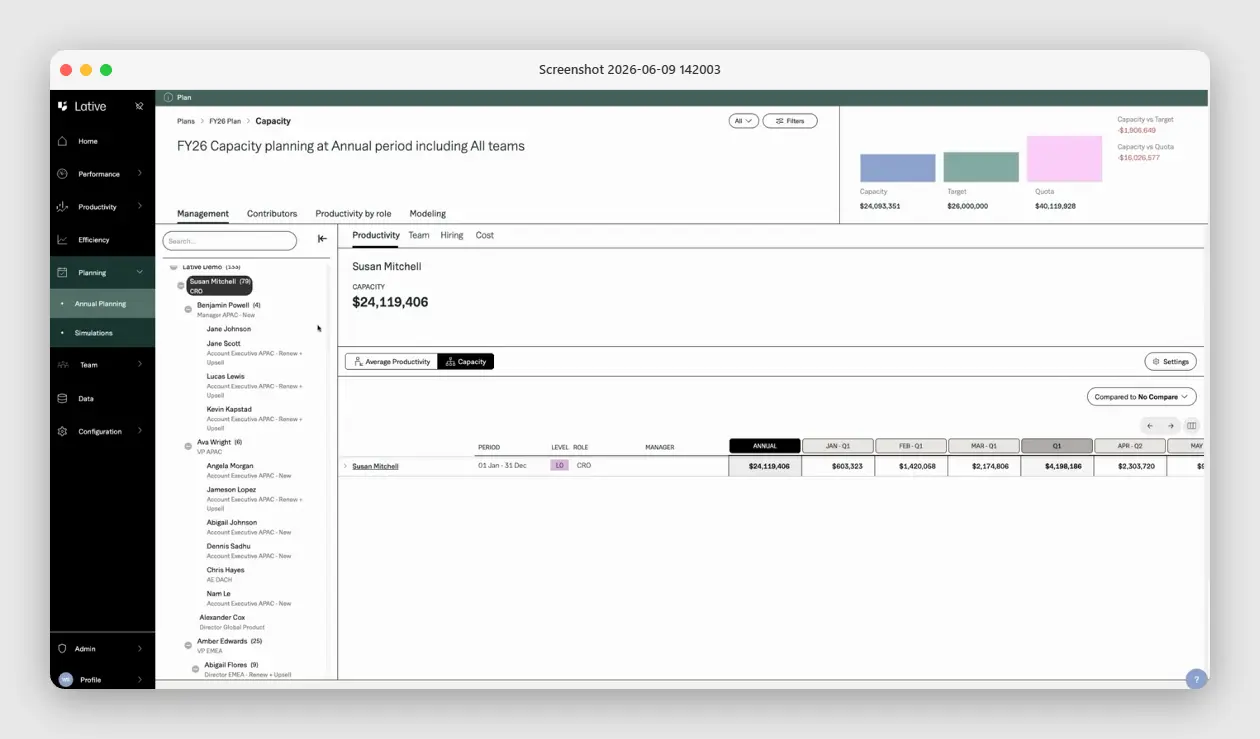
Lative is an AI-native sales planning platform that runs this exact model as a live system instead of an annual artifact. Its Productivity module computes production per rep from closed-won data, broken out by segment, product line, and opportunity type, including tenure-adjusted productivity so ramping reps are measured fairly.
Average Ramping Time derives ramp curves from your real hire cohorts: days to full productivity and time to first deal, per rep, not a flat assumption. The Capacity view then sums ramp-adjusted productive capacity per rep and team, and the Annual Planning view reconciles that bottom-up number against the top-down target and quota on one screen, with headcount, joiners, leavers, and attrition modeled in the gap.
When an input moves, a cohort ramps slow, a rep resigns, a segment’s attainment shifts, the capacity number updates with it. The model stops being a January estimate and becomes the operating number your CRO and CFO both read from. For what-if work, the Simulations view models hiring timing and initiative lifts against a long-range capacity plan.
FAQ
What is a sales capacity model?
A model that estimates how much revenue a sales team can realistically produce, based on rep count, per-rep productivity, ramp position, and attrition, checked against the revenue target.
What is the sales capacity formula?
Number of reps times average productive capacity per rep, adjusted for where each rep sits on the ramp curve. Productive capacity per rep is quota times trailing attainment.
What is the best type of capacity model?
For scaling SaaS teams, a bottom-up or hybrid model is most accurate, because it ties capacity to real rep productivity rather than a top-down target divided by headcount.
How often should a capacity model be updated?
Monthly at minimum, on trailing actuals. Annual models are stale by Q2 because hiring, attrition, and conversion rates move faster than planning cycles.
What data do you need to build a capacity model?
A rep roster with start dates, trailing attainment by segment, ramp curves from cohort actuals, attrition rates by tenure band, and clean segment definitions. All of it lives in your CRM and HR system today.
What is the difference between a capacity model and a sales forecast?
A forecast predicts what will close this period from current pipeline. A capacity model defines what the team is structurally able to produce. The forecast should never exceed capacity; when it does, one of the two is wrong.
Put the model to work with how to build a sales capacity plan, see the sales capacity planning guide, or book a demo to see your own roster as a live capacity model.