

Anaplan vs Salesforce Sales Planning is a strange shortlist, because the two tools sit at opposite ends of the market. Anaplan is a heavyweight connected-planning platform you build almost anything in. Salesforce Sales Planning is native planning inside the CRM your reps already live in.
The real decision is not which is better, it is how much planning depth you need and how much build you are willing to own to get it.
Both tools can hold a plan; neither guarantees the quota inside it was set to what the team can actually carry, which is where most misses start.
One disclosure up front: Lative is our product, and it appears here as the capacity-first alternative to both, not a neutral referee. We will say where each tool wins, including where Lative does not.
The verdict, up front
Short version. Pick Anaplan if you have a dedicated planning team and sales capacity is one province of a much larger, multi-domain model. Pick Salesforce Sales Planning if you want planning on trusted CRM data with no integration project and your needs are straightforward.
Pick a capacity-first tool like Lative if the specific job is setting quota to ramp-adjusted capacity without a modeling team or a heavy rollout.
- Best for multi-domain enterprise modeling: Anaplan
- Best for native planning with no integration project: Salesforce Sales Planning
- Best for quota set to ramp-adjusted capacity: Lative
Anaplan vs Salesforce Sales Planning at a glance
| Anaplan | Salesforce Sales Planning | Lative | |
|---|---|---|---|
| Best for | Enterprise multi-domain modeling | Native CRM-based planning | Capacity-first quota planning |
| Setup | Months, needs a modeling team | Native, no integration | Weeks, RevOps-owned |
| Ramp-adjusted capacity | Build it yourself | Not native | Native object |
| Data source | Any, via integrations | Salesforce CRM data | CRM plus planning inputs |
| Pricing | Custom quote | Add-on to Sales Cloud | Custom quote, no per-user |
| Standout | Model almost anything | Trusted, native data | Quota in ramped equivalents |
Enterprise tools here are custom-quote; Salesforce is an add-on to Sales Cloud. Confirm current pricing with each vendor.
How we compared them
We compared the two on the questions a revenue leader actually asks: how much modeling depth do you get, how long until it is live, does it model ramp-adjusted capacity natively, and who has to own it? Then we flagged the thing both leave to you, sizing quota to real capacity, and where a capacity-first tool fits. For the wider set, see our roundup of the best CRM for sales planning.
How they differ, tool by tool
1. Anaplan: the enterprise modeling platform

Enterprise connected planning with near-unlimited modeling flexibility across finance, sales, and operations. It is the default when a dedicated planning team owns a multi-domain model and this problem is one province of a much larger map.
The trade-off is weight: implementations run in months, model maintenance is a standing job, and the domain logic is yours to build inside the platform. For a single job it is more platform than the problem needs.
2. Salesforce Sales Planning: the CRM-native option
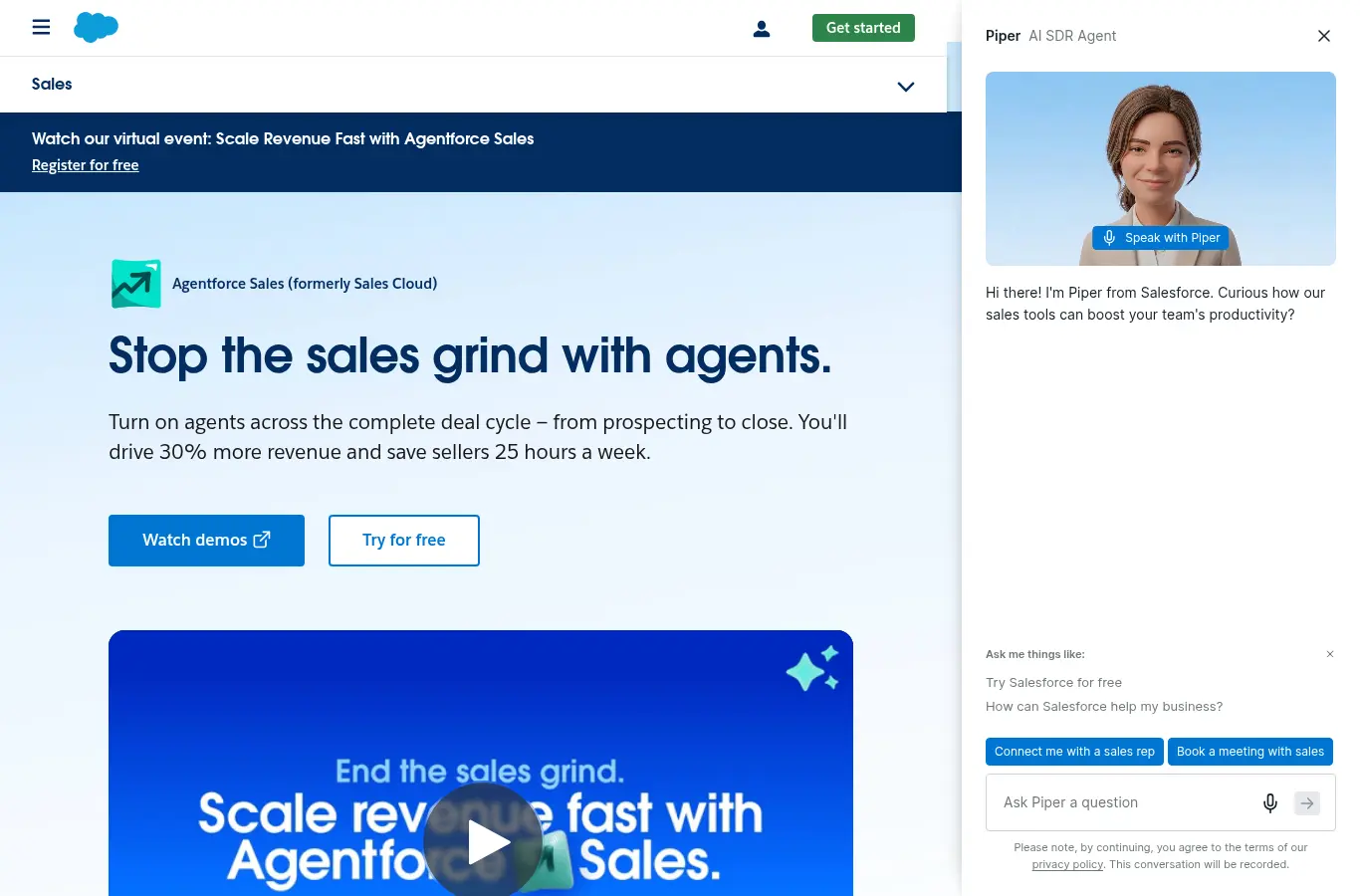
Native planning and reporting inside Salesforce, on data your team already trusts and maintains. No integration project, and fine for straightforward work alongside the CRM reps live in every day.
It is lighter than dedicated tools on ramp-adjusted capacity and continuous scenario modeling, which is where plans break mid-year. It handles the CRM job; it does not model the team that delivers the number.
3. Lative: the capacity-first alternative to both
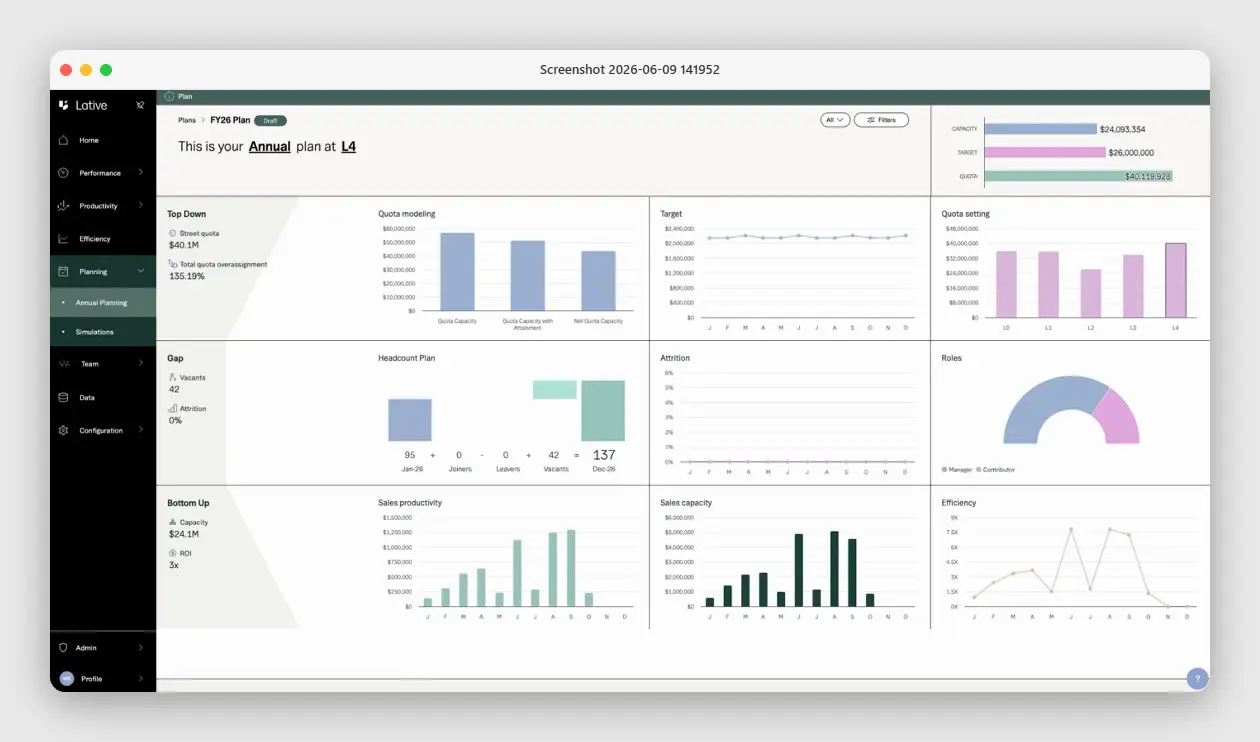
Full disclosure: Lative is our product, so weigh this with the appropriate skepticism. In an Anaplan-versus-Salesforce decision it is the third option worth knowing about when the specific job is sales capacity and quota.
Anaplan hands you a blank modeling canvas; Salesforce gives you native CRM planning; Lative gives you ramp-adjusted capacity and quota as native objects, without a modeling team or an integration project.
It is narrower than Anaplan and deeper than Salesforce on one thing: it sets quota to real productive capacity and reconciles top-down target with bottom-up, ramp-adjusted capacity as net quota capacity in fully ramped equivalents. It is not a multi-domain modeling platform, and it does not replace the CRM.
Which should you choose
Choose Anaplan when planning is a discipline you staff, not a tool you buy, and sales capacity is one model among finance, supply, and workforce. Choose Salesforce Sales Planning when you want to plan on CRM data without moving it, and your territory and quota work is relatively standard.
Reach for a capacity-first tool like Lative when your attainment keeps landing near half the team and the fix is a quota tied to ramped capacity, not more modeling horsepower or another CRM tab. Many teams pair one of the two with Lative rather than choosing between all three. See how the pieces connect on our sales capacity planning hub.
Frequently asked
Is Anaplan or Salesforce better for sales planning?
Neither is universally better; they solve different problems. Anaplan is the deeper, more flexible platform for teams with a modeling function and multi-domain planning needs. Salesforce Sales Planning is simpler and native to CRM data, which suits teams that want planning without an integration project or a dedicated planning team.
Can Salesforce Sales Planning replace Anaplan?
For straightforward territory and quota planning on CRM data, it can. For complex, multi-domain modeling with heavy scenario work across finance and operations, it usually cannot match Anaplan’s depth. The honest test is how much modeling flexibility you actually need versus how much build you want to own.
Does Salesforce Sales Planning do capacity planning?
It handles territory and quota planning natively, but ramp-adjusted, per-rep productive capacity is not a native object; it is something you build on top. A capacity-first tool such as Lative models ramp and capacity natively and reconciles them to the target.
What is a lighter alternative to both?
If the specific job is sales capacity and quota rather than broad modeling or CRM-native planning, a purpose-built tool such as Lative is lighter than Anaplan and deeper than Salesforce on that one job. It stands up in weeks and does not need a modeling team.
How is Lative different from Anaplan and Salesforce?
Anaplan is a general modeling platform, Salesforce is CRM-native planning, and Lative is a capacity-first planning tool. Lative sets quota to ramp-adjusted capacity as a native object, reconciling top-down target with bottom-up capacity, without a modeling team or an integration project.
See it in action. Book a Lative demo and see how it sets quota to real, ramp-adjusted capacity, whether you plan in Anaplan, Salesforce, or a spreadsheet today.
Werner Schmidt — Werner Schmidt is the CEO and Co-founder of Lative, with over 20 years of experience in Revenue Operations with companies including Forcepoint, Aruba Networks, Citrix, and Sage.