
Sales reps spend a surprising amount of their week not selling. They fix CRM data, build reports, chase approvals, and argue about territories. Sales operations exists to take that work off their plate so the team can sell, and, done well, it is the difference between a revenue org that runs on instinct and one that runs on a system.
The cost of running on instinct is measurable. The Bridge Group’s 2024 SaaS AE Metrics Report (170+ B2B SaaS companies) found the share of AEs hitting quota fell to 51% in 2024 from 66% in 2022, and the Ebsta x Pavilion 2024 analysis of 4.2 million opportunities found teams with RevOps-style operational discipline achieved 87% higher win rates and 21% shorter cycles than peers.
The gap between those two realities is, to a large degree, the sales operations function. This guide covers what sales operations is, what it actually owns, how it differs from the functions it gets confused with, the KPIs it should run on, and how to build it.
Sales operations, defined
Sales operations is the function that designs and runs the systems, processes, and data behind a sales team. It owns the plumbing of revenue: CRM hygiene, the forecasting process, territory and quota design, capacity planning, tooling, and the analytics leadership uses to make decisions.
The simplest framing: reps own deals; sales ops owns the machine that helps them close more of them. When the machine is good, reps sell more hours of the week, forecasts hold, and planning conversations run on shared numbers. When it is bad, everything looks like a performance problem and nothing responds to performance management.
What sales operations actually owns
- Process design. Sales stages with written exit criteria, the rules of engagement between SDRs and AEs, handoff definitions, and what “qualified” means. Ambiguous stage definitions are the root cause of half of all forecast arguments, because every conversion rate downstream inherits the ambiguity.
- Data and CRM. Field hygiene, deduplication, stage discipline, and the integrations that keep the CRM the single source of truth. Every analytics and AI initiative the company attempts later stands on this foundation.
- Planning. Territory design balanced on real opportunity, quotas derived from capacity rather than division, headcount models that account for ramp and attrition, and the capacity model that ties them together. This is the highest-impact and most neglected part of the job.
- Forecasting. The weekly cadence, the commit definitions, the stage weights derived from trailing actuals, and the accuracy tracking that improves all three over time.
- Tooling. Selecting, integrating, and, more often, retiring sales technology. A leaner stack that reps actually use beats a complete one they work around.
- Analytics. The reports leadership runs the business on: attainment by cohort, pipeline coverage by segment, conversion by stage, productivity per rep.
Sales ops vs RevOps vs enablement
Three functions get blended in org charts and job postings, and the boundaries matter. Sales operations serves the sales org specifically. Revenue operations applies the same discipline across marketing, sales, and customer success, so the whole revenue engine runs on one process and one set of data; most companies build sales ops first and widen the mandate into RevOps somewhere past $20M ARR.
Sales enablement owns rep skills, content, and training, what reps say and how well they say it, where sales ops owns the system they say it inside. The functions overlap at onboarding and tooling, which is why the boundary should be written down: ops owns process and data, enablement owns competence, and ramp belongs to both.
The KPIs sales operations owns
- Forecast accuracy. Week-one forecast versus quarter-end actual, by segment. The single best measure of whether the operating system works. Target within 5 to 10% and track your own bias.
- Quota attainment and its distribution. Not just the average: how many reps hit, and whether the number is carried by two stars or the whole team. Healthy teams see 60 to 80% of ramped reps at quota; see what is quota attainment for the benchmarks.
- Sales cycle length and stage conversion. By segment, trended. The early-warning system for motion problems.
- Pipeline coverage. Open qualified pipeline against target, by segment, weekly. Aggregate coverage hides segment deficits.
- Ramp time and productive capacity. How long hires take to reach full productivity, and what the roster can actually produce after ramp and attrition. These two connect sales ops to the company’s hiring and revenue plans.
- Selling-time share. The fraction of rep hours spent selling versus admin. It is the KPI for sales ops’ own core promise.
Notice the theme: the best sales ops teams do not just report numbers, they connect each number back to capacity, so when the forecast slips they can say whether it is a pipeline problem or a staffing problem and respond accordingly.
When to hire sales operations, and what the first 90 days look like
The common trigger is $5M to $10M ARR, when spreadsheets stop scaling, the forecast starts wobbling, and the founder is still personally carving territories. A useful worked sequence for the first hire’s first quarter: weeks one to four, audit and fix the CRM, stage definitions written, dead pipeline purged, close dates made honest, because nothing else works on dirty data.
Weeks five to eight, stand up the weekly forecast cadence with written commit criteria and start logging accuracy. Weeks nine to twelve, build the first ramp-adjusted capacity model from the rep roster and trailing attainment, and re-derive next quarter’s quotas from it.
That ninety-day sequence, data, then forecast, then planning, converts a sales team from anecdotes to operations in one quarter, and each step makes the next one trustworthy.
How sales operations evolves with scale
The function changes shape as the company grows, and staffing it for the wrong stage wastes the hire. At the first-hire stage, the job is generalist plumbing: data, forecast cadence, and a first capacity model, as in the ninety-day sequence above.
Between roughly $20M and $50M ARR, the role splits: a deal-desk and process specialist, an analyst owning forecasting and reporting, and a planner owning territory, quota, and capacity.
Past $50M, sales ops typically folds into a RevOps organization with marketing and CS operations, and the planning seat becomes its own discipline with a model owner, a refresh SLA, and an audit trail for assumption changes. The constant through every stage is the planning layer: whoever owns it, the capacity model is the artifact the rest of the function hangs off.
Common sales operations mistakes
Becoming the reporting team. If sales ops spends its week exporting dashboards, the strategic work, territory, quota, capacity, never happens. Reporting is an output of good operations, not the job.
Tooling before process. Buying software to fix an undefined process automates the confusion. Write the process, then tool it.
Planning in disconnected spreadsheets. When the capacity model, the quota sheet, and the territory map live in three files owned by three people, they diverge by Q2 and planning meetings become reconciliation meetings.
Ignoring the distribution. Averages hide everything interesting. Attainment, ramp, and productivity all need cohort-level views before they support decisions.
How Lative powers the sales ops planning stack
The planning side of sales operations is usually its weakest, because the CRM does not do it and spreadsheets cannot keep it current.
That layer is what Lative is built for:
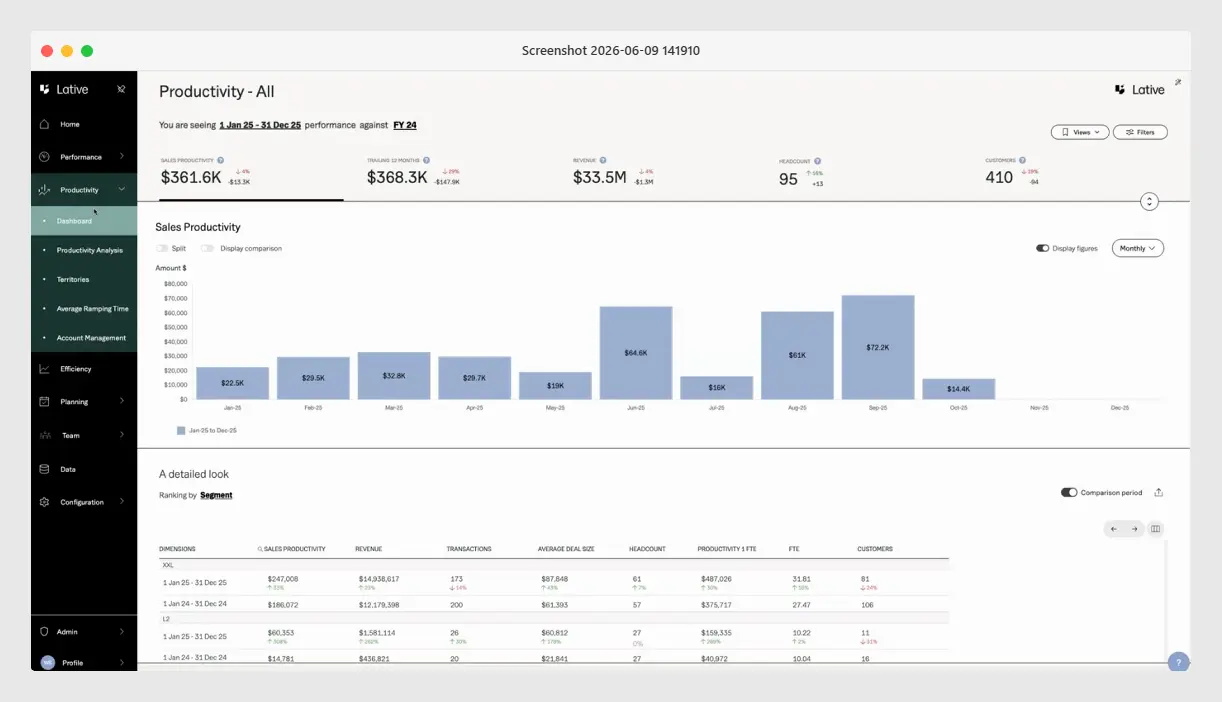
- Productivity computes production per rep from closed-won data, by segment and tenure-adjusted.
- Average Ramping Time derives ramp curves from real hire cohorts.
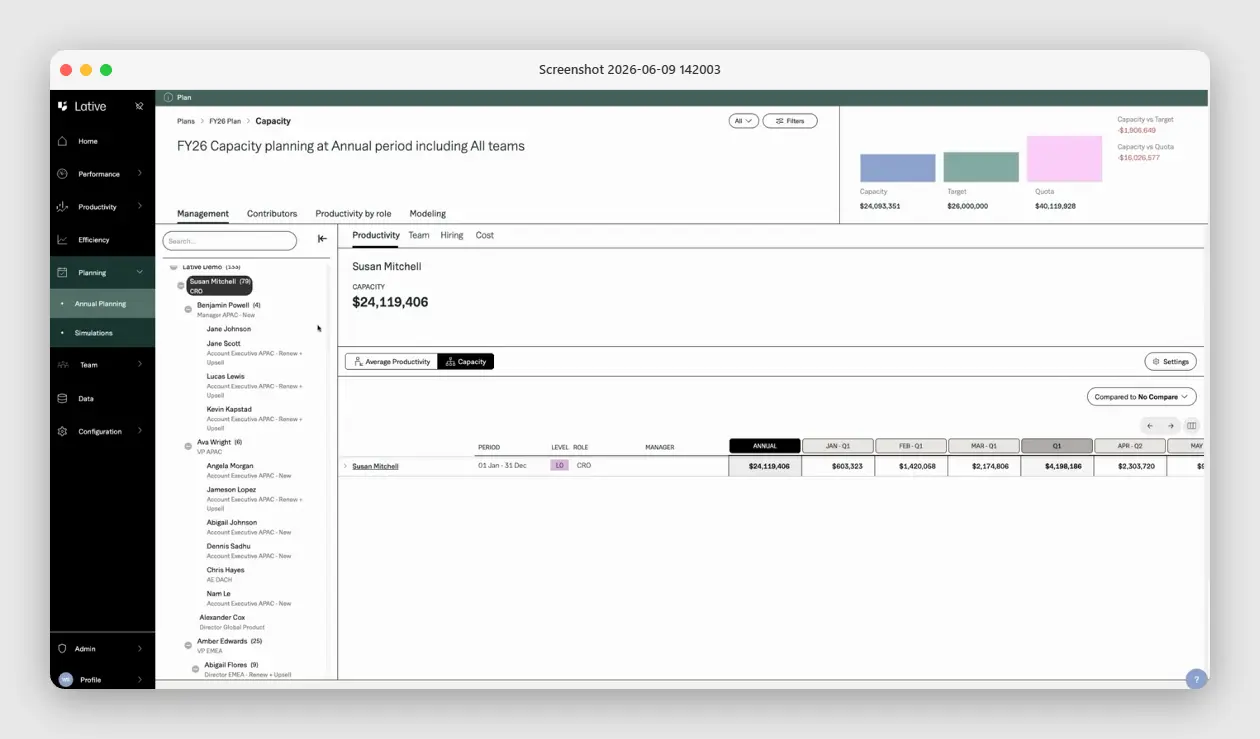
- Capacity turns roster, ramp, and attainment into productive capacity per rep and team.
- Annual Planning reconciles that capacity against target and quota on one screen, with hiring and attrition modeled in the gap.
Quota Modeling and Quota Setting then turn the capacity number into quotas that roll out cleanly. For sales ops, that converts the quarterly planning scramble into a model that is simply always current.
Key takeaways
- Sales ops owns the machine, the systems, data, and planning, so reps spend more of the week selling.
- The planning layer (territory, quota, capacity) is the highest-impact and most-neglected part of the job.
- Every KPI should tie back to capacity, so a forecast slip reads as a pipeline or a staffing problem.
- Build it in order: fix the data, then the forecast cadence, then the capacity model.
Frequently asked
What is sales operations?
The function that designs and runs the systems, processes, and data behind a sales team: CRM hygiene, forecasting, territory and quota design, capacity planning, tooling, and analytics.
Who does sales operations report to?
Usually the CRO or VP of Sales. In larger companies it often rolls into a RevOps leader who owns operations across the full revenue org.
What is the difference between sales ops and sales enablement?
Sales ops owns process, data, and planning, the system. Enablement owns rep skills, content, and training, the competence inside the system. They share onboarding.
When should a company hire its first sales ops person?
Typically around $5M to $10M ARR, when spreadsheets stop scaling and the forecast starts to wobble. The first hire should fix data, then forecasting, then planning, in that order.
What KPIs does sales operations own?
Forecast accuracy, quota attainment and its distribution, stage conversion and cycle length, pipeline coverage by segment, ramp time, productive capacity, and selling-time share.
Is sales operations the same as RevOps?
No. Sales ops serves the sales org; RevOps applies the same discipline across marketing, sales, and customer success. Most companies grow from the first into the second.
Sales operations is not overhead. It is the function that lets everyone else move faster, and the planning layer is where it earns the most. See the full sales capacity planning guide, or book a demo to see the capacity side of the job running live.