
Most go-to-market teams do not have a strategy problem. They have an alignment problem. Marketing measures one thing, sales another, finance a third, and the handoffs between them leak revenue at every seam. Revenue operations, RevOps, exists to fix that, and the performance gap between companies that have it and companies that do not is now one of the best-documented effects in B2B.
The Ebsta x Pavilion 2024 analysis of 4.2 million opportunities found that teams adopting a RevOps-driven approach achieved 87% higher win rates and 21% shorter sales cycles than peers running without that infrastructure.
Gartner predicted in 2021 that 75% of the highest-growth companies would deploy a RevOps model by 2025, and the prediction aged well: the function has moved from nice-to-have to standard in scaling SaaS. This guide covers what RevOps is, what it owns, how it differs from sales ops, the metrics it runs on, when to build it, and the mistakes that hollow it out.
Revenue operations, defined
Revenue operations is the function that aligns marketing, sales, and customer success around one shared process, one set of data, and one view of the revenue engine. It takes the discipline that historically lived in separate silos, marketing ops, sales ops, CS ops, and unifies it end to end, from first touch to renewal.
The goal is simple to state and hard to do: make the whole revenue process run as one system instead of three teams optimizing their own metrics. Marketing optimizing MQLs, sales optimizing stage progression, and CS optimizing tickets can each hit their numbers while the company misses its own. RevOps exists to make that outcome structurally impossible.
What RevOps owns
- Process. The end-to-end revenue process with written stage definitions and clean handoffs: marketing to SDR, SDR to AE, AE to CS. Every leaky funnel audit eventually finds an undefined handoff.
- Data. One source of truth across the GTM stack, so teams argue about decisions instead of whose numbers are right. This is the foundation everything else stands on, and the first thing to fix.
- Technology. The shared tech stack: CRM at the center, marketing automation, engagement, intelligence, and the integrations holding them together. Owning it as one portfolio prevents the three-teams-three-stacks drift.
- Planning. Capacity, quota, territory, and forecast planning that spans the full funnel. This is where RevOps earns its seat: tying marketing’s pipeline promises to the sales team’s capacity to actually work them, and both to the hiring plan.
- Insight. Full-funnel analytics: where revenue is won and lost, which segments convert, what the engine can produce next quarter and at what cost.
A worked example: the handoff leak
Here is what the alignment problem looks like in numbers, in a hypothetical but typical mid-market funnel. Marketing generates 1,000 MQLs a quarter and celebrates a 10% quarter-over-quarter increase. SDRs accept 400 of them, a 40% acceptance rate nobody tracks because it belongs to no one. AEs convert accepted meetings to pipeline at 50%, and pipeline closes at 20%. Net result: 40 deals.
Now fix nothing about volume and fix only the unowned seam: a written MQL definition negotiated between marketing and the SDR team lifts acceptance from 40% to 55%. Same spend, same headcount, 55 deals, a 37.5% revenue increase from a definitional meeting.
That seam is invisible in marketing’s dashboard (MQLs up), invisible in sales’ dashboard (conversion stable), and only visible in the one full-funnel view RevOps owns. Multiply by every handoff in the funnel and you have the RevOps business case.
RevOps vs sales ops
Scope is the difference. Sales operations serves the sales org: its CRM hygiene, its forecast, its quotas. RevOps serves the entire revenue organization and owns the seams between functions, which is where the money leaks.
Most companies sequence it: hire sales ops first around $5M to $10M ARR, then widen the mandate into RevOps somewhere past $20M, when misalignment between marketing, sales, and CS starts costing real revenue. The promotion is not a rename; it is a mandate change, from optimizing one function to owning one process.
The metrics RevOps owns
- Full-funnel conversion. Stage-to-stage rates from first touch through closed-won and renewal, by segment. The diagnostic backbone.
- Pipeline coverage by segment. Open qualified pipeline against target, read against the capacity available to work it. Aggregate coverage hides segment deficits; see what is pipeline coverage.
- Forecast accuracy. Week-one forecast versus actual, tracked by segment and trended. The single best summary of whether the operating system works.
- Quota attainment and distribution. Healthy teams see 60 to 80% of ramped reps at quota. The Bridge Group’s 2024 SaaS AE Metrics Report (170+ B2B SaaS companies) found 51% of AEs hit quota in 2024, which is what unowned planning produces.
- CAC and NRR. Customer acquisition cost and net revenue retention, the efficiency bookends that connect GTM execution to the financial plan.
- Productive capacity. What the revenue team can structurally produce after ramp and attrition, the number every other target should be checked against.
When to build RevOps, and what the first quarter looks like
The common trigger is $20M to $50M ARR, or earlier if the GTM motion is complex: multiple segments, product-led plus sales-led, heavy partner mix. A worked first-quarter sequence for a new RevOps leader: month one, unify definitions, one written dictionary of stages, MQL, SQL, pipeline, commit, signed off by marketing, sales, and CS, because every later fight traces to a definition.
Month two, consolidate reporting onto one funnel view from one data source, retiring the three slide decks that disagree. Month three, stand up the planning layer: a ramp-adjusted capacity model, quota checked against it, and a weekly pipeline-versus-capacity review. Definitions, then data, then planning: each step makes the next one mean something.
RevOps and the AI layer
One more reason the function went from optional to standard: AI in the GTM stack is only as good as the data model underneath it. Forecasting models, deal-scoring, and AI-generated planning targets all train on stage data, conversion history, and attribution records. In a siloed org those inputs disagree with each other, and the AI confidently automates the disagreement.
The unified data foundation RevOps builds is the precondition for any of it to work, which is why companies that invested in RevOps first are the ones extracting real value from AI-native planning now, while everyone else is still arguing about whose pipeline number the model should learn from.
Common RevOps mistakes
Making it a reporting function. If RevOps spends its week building dashboards, the seams it was hired to own go unowned. Reporting is exhaust from good operations, not the engine.
Tool-first thinking. Buying a RevOps platform before unifying definitions automates the disagreement. Process and dictionary first, then tooling.
Leaving planning in spreadsheets. The capacity model, quota sheet, and territory map in three diverging files is the exact fragmentation RevOps exists to end, and it is the most common gap in otherwise mature teams.
Reporting lines that recreate silos. RevOps reporting into sales tends to become sales ops with a bigger title. Report it to the CRO or COO with an explicit cross-functional mandate, or to the CFO where finance discipline is the priority.
How Lative gives RevOps its planning layer
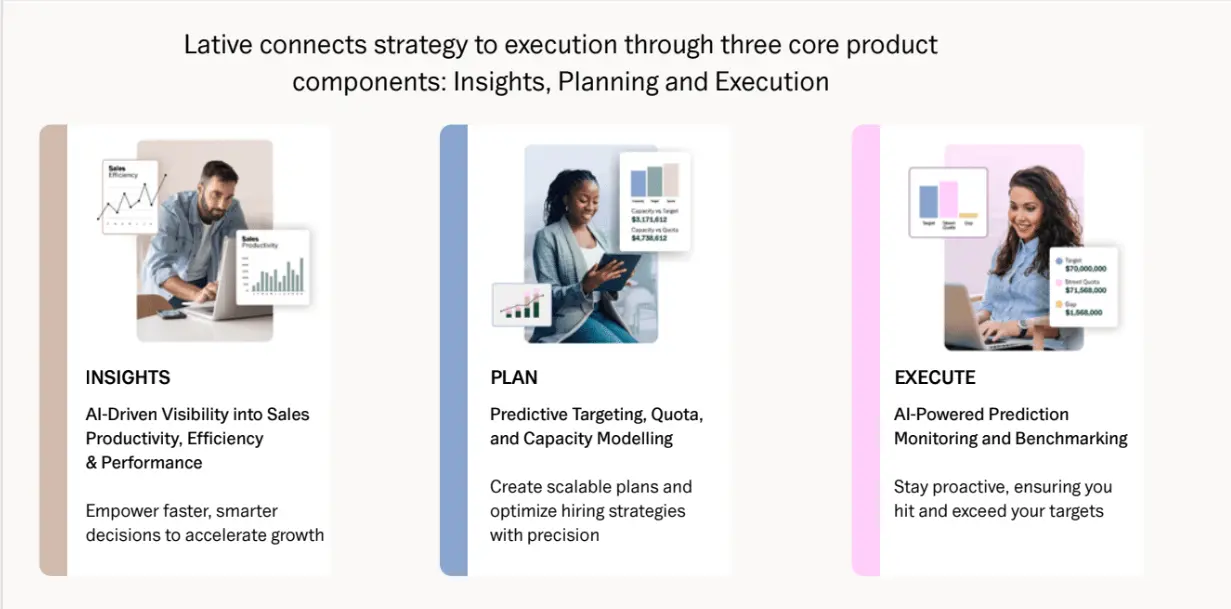
The planning mandate is where RevOps most often lacks tooling, and it is the layer Lative is built to own.
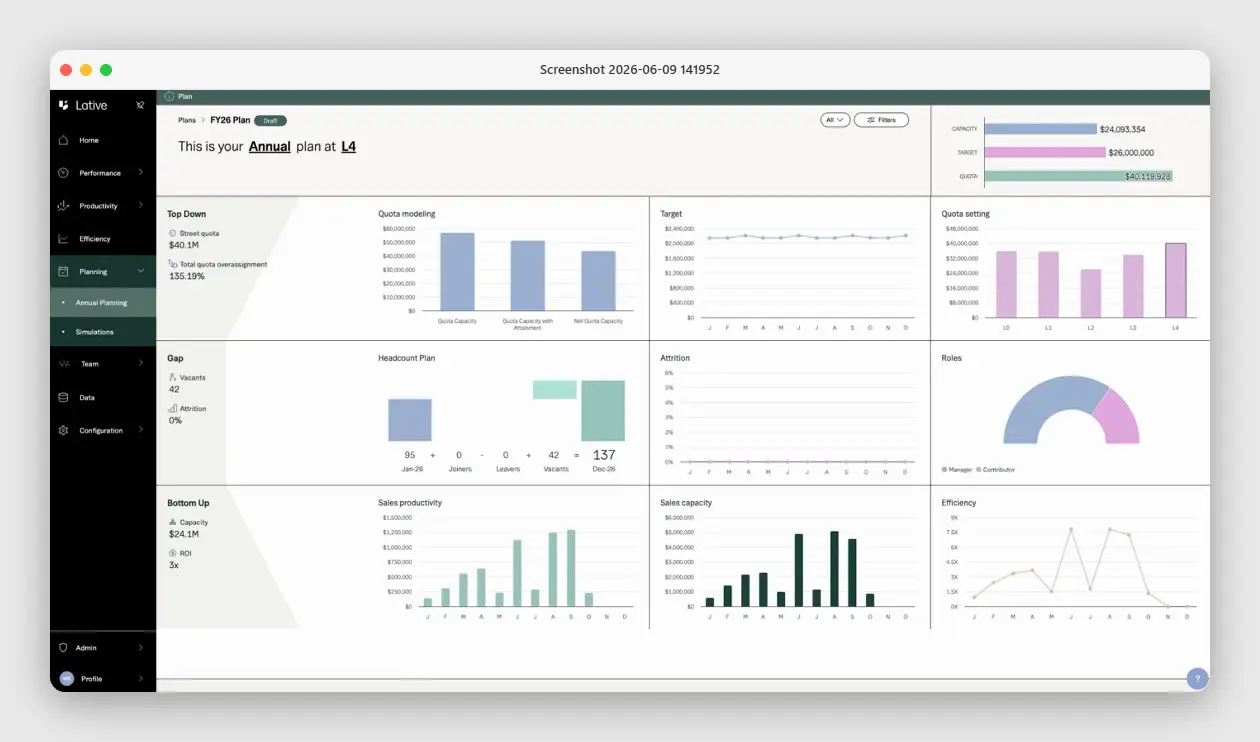
The Productivity module computes production per rep from closed-won data, by segment and tenure-adjusted; Average Ramping Time turns hire cohorts into real ramp curves; the Capacity view converts roster, ramp, and attainment into productive capacity; and Annual Planning reconciles that capacity against target and quota on one screen, with hiring and attrition modeled in the gap.
Quota Modeling and Quota Setting roll the result out as quotas the roster can actually carry, and Simulations answers the what-ifs, hiring timing, ramp compression, initiative lifts, before they are committed. For RevOps, that is the difference between owning planning on paper and owning it in practice: marketing’s pipeline promises, sales capacity, and the hiring plan, finally reading from one model.
Key takeaways
- RevOps aligns marketing, sales, and CS around one process, one data set, and one view of the engine.
- The money leaks at the seams between functions — the only place a full-funnel owner can see it.
- Its planning layer ties marketing’s pipeline promises to sales capacity and the hiring plan.
- Sequence the build: shared definitions, then unified data, then the capacity-grounded planning layer.
Frequently asked
What is RevOps?
Revenue operations: the function that aligns marketing, sales, and customer success around one process, one data set, and one view of the revenue engine, owning process, data, technology, planning, and insight end to end.
What is the difference between RevOps and sales ops?
Scope. Sales ops serves the sales org; RevOps serves the entire revenue organization and owns the handoffs between functions, where most revenue leaks.
Who does RevOps report to?
Usually the CRO or COO; sometimes the CFO where financial discipline is the priority. Reporting into one GTM function tends to recreate the silo it was meant to remove.
When should a company build a RevOps team?
Commonly between $20M and $50M ARR, or earlier with a complex GTM motion. Sequence the build: shared definitions, then unified data, then the planning layer.
What metrics does RevOps own?
Full-funnel conversion, pipeline coverage by segment, forecast accuracy, quota attainment and its distribution, CAC, NRR, and productive capacity.
Does RevOps replace marketing ops and sales ops?
Usually it absorbs them: the specialist roles remain, but they operate one shared process and data model instead of three parallel ones.
RevOps is not a rebrand of sales ops. It is the recognition that revenue is one process, and the planning layer is where that recognition becomes operational. See the full sales capacity planning guide, or book a demo to see the RevOps planning stack live.