
Most sales organisations think they’ve done their sales capacity planning. They haven’t. They’ve done quota capacity planning. That’s a different thing. And mixing the two up is one of the main reasons so many sales teams miss their numbers year after year. Let me break down what each one actually means and why the distinction matters.
Sales Capacity Planning: The Foundation
Sales Capacity is the actual productive output of your sales team.
It’s grounded in reality. Not what you hope the team can do. What they demonstrably do.
The formula is straightforward:
Sales Capacity = Sales Productivity (yield per rep per unit of time) x Headcount
Sales productivity is your anchor. It’s built from historical performance, what a rep in a given role, in a given segment, at a given time actually delivered. Headcount is the number of people available to sell in that same period.
That’s it. No assumptions. No adjustments. Just what the machine produces when it runs. This is the number you should be building your GTM plan on as a baseline.
If you want to go deeper on building the model, this post covers the full framework.
A worked example of the difference
Let me make the two formulas concrete with a hypothetical team, because the gap between them is rarely small. Ten reps. Sales Capacity first: trailing productivity says a ramped rep on this team produces $720K a year, eight reps are ramped, and two are mid-ramp contributing roughly 40% each. Sales Capacity = (8 x $720K) + (2 x $288K) = $6.34M. That is the rock.
Now Quota Capacity: each rep carries a $1M quota, the model assumes 85% attainment and 10% attrition. Quota Capacity = $10M x 0.85 x 0.90 = $7.65M. That is the sand.
The board sees $7.65M and plans spend against it. The machine, running exactly as it has run for the last eight quarters, produces $6.34M. The $1.31M difference is not a performance problem waiting to happen. It already happened, in the planning meeting, months before anyone misses a number. And the assumed 85% was always fiction: The Bridge Group’s 2024 SaaS AE Metrics Report, covering more than 170 B2B SaaS companies, found only 51% of AEs hit quota, and RepVue’s Q2 2025 index of roughly 47,000 rep ratings put average attainment at 42.69%. Most Quota Capacity models assume a number the industry has not delivered in years.
Quota Capacity: The Aspiration
Quota Capacity is different. It starts with what you want to happen, then layers in assumptions to arrive at an expected outcome.
The simple formula looks like this:
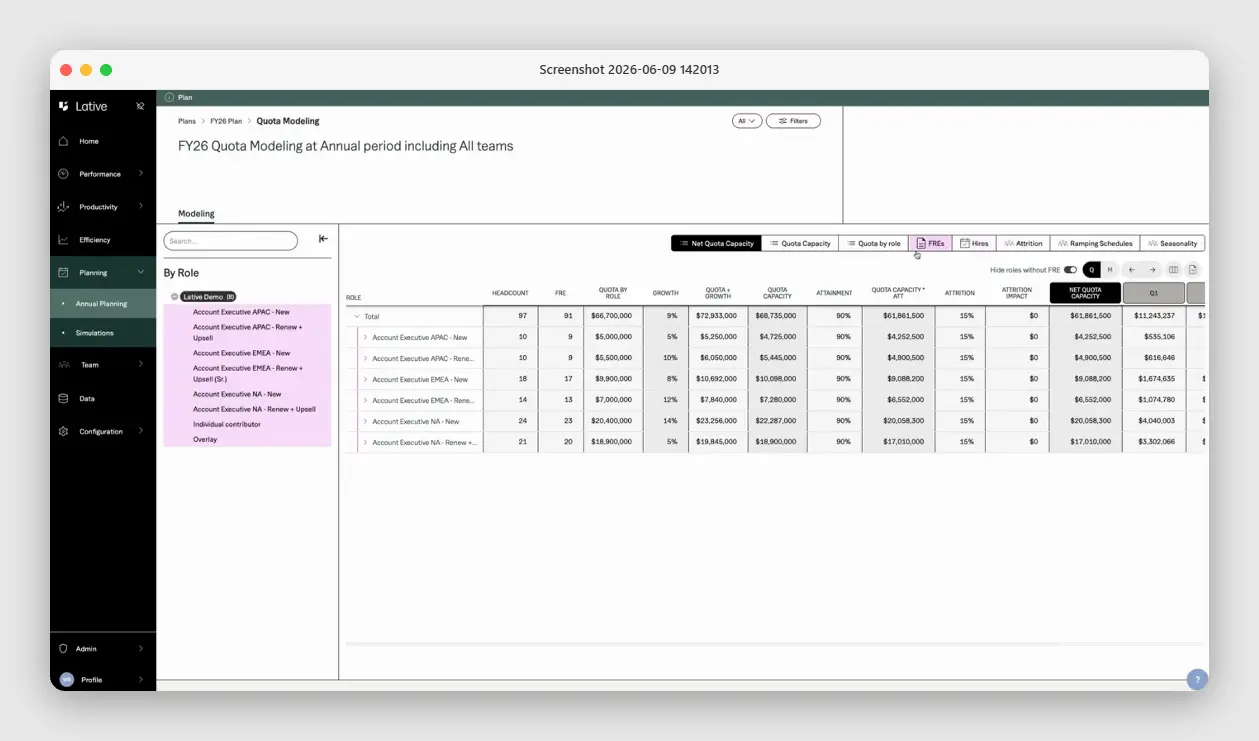
Quota Capacity = Quota x Attainment % x Attrition %
Attainment is assumed. Attrition is assumed. The quota itself is usually set top-down from Finance or the Board, anchored to growth targets rather than what the team can actually produce. Every variable in that formula is an estimate. Sometimes a well-informed one. Often not. Stack three uncertain numbers on top of each other and you shouldn’t be surprised when the result misses. Across the industry roughly half of AEs hit quota at all, and the average rep lands near 43% of their number. Yet most Quota Capacity models assume 80-90% attainment. That gap is baked into the plan before the year even starts.
Where organisations get this wrong
Here’s what I hear constantly when we talk to revenue leaders:
“We’ve done our sales capacity analysis.”
But when you look at what they’ve built, it’s a quota capacity model. They’re using quotas and attainment assumptions as a proxy for what the team can produce. Then they’re using that number to set headcount targets, territory plans, and hiring timelines. The entire GTM plan is then built on sand then and not rock and it’s beyond me on how so many organisations today be it small and large continue to do this given how critical this is to the business.
When the numbers don’t come in, the usual explanations surface. Bad market. Poor execution. Reps underperforming. Sometimes those are true. But often the plan was unrealistic from the start because it was never grounded in actual productivity data.
How to use each one correctly
These aren’t competing metrics. They serve different purposes.
Sales Capacity tells you what the business can actually produce given current headcount and productivity levels. Use it as the baseline for your GTM plan. If your Sales Capacity can’t support your revenue target, you have a gap that needs to be solved before the fiscal year starts, not after.
Quota Capacity tells you what you could achieve under a set of assumptions. Use it as your starting point to see what you can expect the quotas to be by role, segment, etc. It’s useful for scenario planning and for Finance conversations. But treat it as what it is – a projection based on inputs that may or may not hold.
The gap between Sales Capacity and Quota Capacity is where the real work is.
That gap tells you exactly what needs to improve, whether it’s sales productivity improvements per rep, headcount levels, ramp times, or attainment rates, to have a realistic shot at hitting the number the Board is expecting.
GTM leadership teams should be staring at that gap and building a concrete plan to close it. Not ignoring it.
The planning discipline that changes the outcome
Start every planning cycle with Sales Capacity. Lock that number down. Understand it by role, by segment, by region. Then build your Quota Capacity view. Socialise the assumptions. Be honest about what’s baked in. Now you can have the real conversation: here’s what we can produce today, here’s what we need to produce, and here’s what has to change to get there. That’s a plannable problem. It has levers. It can be tracked. For the levers that actually move Sales Capacity such as ramp time, enablement, coverage start here.
What you can’t plan from is hope dressed up as a sales capacity model. It frustrates me so much every time we see it as it’s like a domino effect that then happens within the sales organisation.
The three places the confusion costs you
If you take nothing else from this, watch for the three rooms where the two numbers get swapped. The board room: a deck that presents Quota Capacity as “our capacity” commits the company to assumptions stacked on assumptions, and the correction arrives publicly two quarters later. The hiring room: headcount asks justified by quota math instead of capacity math either over-hire into segments that cannot absorb the heads or under-hire the ones that can, and both errors are expensive in opposite directions. And the comp room: when quotas are set from Quota Capacity that was never grounded in Sales Capacity, the attainment distribution collapses, the comp plan pays almost nobody, and your best people read the math faster than your planning team did. Three rooms, one root cause, one fix: lead every conversation with the number built on what the team demonstrably does.
Running the planning cycle on both numbers
Here is the cadence I push every revenue team toward. Start the cycle with Sales Capacity, built from trailing productivity, real ramp curves, and actual attrition, by role and segment. Lock it before anyone mentions the target. Then build the Quota Capacity view and put the two numbers side by side in one meeting with the CRO, CFO, and RevOps in the room. The gap between them is the agenda: which levers close it, productivity per rep, ramp compression, heads, or an honest target, who owns each lever, and by when.
Then re-run it monthly. Not quarterly, monthly. Hires slip, reps leave, productivity moves, and a gap you see in February is a plan while the same gap in September is an excuse. The teams that do this treat the two numbers as instruments on the same dashboard. The teams that do not are flying one instrument, and it is the one that measures hope.
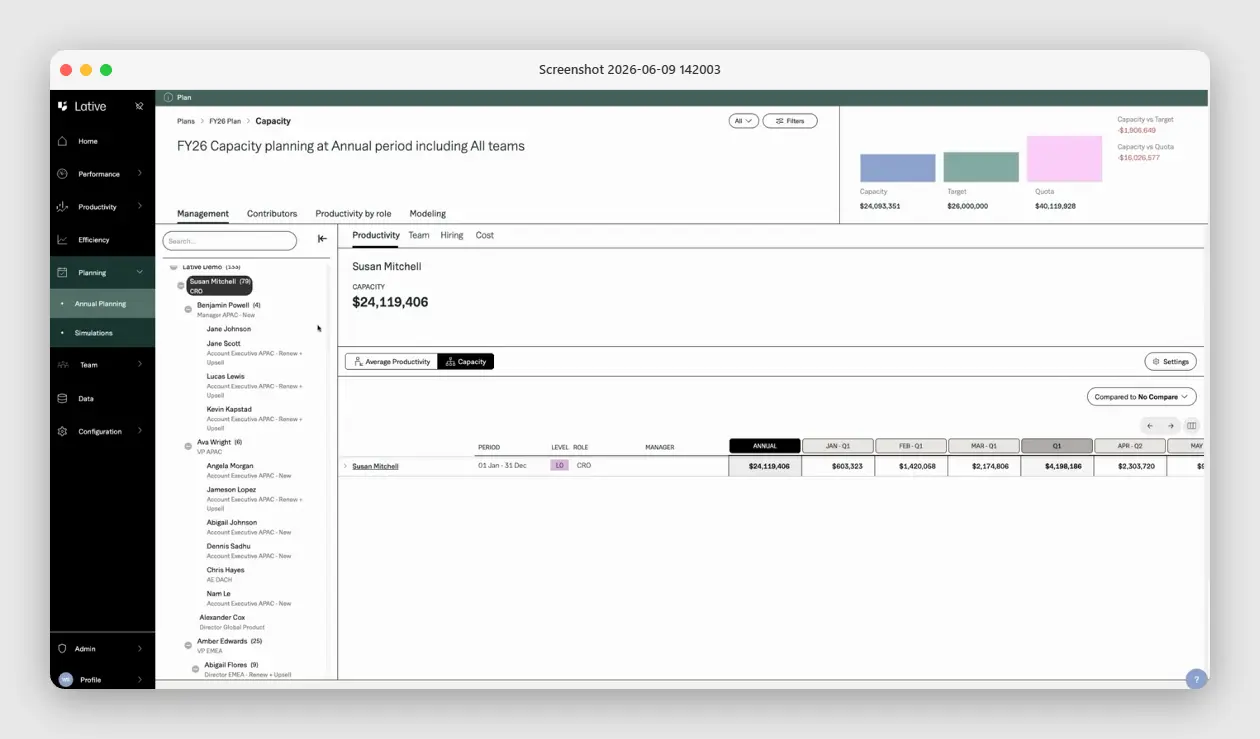
This is exactly what we built Lative to do: the Productivity module computes the real per-rep number from your closed-won data, Average Ramping Time keeps the ramp input honest, and the Annual Planning view holds Sales Capacity and Quota Capacity on one screen with the gap in between, refreshed continuously instead of rebuilt every cycle. The discipline stays yours. The reconciliation stops being a spreadsheet project. The full capacity math is here, and the attainment side here.
Most missed revenue targets have a planning problem at their root. The forecast wasn’t wrong. The plan was wrong. And the plan was wrong because it was built on quota assumptions instead of sales capacity reality.
And if you want the simplest possible test of which model your organisation is really running: ask three leaders, separately, what the team’s capacity is for next quarter. If you get three different numbers, or three versions of the quota restated as capacity, you have your answer, and you have your starting point.
Fix the foundation first, build on rock and not sand.