
Until recently for many B2B sales teams, not having enough sales capacity wasn’t a problem as you would just hire ahead of the expected growth ‘growth at all costs’. This was inefficient as it meant bringing costs into the business and lowering your sales productivity (yield per rep per unit of time) and return on investment (ROI). Now with the shift to efficiency and profit adjusting to the new normal of sustainable growth has been painful. So how do you know whether you have enough sales capacity to ensure you hit your numbers, while avoiding over- or under-hiring or being forced to make uncomfortable cuts?
Here’s an all-too-common scenario. Your headcount plan looked right in Q4. By Q2, you had a gap you couldn’t explain. Two reps had left, three new hires were still ramping, and the capacity assumptions baked into the annual plan were already stale. Nobody had updated the model.
That’s not an execution failure. That’s a planning failure, and it’s more common than most revenue leaders want to admit. Gartner’s 2026 Budget Assumptions survey found that 64% of CFOs are planning for SG&A budgets to grow more slowly than revenue, meaning sales organizations are expected to produce more with tighter headcount. Knowing exactly what your team can deliver, and when, has never mattered more.
In the previous posts in this series, I shared industry best practices for measuring, managing and elevating your sales performance and efficiency, using sales productivity as the foundational KPI.
Now we can use what we learned to go even deeper and look at how you can build and tune your sales capacity plan with precision and confidence to know what investments and adjustments to make to your sales organization and when you need to make them.
Read on to learn more about how to measure and predict your sales capacity and build revenue-efficient capacity plans.
JUMP TO EACH SECTION TO LEARN MORE
- Understanding sales capacity
- Why sales capacity is so important
- How to build an accurate sales capacity plan
- Real-world illustration: How ramp time can affect sales capacity
- Insights from accurately predicting sales capacity
- Top ways to ensure you have enough sales capacity to hit your targets
- Optimize the horsepower of your revenue engine
Understanding sales capacity
The fundamental question we’re asking when we start to look at sales capacity and build annual capacity plans is: What does the sales organization need to look like to ensure we hit our numbers for the upcoming year?
In the past, I’ve had a very simplified way to figure out what quotas should be for the sales organization. I’d look at what the sales target was that we were given by finance, how many salespeople did we have, divide one by the other, and that’s what the quotas needed to be. Fundamentally, that’s what we’d need each salesperson to produce to hit the number, ignoring any overassignment that would be applied.
The struggle with this approach was figuring out how many salespeople we needed to hire beyond the existing team and when to hire them. And so, over the years, I developed many custom spreadsheet models to help me figure this out.
Defining sales capacity
Let’s get a bit more specific and define what we mean by sales capacity. In simple terms, sales capacity is a prediction of a sales team’s ability to deliver on revenue based on available/expected head count and productivity.
What’s really important here is that you need to be able to accurately predict what the current sales team is capable of delivering today and in the future. And then if you add people to the team or remove them, or add strategic initiatives, what impact does that have on what the team can deliver and how does that measure up to the plan for the year?
Why sales capacity is so important
Simply put, predicting your sales capacity enables tactical and strategic planning. You can start to review your planned hiring, investment, and improvement initiatives and begin to predict and simulate their impact on your future capacity.
I remember back when I was running sales operations at Websense (now Forcepoint), every year I was told that sales productivity needed to go up by 10% with no additional funding. It’s interesting when you start to look at that to see where you’re going to find that 10%.
Maybe you’ll get some lift in productivity from a new enablement program. Maybe you’re rolling out a new engagement platform or forecasting platform that will give you some more lift. You start to allocate 2% here, 2% there and so forth . But this was really hard to model, especially in spreadsheets and these allocations were really only guesses rather than precise, data-driven predictions.
Those times have changed; we need to be far more precise and align with the strategic initiatives that are going to drive these types of productivity improvements. To do this, you need to use bottom-up operational data points to be very clear and confident in predicting where you’ll see those lifts. And once you’ve done that, you need to measure the lift against these predictions so you can course-correct if they diverge.
How to build an accurate sales capacity plan
So now that we understand exactly what sales capacity is and why it’s so important, let’s take a look at how to build an accurate sales capacity plan.
The figure below is from a recent Gartner research paper that gives a good view of all the high-level factors that can influence sales capacity and which can be used as inputs to build a sales capacity plan. We’ll cover these and other inputs in more detail below.
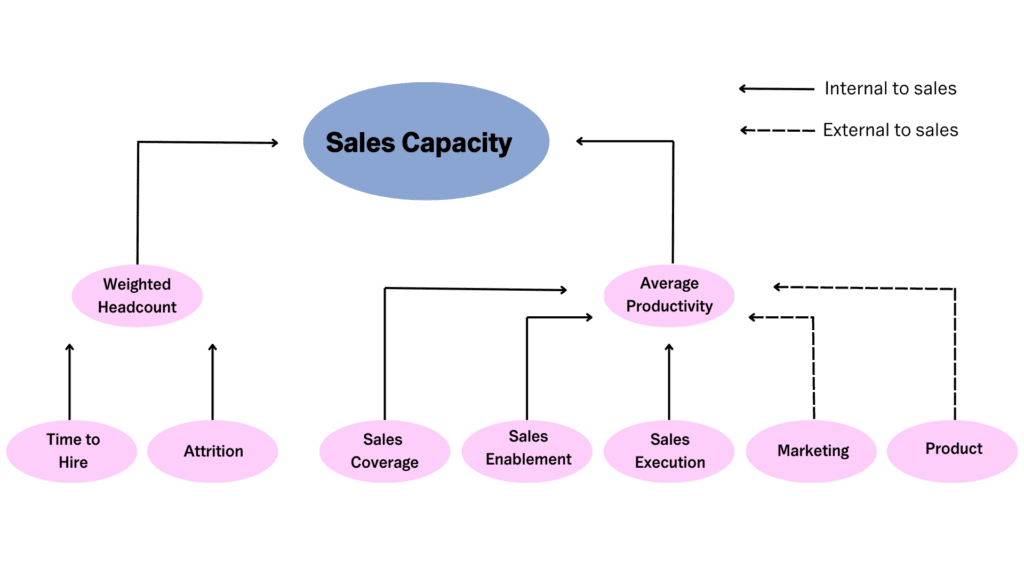
Why Sales Capacity Matters. Gartner, 2020.
Weighted sales headcount
First, you need to look at how many salespeople in full-time equivalent (FTE) terms are actually able to sell in each dimension (i.e. regions, market segments, types of business, product lines, etc.) of your sales organization.
Let’s break this down into more detailed inputs, including some not shown in the figure above, as each can be important to ensuring a high level of accuracy.
1. Time to hire
- You need to allow lead time for hiring new sales people, the more accurately you’re able to measure recent hiring lead times, the better, as it will help you evaluate whether your hiring plans are realistic
- You should also track start dates for new team members to help you accurately measure ramp time (more details below)
- As with ramp time, understanding your time to hire in days based on your recent hiring efforts rather than using rough estimates is very important
2. Ramp time
- If you’re going to add more sales heads in the upcoming year, once you’ve hired them, you need to factor in how long it takes for them to ramp up to average productivity
- You should be aiming to measure ramp time as accurately as possible, right down to the number of days, rather than an estimate in weeks or months, as is done today in so many organisations.
- Every day matters, and knowing this will give you a much more accurate prediction of exactly when new sales heads will start to contribute towards your targets and get to average productivity
- More granular measurement of ramp times is also very valuable information for your sales enablement team to be able to see if their efforts are driving faster ramp times for each new salesperson
3. Attrition
- Factoring in attrition and expected attrition is also very important
- Even a small percentage of attrition creates a productivity deficit that you’ll need to fill
- Needs to be done at the salesperson’s level for accuracy
4. Additional inputs
- You should also account for variances like vacation, maternity leave, transfers, hybrid roles, and other factors, all of which can have significant impacts on sales capacity throughout the period you’re looking at depending on the size and rate of change of your organization
Average sales productivity
I recently wrote an in-depth post on how to accurately measure sales performance. In it I describe why sales productivity is the most accurate and objective way to measure performance and include an advanced formula on how to measure productivity the right way.
If you’re interested in seeing details of the advanced formula for measuring productivity, I’d encourage you to read the previous post here.
Below, we’ll take a high-level look at some direct inputs internal to sales that can affect sales productivity.
1. Sales coverage
- Your sales coverage strategy should take into account your target customer segment(s) and align the structure and size of the team to maximize the number of prospects you can reach
2. Sales enablement
- Sales enablement is a key function and the iterative process of providing your organization’s sales team with the Skills, Mindset and Structures resources they need to close more deals
- These resources may include content, tools, knowledge, and information to effectively sell your product and/or services to customers
- The effectiveness of your sales enablement is a major factor in driving sales productivity and can also affect how long it takes to ramp new salespeople
3. Sales execution
- Sales execution is the sum of the activities and processes that a team applies to guide a lead through the sales funnel and close business
- Improving sales execution drives increased sales productivity and capacity
Now, let’s take a look at some of the inputs external to sales that can influence average sales productivity and team capacity.
1. Marketing
- The efficiency and effectiveness of your marketing demand generation can be a big influencer
- If your marketing is working well, your team will be able to generate higher levels of productivity, which will translate into more sales capacity
2. Product
- The efficiency and effectiveness of your marketing demand generation can be a big influencer
- Improving and enhancing existing products and/or releasing new product lines or add-ons can give your sales team a better ability to retain and upsell existing customers and/or win new customers
Real-world illustration: How ramp time can affect sales capacity
Now we’ll use one of these more detailed inputs, ramp time, to illustrate how much they can affect your predicted sales capacity.
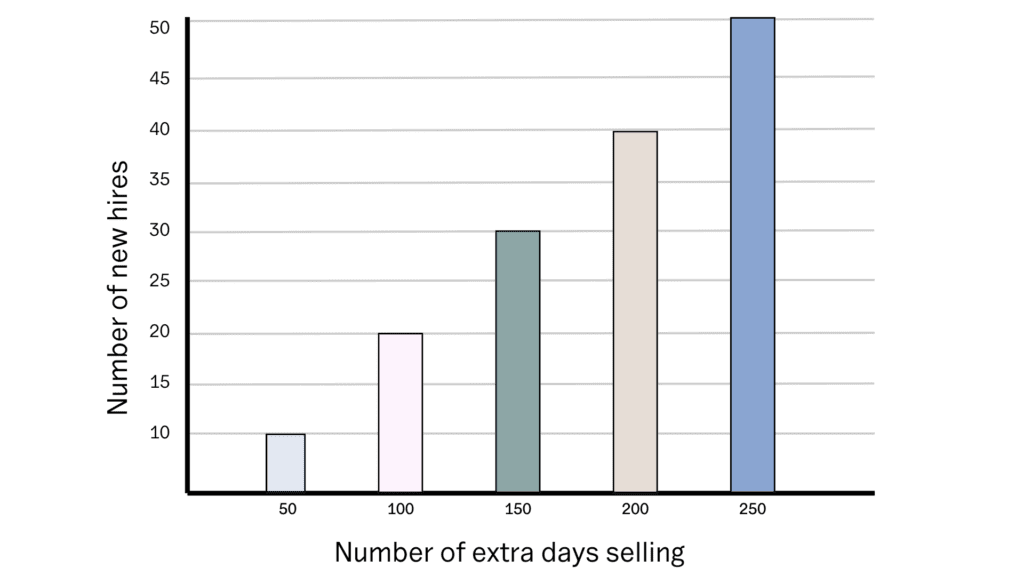
Let’s say you can improve ramp time for a new salesperson from 90 to 85 days. A 5 day improvement doesn’t seem like a big difference, but let’s say you hire 5 people over the course of a year. Now your improvement is 25 days. That’s more than a month of additional selling that you could have done.
If we apply that to a larger sales organization, who might hire 50 new people over the course of a year, that’s 250 extra days of selling.
Going back to my time running sales enablement at Sage, we had 2,500+ salespeople and a lot of people coming and going in multiple regions. We needed to onboard a large number of salespeople each year who were selling in the high velocity and Mid-Market segments, and through a completely redesigned onboarding program that focused on High Performance Learning Journeys , we reduced the time to average productivity from 155 days to 92 days and when you multiply those days saved by 150+ reps each year, it’s a significant lift in sales productivity for the company.
Sales capacity plans are only as accurate as the inputs you provide them
Companies invest so much time and money in finding and hiring the right people and getting them onboarded and enabled. The programs we ran at Sage, Citrix, Aruba Networks and even Websense in the early 2000s were extensive and the teams, tools and content behind delivering them were a big investment.
When you’re making investments like these, why do we think it’s okay to just guess that ramp times are “about 3 months” or that we will see a 5%+ lift for a particular strategic initiative? At Lative, we don’t think that’s good enough; we believe you need to know ramp times down to the number of days and exactly what the productivity lift will mean in dollars for each salesperson.
What may seem like small improvements or setbacks can add up and become meaningful. They can be the difference between hitting or missing your number. When you’re able to track these inputs more accurately, you will get your capacity plans right and hit your numbers more consistently.
It always happened to me in the past that at the end of the second quarter, we had a gap and I could not figure out why, as we thought we had done everything right in the planning phase. The problem was we were not accurately predicting the impact of new hires and the strategic initiatives, and once we started doing this correctly, we were able to create far more accurate capacity plans.
Insights from accurately predicting sales capacity
So now that you know how to predict sales capacity with high accuracy, let’s review some of the key insights and benefits you gain.
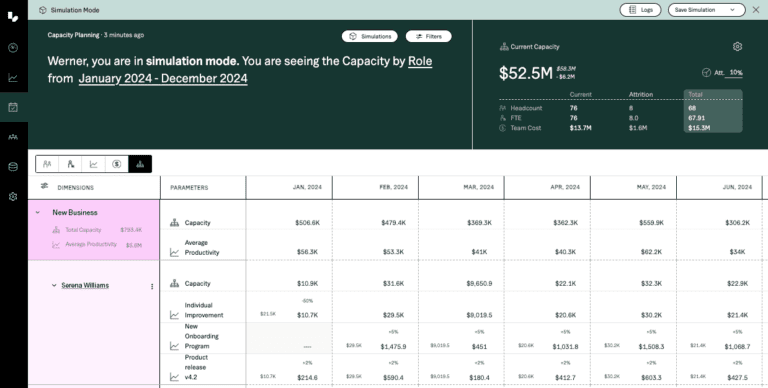
1. Aids investment, hiring and coverage model planning
- A better understanding of your current and future capacity helps you more confidently decide where and when to hire
- Showing the bottom-up data behind the plan enables a far richer conversation with finance teams and helps justify any changes to the plan and/or budget based on how they will affect your ability to hit the targets that have been set
2. Predict potential divergences from the plan
- By tracking execution against the plan continuously throughout the year as changes happen in the business, you get early visibility on potential divergences
- This gives you the ability to course correct if needed to ensure you’ll still hit your number
3. Helps set realistic guardrails for quotas
- It helps you think about what the right quota levels should be and we will talk about this morning in a future blog
- Helps you think about how quotas should roll out over the course of the year based on your hiring plans and what the mix of business should look like
4. Helps to validate forecasts
- You can compare your predicted sales capacity to the sales forecasts to see how well they match up and if there are any gaps to be concerned about
Top ways to ensure you have enough sales capacity to hit your targets
With better visibility into your sales capacity, you can start making more confident decisions about the investments and adjustments you need to ensure you hit your targets.
1. Hire salespeople in the right places at the right times
The most expensive hiring mistake is a mistimed one. Bringing on five reps in Q1 when your ramp model shows they won’t reach average productivity until Q3 creates a capacity illusion. The headcount is there on paper but the output isn’t.
Accurate capacity planning tells you not just how many people to hire, but also when they need to start to contribute within your planning window. It also helps you make the case to the finance team. 65% of sales leaders struggle to adapt strategic plans in the face of sudden change, according to Salesforce’s State of Sales report. Showing the bottom-up data behind your hiring request shifts the conversation from a budget negotiation to a revenue discussion.
Avoid over- or under-hiring by anchoring every headcount decision to your current productivity baseline and projected capacity gap, not to last year’s plan or an industry rule of thumb.
2. Invest in enablement and onboarding
Enablement is a capacity lever, not just a training function. Every day you shave off ramp time is a day of productive selling recovered. At the team level, that compounds fast.
The Sage example earlier in this post illustrates it precisely: reducing time to average productivity from 155 days to 92 days across 150+ reps per year is a material capacity gain, not a marginal one. The total cost to ramp a new sales rep is estimated at three times their base salary, including recruiting and training costs. Investments that measurably shorten that window pay back quickly.
The key is measuring the impact. If you can’t track ramp time to the day and attribute changes to specific enablement programs, you’re guessing at the ROI. That’s where most enablement budgets get cut: not because they don’t work, but because the evidence isn’t there when finance asks.
3. Increase productivity through cross-functional initiatives
Capacity gains don’t only come from headcount. Some of the highest-ROI improvements come from removing friction elsewhere in the system.
Marketing that generates a higher-quality pipeline means your reps spend less time on poor-fit accounts and more time closing. Product improvements that increase retention reduce the pressure on new business capacity to compensate for churn. Pricing or packaging changes that increase average deal size can shift your productivity per rep without adding a single hire.
When you’re modelling capacity, these initiatives should appear as explicit inputs with projected lift values, not as qualitative notes in a slide deck. A 5% productivity improvement across 40 reps is 2 FTE worth of capacity. If a cross-functional initiative can credibly deliver that, it belongs in the plan with the same rigour as a hiring decision.
Build a feedback loop. Set the expected lift before the initiative launches, measure against it monthly, and course-correct if actuals diverge. That’s what turns strategic initiatives from aspirational to operational.
Optimize the horsepower of your revenue engine
Sales capacity planning shouldn’t be a once-a-year exercise. It’s something you should be doing regularly throughout the year, as businesses move too fast now. Continuous Planning helps you to continuously calibrate your revenue engine’s output so that it has enough horsepower to hit your sales targets without breaking the bank.
As someone who has been leading revenue operations teams for over 20 years, I know just how hard this can be. That’s why my co-founder, Laura, and I started Lative. Lative automates the hard parts of this process so that you have an always-on, accurate, real-time view of the performance, efficiency and capacity of your sales team. It shows you what’s happening in your revenue engine so that you can focus on understanding why and deciding what to do about it.
To learn more, request a demo, contact us or install a free 30-day trial from the Salesforce AppExchange today. We’d love to hear from you!