
After spending two decades in Revenue Operations, I’ve seen firsthand how companies often struggle to strike a balance between growth and operational efficiency. It’s a fine line to walk. On one side, there’s the pressure to hit aggressive growth targets driven from the leadership teams and Board laser-focused on top-line revenue. On the other side, there’s the need to manage costs, ensure teams are performing optimally, and make sure growth is sustainable for the long haul.
Companies can no longer afford to prioritize growth at all costs. The focus has shifted to growing efficiently — scaling in a way that optimizes resources, maximizes return on investment (ROI), and minimizes waste. However, too many companies still make the same costly mistakes when it comes to growing efficiently. Whether it’s over-reliance on quotas, not understanding current productvity levels and capacity, underestimating things like ramp times for new hires and not fully understanding the cost of their sales efforts, these missteps can lead to significant inefficiencies that hinder long-term success.
In this post, I’ll dive into four of the most common mistakes I’ve observed across the industry and how companies can better navigate these challenges to ensure they grow efficiently—not just quickly. When these areas are overlooked, businesses risk burning out their teams, over or under-hiring, and ultimately failing to achieve the sustainable growth they’re striving for.
1. Not understanding current Sales Productivity levels
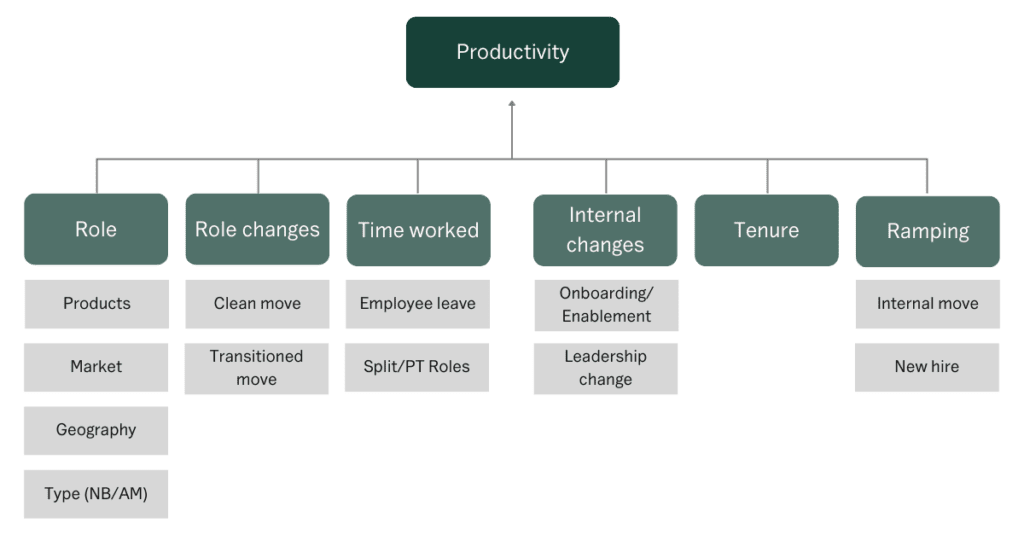
Very few organisations today understand their current sales productivity levels! When I talk about productivity, I mean how much a salesperson produces on average over a given period of time.
The data reflects this. Up to 70% of B2B reps missed quota in 2024, according to the Ebsta B2B Benchmark Report, yet 79% of sales organizations reported revenue growth in the same period. That contradiction is what happens when you manage to top-line revenue without understanding the underlying productivity driving it.
Measuring sales productivity does more than just provide a snapshot of revenue generation; it reflects the operational health of the sales organization. It gives you an accurate and objective view of where you stand and the ability to make well-informed strategic decisions to elevate performance.
Understanding and measuring sales productivity with precision is the foundation to building a high-performance sales engine. Through a well-structured approach to continually analyzing sales productivity in real-time across various business dimensions, you gain actionable insights. This enables not only clarity on where your sales organization stands today but is also the core foundation for a cycle of continuous planning that informs tactical and strategic decisions moving forward.
I believe that without fully understanding productivity at a granular level we can’t answer the 3 key questions we need to be able to answer as a Rev Ops leader:
- Will we hit our number?
- How will we hit our number?
- How will we do it in the most efficient way?
Whether you’re making investment and hiring decisions, identifying areas for optimization, aligning resources, or evaluating the impact of new initiatives, a robust analysis of productivity serves as a critical sales performance management tool. It positions you and your sales team to hit your targets and achieve sustained success.
2. Over-reliance on quotas as a measure of success
Quotas are the go-to tool for sales planning, but they are far from a perfect measurement. The problem lies in how quotas are typically derived. Companies often set them by dividing the company’s overall revenue target by the number of salespeople. This might seem logical on the surface, but it ignores important factors like current productivity levels, ramp times, regional differences, attrition rates.
In my experience, treating quotas as the primary measure leads to two major issues. First, it creates a false sense of achievement or failure. For instance, salespeople in higher-yield markets might meet their quotas more easily, while those in lower-yield regions struggle—despite putting in the same or even greater effort. Quotas don’t reflect the full picture of productivity or effectiveness so you may be hiting your quotas but missing the target
Second, quotas don’t always account for over-assignment, where companies assign a higher sales target to offset potential underperformance or attrition. While over-assigning is needed, it becomes problematic when not tied to the sales productivity data. The better approach is to align quotas with realistic sales productivity levels and growth projections that factor in ramp times, hiring patterns, and market conditions.
But while quotas set the direction for growth, they’re only as good as the people behind them. This brings us to the third common mistake: underestimating ramp times.
3. Underestimating ramp times—and the impact it has on your bottom line
One of the most misunderstood concepts in sales planning is ramp times—the period it takes for a new salesperson to reach full productivity. Many companies assume that ramp time is around six months. But the truth? It often takes six to nine months for a salesperson to reach full productivity, with some not hitting their stride until month 10 or later. It also depends what segment as Entperise sales reps will take longer to ramp than SMB reps as the sales process is usual less complex.
The benchmarks bear this out. Average ramp time for SaaS and technology sales has reached 5.7 months in 2025, up from 4.3 months in 2020: a 32% increase in just four years. Enterprise B2B roles stretch further still, with ramp times of 9 to 12 months due to complex sales cycles and multiple stakeholders. Most capacity models don’t account for this trajectory. They assume a new hire is productive far earlier than the data supports.
That’s a long runway for any organization, and it requires significant investment. Sales enablement teams, product experts, marketing teams—all need to spend time onboarding and training these new hires. If you’re hiring aggressively without a clear understanding of how long it takes for these salespeople to ramp, you’re essentially guessing or building in buffers that can be expensive mistakes.
For example, I’ve seen companies invest heavily in rapid expansion, only to find themselves letting people go six months later because the expected revenue didn’t materialize. This cycle can be avoided if there is a laser focus on ramp times and what happens during each phase of the ramp process. Tracking this in real-time can help refine your hiring and onboarding programs, reducing ramp times and improving efficiency.
The cost of getting this wrong is significant. The total cost to ramp a new sales rep is estimated at three times their base salary, including recruiting and training costs. Multiply that across a cohort of mis-timed hires and the financial impact compounds quickly.
Moreover, if ramp times are measured consistently, you can forecast your sales capacity and revenue more accurately . It also allows you to plan your growth better and invest resources in a way that maximizes ROI. And this leads us to another critical aspect of growth efficiency: cost efficiency.
4. Ignoring the critical importance of Return on investment (ROI)
Growth at any cost is no longer a sustainable strategy. While rapid expansion might boost short-term results, long-term success requires a careful balance between growth and efficiency. One of the key metrics often overlooked is ROI cost efficiency—understanding the cost of your sales team relative to the revenue generated.
Return on investment isn’t just about headcount costs, it’s about determining whether your team is delivering the revenue needed to justify their cost. This is particularly important as your business scales. In one case, I worked with a company that invested heavily in an SMB sales segment. It took nearly two years to realize the returns didn’t justify the investment. If we had better real-time data, we could have reallocated resources sooner and faster on more profitable segments like Mid-Market and Enterprise.
Having a clear baseline for ROI is essential. Many companies aim for a 3-5:1 ROI on their sales investments, but the actual return can vary across segments and regions. If you’re not constantly analyzing your ROI, you may find that certain parts of your organization are underperforming—and dragging down overall profitability.
And ROI isn’t just about numbers—it informs your entire hiring and investment strategy. Which leads us to one of the most critical and misunderstood areas: capacity planning.
5. Inaccurate Capacity Planning
Capacity planning or Productive Capacity is perhaps one of the most crucial—and most frequently misunderstood—elements of growing a revenue organization efficiently. Without a deep understanding of your productive capacity which is driven by your current sales productivity levels, attrition, ramp times and importantly strategic initiatives impact, most companies are flying blind when it comes to capacity planning. This often leads to over or under hiring or hiring people in the wrong places.
In many cases, companies hedge their bets by over-hiring to build in a buffer. The problem with this approach is that it’s extremely expensive. Let’s say you hire ten salespeople, but you only needed 8 when reviewing the sales productivity levels. The cost of those additional heads quickly adds up, and you’ve effectively thrown away hundreds of thousands in hiring costs and that’s not factoring in the Onboading costs.
Instead, capacity planning needs to be based on real-time data about your team’s current sales productivity, attrition, ramp times and importantly, strategic initiatives. If you know, for example, that it takes six months for a new hire to hit their stride, you can then project how much revenue they’ll generate in month six vs. month nine. This allows you to build a more accurate sales capacity model and make better more informed hiring decisions.
Accurate capacity planning also helps optimize resource allocation. Productivity can vary widely across regions, segments and product lines. For instance, a salesperson in North America might generate more revenue per head than one in Europe. Understanding these differences allows you to make informed decisions about where to invest and where to pull back.
And when you integrate all these factors—sales productivity, quotas, ramp times, return on investment, and capacity planning—you begin to build a more cohesive, data-driven approach to growth.
Achieving sustainable growth through efficiency
- Ultimately, the difference between organizations that grow successfully and those that struggle lies in their ability to optimize growth without sacrificing efficiency. Over the last 20 years, I’ve seen many companies make the same mistakes over and over again —relying too heavily on quotas and not understanding their current sales productivity levels, underestimating ramp times, ignoring ROI, and not fully understanding how to build accurate sales capacity plans. These inefficiencies not only drain resources but also limit a company’s potential to scale sustainably.Growth should never be a guessing game. By leveraging real-time data, refining how you measure productivity, and ensuring your teams are set up for success from day one, you can transform your revenue operations into a powerful engine that drives both profitability and long-term success. It’s about making informed decisions that consider not just immediate growth, but also what it takes to sustain that growth over time.
In today’s economic climate, every hire, every investment, and every plan must be rooted in data-driven strategies that optimize both efficiency and effectiveness. Companies that understand and address these five critical areas— sales productivity, quotas, ramp times, return on investment, and capacity planning—will find themselves better equipped to weather market shifts, scale intelligently, and drive meaningful revenue growth.
By treating these factors as interconnected pillars of your growth strategy, you’ll be better positioned to build a revenue organization that scales efficiently. The future belongs to organizations that know how to do more with less, maximizing their resources and minimizing their risks. And it starts by getting these fundamentals right.
Implementing a revenue planning automation platform can significantly streamline your planning process, saving time, reducing errors, and enhancing overall efficiency. Automation tools like Lative orchestrate complex planning activities by connecting the top down plans with bottoms up operating data to have a cohesive overview of the organisation. This not only speeds up the decision making process but also minimizes human error and ensures consistency across all planning stages.
Regardless of your company’s stage, you need a revenue planning framework. By implementing the strategies discussed you can significantly streamline this process and produce plans that are realistic, attainable and build healthy high performing organisations.
If you’d like to learn more about Lative, please visit our home page, book a product demo, or reach out to our team. We’d love to hear from you!
About the Authors
Werner Schmidt and George Erskine
Werner Schmidt, CEO and Co-founder of Lative, has over 20 years of experience in Revenue Operations with companies like Forcepoint, Aruba Networks, Citrix, and Sage.
George Erskine, advisor at Lative, has led Revenue and Sales Operations for companies like Adobe, Saba Software, Propel Software, and SolarCity.