
Sales scenario planning is how you stop betting the year on a single forecast. Instead of one number, you model best, base, and worst-case outcomes and decide what you would do in each.
The single-number habit is expensive: RepVue’s Q2 2025 Cloud Sales Index (roughly 47,000 reps across 246 companies) put average quota attainment at 42.69%, and most of those plans had no documented response for the downside that actually arrived. This guide covers the three what-if models every plan needs, a worked example, and how to build your first scenario model this week.
Key takeaways
- Sales scenario planning replaces a single forecast with three pressure-tested versions of the plan, so the team knows its response before reality forces one.
- Base, best, and worst cases are enough. More scenarios add complexity without adding insight.
- Sensitivity analysis tells you which variable matters most. Scenario analysis tells you how those variables interact. Most teams need both.
- The output is not the model. It is the documented trigger and response for each scenario, agreed before the quarter begins.
- Scenarios that take days to rebuild in spreadsheets get run once. Scenarios that take seconds in a connected planning tool get run as a habit.
What sales scenario planning is
Scenario planning builds multiple versions of your sales plan under different assumptions, then pressure-tests your response to each. It replaces a vague hope of hitting the number with a concrete plan for what to do if you are tracking 20% behind by April.
The three what-if models every plan needs
1. Base case
Your most likely outcome, built bottom-up from current capacity, ramp, and pipeline. This is the number you commit.
2. Best case
What happens if hiring lands early, ramp beats plan, and win rates hold. Useful for knowing whether you could pull next year’s growth forward, and what capacity you would need to support it.
3. Worst case
What happens if two reps churn, a segment softens, or ramp slips. The point is not to be gloomy. It is to know your triggers and your response before you are in it.
Why spreadsheets struggle with scenarios
Running real scenarios means changing dozens of linked assumptions, headcount, ramp, win rate, cycle length, and seeing the roll-up update instantly. Spreadsheets turn that into hours of manual rework, so most teams model one scenario and hope.
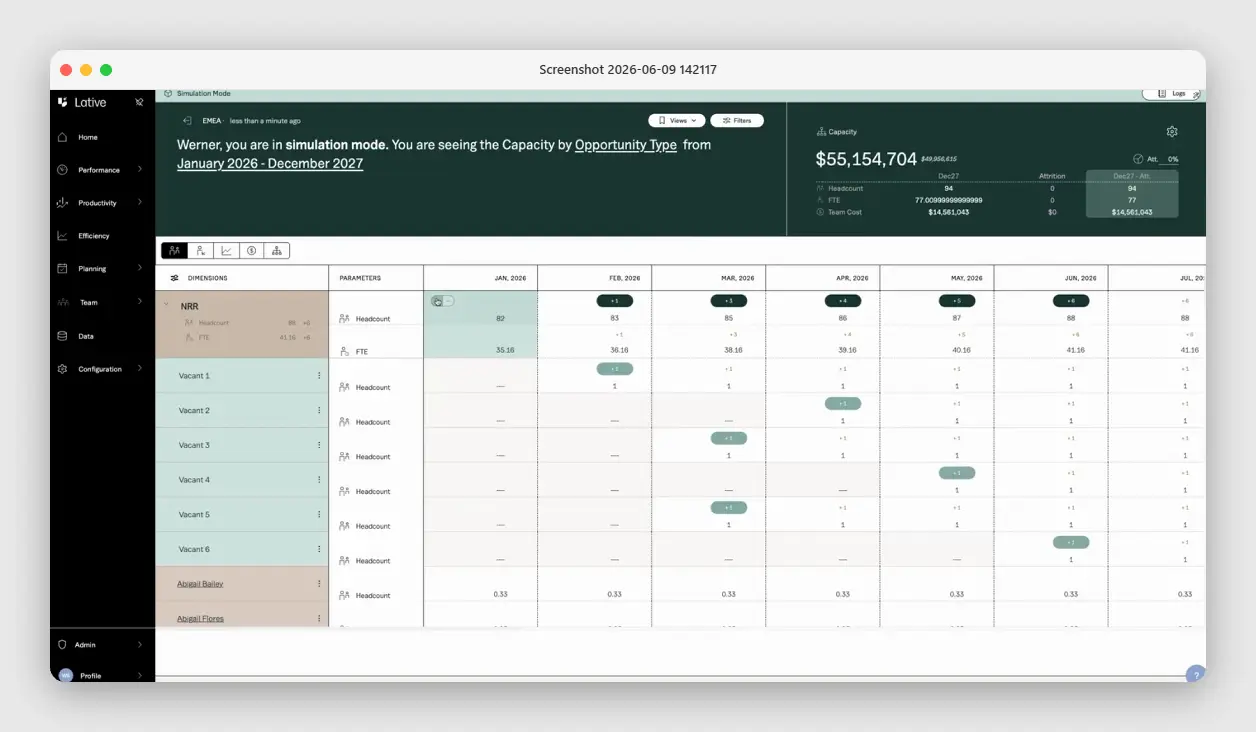
An AI-native planning tool runs scenarios in seconds, which is the difference between scenario planning as a slide and scenario planning as a habit. Lative’s Simulations view does exactly this: drop a hire into January or June, or model a strategic-initiative lift, against a long-range capacity plan and see the impact immediately.
A worked example: the hiring-delay scenario
Take a hypothetical mid-market team planning $12M for the year: ten ramped reps with $1M ramp-adjusted productive capacity each, plus four hires planned for Q1 on six-month ramps expected to add roughly $2M of in-year capacity.
Base case: hires land in January, ramp holds, capacity is $12M against the $12M target. Coverage is exact, which already means any negative variance is a miss.
Bear case, named and sized: the four hires slip to April. Each now delivers roughly half their planned in-year contribution, cutting capacity by about $1M. The plan is 8% short the day the requisitions slip, not in October when the pipeline review notices. Documented response: backfill with a contractor SDR program to lift ramped-rep pipeline 15%, and revisit Q3 quota distribution.
Bull case, named and sized: onboarding improvements compress ramp from six months to four and a half. The same four hires add roughly $600K of extra in-year capacity, funding a stretch target without a single extra head. Documented response: pre-approve the stretch plan so the upside is captured instead of discovered.
Three numbers, three triggers, three pre-agreed responses. That is the entire discipline, and none of it requires predicting which case arrives. Teams that run planning this way perform measurably better: the Ebsta x Pavilion 2024 analysis of 4.2 million opportunities found RevOps-driven planning correlated with 87% higher win rates and 21% shorter cycles.
How to run scenario planning
- Build the base case from capacity, not a top-down target. See how to build a sales capacity plan.
- Flex the few variables that matter most: hiring timing, ramp, win rate, attrition.
- Define the trigger and response for each scenario in advance.
- Re-run as reality moves, not once a year.
Building your first scenario model this week
You do not need new software to start; you need four inputs and two hours. Pull the rep roster with hire dates, trailing attainment by segment, your last cohort’s ramp curve, and current pipeline by stage. Build the base case as ramp-adjusted capacity (the sales capacity model walks through the math).
Then flex exactly two variables, hiring timing and ramp speed, by realistic amounts taken from your own history: how late did hires actually land last year, how far did ramp actually drift?
Write down the trigger and response for each case on one page and put it in front of the CRO and CFO together. The two-variable version catches most of the value; sophistication can come later. What cannot come later is the discipline of deciding responses before the quarter forces them.
Scenario planning vs sensitivity analysis
The two get conflated constantly, and the difference matters in practice. Sensitivity analysis flexes one variable at a time, win rate up two points, ramp out four weeks, and shows which lever moves the number most.
It answers “what matters?” Scenario analysis flexes several variables together into a coherent future state, the hiring slip that also stretches ramp because manager attention got thinner, and answers “what do we do?” Run sensitivity first to find your binding constraint, then build scenarios around that constraint.
Teams that skip the first step build scenarios around the wrong variable; teams that skip the second produce tornado charts nobody acts on.
Common mistakes in sales scenario planning
Most scenario planning fails for the same reasons. The fix is rarely a better tool. It is a tighter discipline around how you build, interpret, and act on the scenarios you already have.
- Anchoring the best and worst cases too close to the base. If your worst case is “we miss by 5%,” it is not a worst case. It is a soft landing. Real scenario modeling stretches the range until it feels uncomfortable, because that is the range your team needs to be ready for.
- Treating sensitivity analysis like scenario analysis. Sensitivity analysis flexes one variable at a time, so you can see which lever moves the number most. Scenario analysis flexes several together to model a coherent future state. You need both, and confusing them produces narrow plans that miss compounding effects.
- Ignoring the dependencies between variables. Changing win rate without flexing pipeline coverage, or hiring without flexing ramp, gives you a number that looks clean and is quietly wrong. Capacity planning, win rate, ramp, and revenue forecasting move together. Model them that way.
- Presenting scenarios without action plans. A scenario without a trigger and a documented response is an analyst exercise. The point of what-if analysis is to know what you would do, and at what threshold, before you have to do it.
- Modeling once a year and shelving it. Scenarios go stale within a quarter. Re-run them when pipeline, hiring, or win rate moves meaningfully, not on a calendar.
FAQ
What is sales scenario planning?
Modeling multiple versions of your sales plan under different assumptions, so you know your response to each outcome before it happens.
How many scenarios should you model?
Three is enough for most teams: base, best, and worst case. More than that adds complexity without much extra insight.
Why is scenario planning hard in spreadsheets?
Changing linked assumptions and re-rolling up the plan is slow and error-prone, so teams model one scenario instead of several.
See how Lative runs what-if scenarios in the sales capacity planning guide, or read what is sales forecasting. Book a demo.
More on sales scenario planning
What is the difference between sales scenario planning and sales forecasting?
Sales forecasting produces a single expected number, usually rolled up from pipeline and historical close rates. Sales scenario planning produces several plans under different assumptions, then defines the response to each. Forecasting tells you where you are likely to land. Scenario planning tells you what to do if you are not.
How often should sales scenario planning be refreshed?
Refresh whenever a load-bearing input moves: hiring slips by a month, win rate shifts by more than two points, a segment softens, or a major deal slides. A fixed quarterly cadence is the minimum. The teams getting real value from scenario modeling re-run as the inputs change, not when the calendar says to.
How do you connect sales scenario planning to capacity planning?
Capacity planning sets the floor: how much pipeline and revenue your current and ramping reps can realistically produce. Scenario planning flexes assumptions on top of that floor, including hiring timing, ramp speed, and attrition, to show how the achievable number changes under each set of conditions. Without a real capacity model underneath, scenario planning becomes guesswork in three colours.