
I’ve been working with revenue operations teams since 2017, and the biggest challenge I see companies face is moving beyond spreadsheet-based sales planning. After implementing these platforms several times across different scenarios, I can tell you which ones actually deliver value and which ones collect dust after the initial rollout.
This article examines the seven tools that modern RevOps teams are converging on in 2026. I’ll focus on sales planning, capacity modelling, forecasting, and execution intelligence – the capabilities that actually reduce planning risk and forecast volatility.
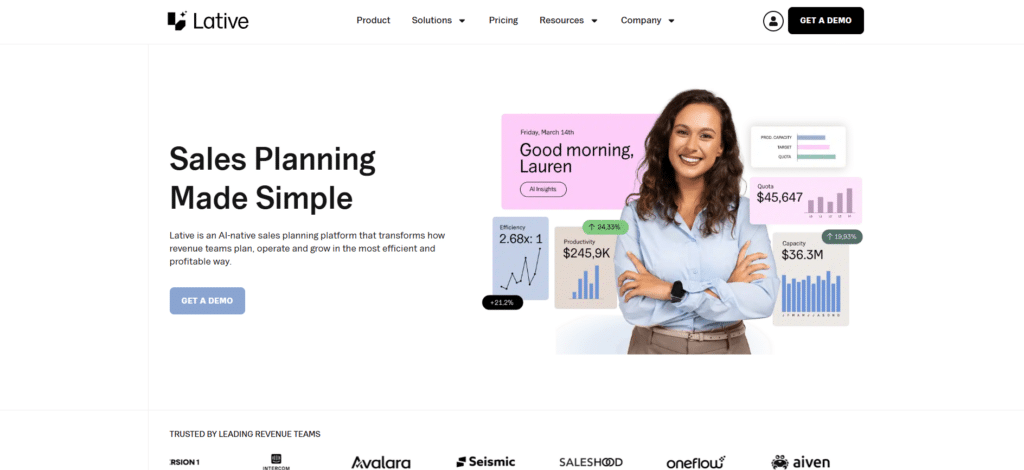
Lative solves the fundamental sales planning problem better than any platform I’ve tested. It does this by connecting top-down revenue targets to bottom-up operational reality. Most companies still use spreadsheets for this, and it shows in their forecasting accuracy.
Main Features
Real-Time Capacity Modelling
Speaking of accuracy, Lative shows you productive capacity, not just headcount. The platform pulls ramp curves, tenure data, and historical performance to give you an accurate picture of who can actually sell what. You can now answer the most important questions like “if we hire 10 AEs in Q2, when do they actually start contributing?”, quickly and reliably. And all with data rather than guesswork.
Scenario Planning
Testing different hiring plans, quota distributions, or territory alignments takes minutes instead of the hours you’d spend in Excel. You can run scenarios during live planning meetings, and if someone asks “what if we reallocate 5 reps from East to West?” you can show them the impact immediately.
Sales Productivity Dashboards
The platform tracks activity, conversion, and attainment across reps, teams, and regions. You can benchmark efficiency and determine whether someone needs coaching or a different account. The insights actually drive decisions, not just make pretty slides.
Annual Revenue Planning
Lative automates quota distribution down to individual reps with clear logic. You can model over-assignment cushions and the impact of attrition on hiring. Does this make quota setting less political? Sadly not. But at least you have data to back up yourrecommendations now.
Integration Speed
Setting up the Salesforce connector took me 15 minutes. HubSpot was similar. The data syncs in real-time, so you’re making planning decisions based on current information, not last week’s snapshot.
Pricing
Lative does publish pricing on their website, which I appreciate for the transparency. They offer three tiers designed for different company stages.
The Starter plan begins at $5,000/year and covers teams of up to 20. It includes target and quota planning, real-time performance and efficiency monitoring, capacity planning and simulations, a single CRM instance, and community and email support. This makes it a solid entry point for high-growth startups getting serious about sales planning.
The Growth plan starts at $10,000/year for teams of 21-150. You get everything in Starter, plus multiple CRM instances and priority support, which matters as your RevOps complexity scales.
Enterprise is custom-priced for teams of 151+ and includes dedicated customer success alongside the full feature set.
The ROI calculation becomes straightforward pretty quickly: if you’re currently paying someone $100,000+ to maintain capacity planning spreadsheets, even the Growth tier pays for itself. Most implementations I’ve seen deliver positive returns within the first quarter through better hiring decisions and capacity utilisation.
My Personal Review
The speed is what sold me on Lative. I’ve implemented every major sales planning platform, and nothing comes close to how fast Lative runs scenarios. When you’re in a planning meeting, and executives want to see alternatives, you can actually deliver them in real time instead of promising an updated model tomorrow.
Real-time data integration means I never have to argue about whether my model is stale. It pulls from Salesforce right now, not from last Wednesday’s refresh.
The support team has impressed me consistently. I worked through a complex multi-currency ARR calculation simulation, and they provided a working solution in 48 hours. Most vendors would have added it to the roadmap for Q3.
The learning curve is manageable. I’ve trained sales operations people who aren’t particularly technical, and they get productive in Lative within a day or two.
What I wish was better: the pricing transparency issue I mentioned. Just put a starting price on the website. The visualisation options are functional but limited – I usually export data and create prettier charts in Excel for board presentations. The mobile experience works but it’s clearly designed for desktop first.
For companies with 30+ people in their revenue organisation who need professional capacity planning without enterprise platform complexity, Lative is my top recommendation.
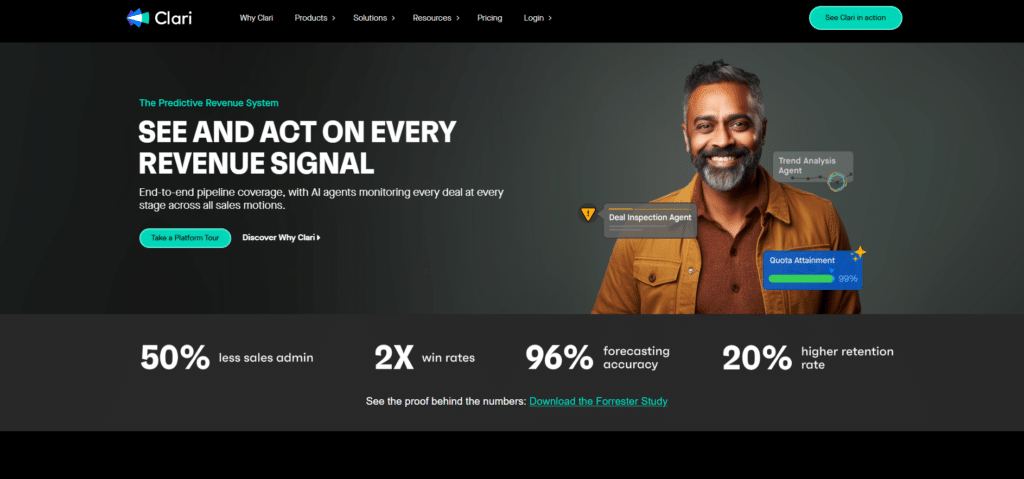
Clari might be the enterprise standard for revenue intelligence, but I have mixed feelings about it based on multiple implementations. The platform is powerful, but its success depends heavily on whether the organisation is genuinely ready for it.
Main Features
Revenue Forecasting
Clari’s forecasting engine analyses historical patterns, current pipeline activity, and engagement signals to generate predictions at the rep, team, and company level. The methodology is transparent, and the drill-down capability is robust enough to withstand executive presentations. Forecast quality depends entirely on your data hygiene and process discipline going in, though.
Pipeline Inspection
Every opportunity gets scored based on engagement frequency, stakeholder involvement, and deal velocity. Managers can drill into individual deals to see health scores, risk factors, and recommended next actions. This visibility is powerful, though it can feel like excessive scrutiny for teams not used to that level of oversight.
Copilot (Conversation Intelligence)
Clari Copilot records and analyses sales calls for coaching opportunities and deal risks. It’s a competent solution, though I find it less sophisticated than Gong’s AI for contextual understanding. If you’re already in the Clari ecosystem and want to reduce vendor complexity, Copilot gets the job done.
Groove (Sales Engagement)
The 2025 Salesloft acquisition brought mature email sequencing, dialling, and prospecting workflows into the Clari platform. Whether the integration runs smoothly depends heavily on the quality of the implementation. It’s a relatively new combination.
Activity Capture
Clari automatically logs emails, meetings, and calls and links them to opportunities. It’s reliable and significantly reduces the overhead of manual CRM updates.
Pricing
Clari’s pricing model is modular and negotiable:
- Core platform: approximately $1,000 to $1,350 per user annually
- Copilot add-on: approximately $60 to $110 per user per month
- Groove add-on: approximately $50 to $80 per user per month
- Platform fee: $5,000 to $50,000 annually
For a 50-person team with the full stack, the total annual cost typically falls in the $136,000 to $204,000 range before implementation and training costs.
My Personal Review
Executive teams tend to trust Clari forecasts, and that credibility matters in practice. The platform carries real authority in finance and boardroom conversations.
After the Salesloft merger, there’s a genuine case for managing your full revenue operation in Clari. Engagement, intelligence, and forecasting all under one roof. For large enterprises, that consolidation has real value.
The platform handles complex edge cases well. It’s been tested across enough enterprise revenue models that unusual situations are usually covered.
What frustrates me: the cost is prohibitive for many mid-market companies. The platform is also management-first in its design. VPs get a lot of value from the dashboards, but individual contributors often find them disconnected from their day-to-day work. Implementation takes 2 to 4 months minimum and requires dedicated RevOps resources. The API-based Salesforce integration can occasionally lag, which creates data freshness issues.
Clari makes sense for companies with 500+ employees, public companies, organisations with complex revenue models, and teams with both the budget and internal resources for a proper rollout. It’s probably not the right fit for Series B companies trying to establish basic capacity planning. You’ll pay for features you don’t use, and adoption tends to suffer because the platform can feel like administrative overhead rather than a productivity tool.
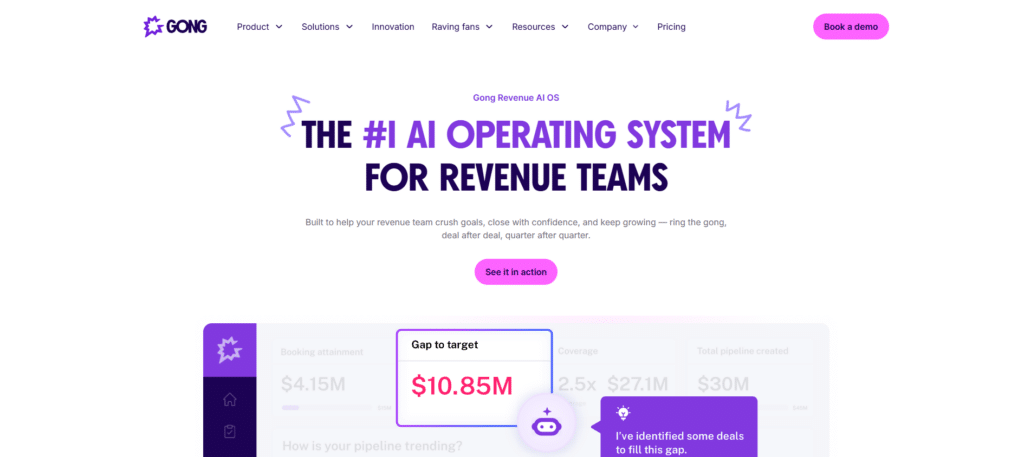
Gong arguably created the conversation intelligence category, and they serve over 4,500 customers, including Fortune 10 companies. In 2026, they’ve got serious competition, and some newer platforms offer real advantages in specific areas.
Main Features
Conversation Intelligence
Gong automatically joins scheduled calls, transcribes everything, and analyses the conversation. You can search across your full call library for specific keywords like competitor names, pricing discussions, or legal review mentions, and immediately surface relevant moments. The platform tracks talk ratios, question patterns, and engagement levels across calls.
For new hire onboarding, the call library is particularly valuable. New reps can listen to top performers’ actual calls and understand what works in the field, which typically cuts ramp time.
Deal Intelligence
Gong monitors deal activity signals across emails, meetings, and stakeholder engagement, and flags risks when engagement drops or competitors get mentioned. Deal boards provide pipeline visibility based on actual activity rather than stage progression alone.
Forecasting
Gong Forecast combines CRM data with engagement signals to predict the likelihood of a close. The accuracy is solid rather than exceptional, but it helps identify gaps between what reps are committing and what the activity data actually suggests will close.
Coaching and Enablement
Managers can create playlists of effective calls for specific situations, track whether reps are following new messaging frameworks, and identify coaching needs around discovery versus closing. The value here is entirely dependent on whether managers actually use it.
Gong Engage
Their sales engagement module for outreach and tracking. It’s newer and less mature than their core product.
Pricing
Gong doesn’t publish pricing publicly. Based on market information:
- Foundation (core product): approximately $1,400 to $1,600 per user annually
- Complete platform with Engage and Forecast: approximately $2,800 to $3,000 per user annually
- Platform infrastructure fee: $5,000 to $50,000 annually, depending on team size
For a 50-person team wanting full capabilities, budget at least $120,000 to $150,000 annually. Renewal pricing typically increases 5 to 7 percent per year.
My Personal Review
The conversation insights are still best-in-class for understanding what’s actually happening in customer interactions. The call search functionality alone provides significant value in competitive markets where understanding positioning matters.
The market intelligence capabilities, tracking competitor mentions, identifying trending objections, and understanding what messaging resonates, provide value beyond just sales. Product and marketing teams get a lot out of it, too.
What bothers me: there’s typically a 20- to 30-minute delay between call completion and the availability of insights. Newer AI-native platforms can deliver insights within 5 minutes, which matters for immediate post-call coaching. The AI relies more on keyword identification than on true contextual understanding, which occasionally leads to false positives. Renewal pricing increases steadily. And Gong increasingly pushes bundled offerings, making it harder to buy only the conversation intelligence piece you actually need.
Gong remains the market leader with the most mature product and the broadest integrations. For large enterprises with 100+ reps and complex sales cycles, the ROI is often justified. In 2026, though, AI-native platforms can deliver much of Gong’s functionality at 50 to 70% lower cost with faster insights. For mid-market teams, I’d recommend evaluating alternatives before defaulting to Gong based solely on name recognition.
One thing worth flagging: Gong only delivers value when people actually use it. High call recording compliance without manager utilisation of coaching features means you’re essentially paying for a call archive. Make sure you have a concrete adoption plan before signing.
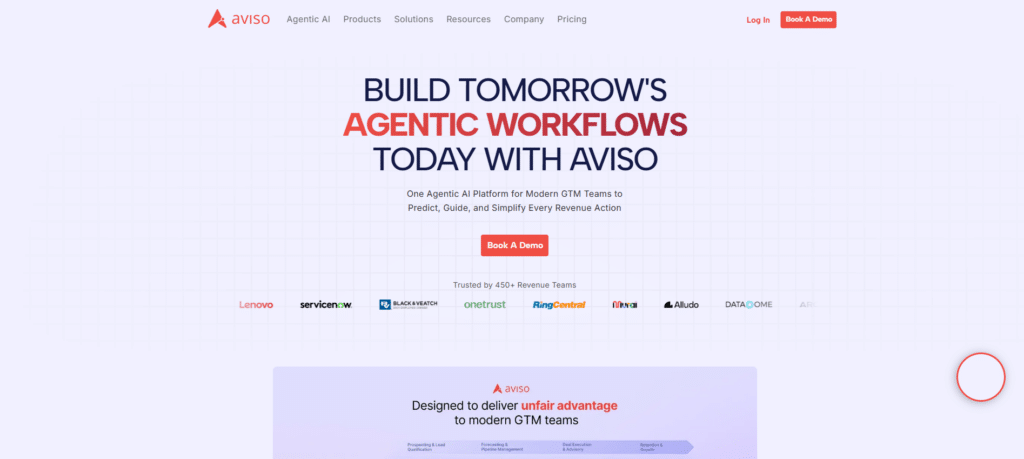
Aviso is my dark horse recommendation. They don’t get the same market attention as Clari or Gong, but they consistently win competitive evaluations against both when buyers take the time to look closely.
Main Features
MIKI (AI Assistant)
MIKI allows natural language queries about your revenue data. Rather than navigating dashboards, you can ask things like “what’s the engagement risk on my top deals?” or “show me all opportunities over $100K with declining stakeholder activity” and get actionable answers. I’ve tested a lot of “conversational AI” features across sales platforms, and most of them are gimmicks. MIKI actually works.
Predictive Forecasting
The platform uses machine learning to analyse historical patterns, activity signals, and deal characteristics to predict outcomes. Aviso claims 98%+ forecasting accuracy. Teams using the platform in practice report accuracy consistently in the mid-90s, which is genuinely strong. Aviso also handles multiple revenue models within a single forecasting framework, including subscription, usage-based, renewals, and product-led growth. This matters a lot if you have a hybrid revenue model.
Deal Collaboration Rooms
Rather than having deal context scattered across Salesforce, Slack, email, and call recordings, Aviso creates unified deal rooms where everything lives. The AI continuously monitors these and automatically surfaces risks and recommended actions.
Conversation Intelligence
Aviso records and analyses calls with an emphasis on translating conversations into deal guidance rather than just producing transcripts. The focus is on what a conversation means for your forecast, not just what was said.
Pipeline Inspection
Multi-dimensional pipeline views let you inspect by stage, segment, rep, product line, or custom dimensions. The platform shows not just what’s in the pipeline but the quality of engagement and statistical likelihood of conversion.
Pricing
Aviso doesn’t publish pricing publicly. Based on deals I’m aware of:
- Starting point around $1,000 per user annually for enterprise deployments
- The platform fee is typically around $50,000 for larger implementations
- 100-person team: expect $150,000 to $200,000 annually all-in
- Best suited for teams with 50+ revenue professionals
My Personal Review
The unified experience is Aviso’s biggest strength. You’re not jumping between different tools for different tasks. Forecasting, deal intelligence, and conversation analysis all connect in one interface.
MIKI is genuinely useful rather than a gimmick. The conversational AI understands what you’re asking and delivers relevant answers, which is rarer than it should be in this space.
For companies with usage-based revenue models, API calls, compute credits, consumption tiers, Aviso handles this complexity better than most competitors. It’s one of the few platforms that doesn’t force you into a single forecasting methodology.
The support team tends toward consultative rather than transactional. They want to understand your business model, which makes a real difference during implementation.
What frustrates me: user reviews consistently mention bugs, particularly around forecast roll-ups not updating correctly and occasional UI quirks. Performance can lag with large data sets. Load times of 5 to 10 seconds aren’t uncommon with complex models. The interface, while functional, feels less polished than you’d expect from a 2026 product. Dashboard and report customisation are more limited than those of some competitors.
Aviso is underrated in the market. If they fixed the performance and bug issues, they’d easily be a top-three platform. The AI capabilities are substantive rather than marketing fluff, and the unified approach solves real workflow problems. I recommend Aviso for mid-to-large companies with complex revenue models that find Clari’s setup overwhelming.
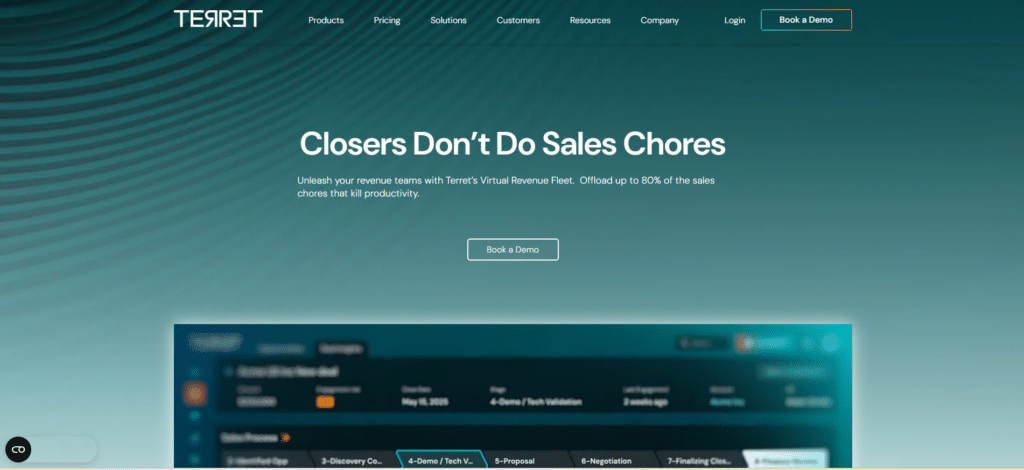
Terret, formerly known as BoostUp, occupies a useful position in the market: professional-grade revenue intelligence at a price point that works for mid-market companies, with an interface that sales reps actually adopt willingly.
Main Features
AI-Powered Machine Forecasting
Terret’s AI analyses CRM data plus email, calendar, and meeting activity to generate forecasts. The key differentiator is multi-dimensional forecasting. You can forecast SaaS ARR, consumption revenue, renewals, and product-led growth, each with its own model, all within one platform. Few platforms handle this complexity without forcing you to pick a single methodology.
Deal and Engagement Risk Scoring
Every deal receives a risk score based on actual engagement rather than just the Salesforce stage. If your champion hasn’t responded in a week, if no meetings are scheduled, if stakeholder diversity is low, BoostUp flags these signals with specific guidance on what to do about them. The actionability of the alerts is a key reason rep adoption tends to be higher with BoostUp than with competing platforms.
BoostBot (AI Revenue Agent)
BoostBot sends proactive alerts: “Your Q4 forecast has a $200K gap,” “Deal XYZ shows disengagement risk,” “You haven’t followed up with ABC Corp in 5 days.” The alerts are contextual and actionable without being overwhelming, which drives actual usage rather than alert fatigue.
RevBI (Revenue Business Intelligence)
The Revenue BI module lets RevOps teams build custom dashboards and define metrics without heavy technical requirements. You’re not dependent on a data team for basic reporting, which matters practically when you need to move fast.
Conversation Intelligence
BoostUp includes native call recording and analysis, plus integrations with Gong and Chorus for teams already using those platforms. The philosophy is surfacing conversation insights in the context of deals and forecasts rather than treating them as a separate workstream.
Mobile Applications
Unlike most revenue platforms that feel exclusively desktop-designed, BoostUp has genuinely functional iOS and Android apps. Sales leaders can review forecasts and update the pipeline while travelling.
Pricing
Terret is actually upfront about pricing, which I appreciate. They offer three separate modules you can buy individually or combine:
- AI Revenue Agents: $50 per user per month. Covers finding and engaging new contacts, building mutual action plans, generating meeting dossiers, updating sales process, and managing action items.
- Machine Forecasting: $80 per user per month. Includes AI-generated forecasts, forecast submission workflows, deal outcomes and risk scoring, and Revenue BI and dashboarding.
- Conversation Intelligence: $30 per user per month. Smart call recording, call archival and sharing, conversation analytics, and call summaries with action items and follow-up.
There’s also a free trial, so you can test the product before committing, which puts Terret ahead of most competitors on this list in terms of transparency alone.
The modular pricing is a double-edged sword. On the one hand, you only pay for what you need. On the other hand, if you want the full stack, you’re looking at $160 per user per month, which adds up fast. A 50-person team using everything would run around $96,000 annually before any discounts.
My Personal Review
Adoption rates with Terret consistently exceed what I see with other platforms. The alerts are genuinely useful, the mobile app works well, and the interface feels like it’s designed to make reps’ jobs easier rather than add overhead.
The price-to-value ratio is strong. You get approximately 80 percent of Clari’s core functionality at half the cost, which makes the economics work for mid-market teams where Clari’s full platform isn’t justifiable.
Terret is more responsive to customer feedback and faster to fix issues than the larger vendors. That responsiveness matters when you’re building workflows around the platform.
For companies with complex revenue models, ARR plus usage plus professional services, Terret handles this without forcing you into rigid frameworks.
What’s limited: Terret is younger than Clari or Gong, and you’ll occasionally encounter edge cases they haven’t fully addressed. The platform is optimised for the mid-market. Very large organisations with 5,000+ revenue professionals may outgrow it. Conversation intelligence is competent but not best-in-class. If call coaching is your primary need, Gong still has the edge. The platform also works best when your Salesforce data is reasonably clean. Messy data architecture complicates implementation.
Ideal use case: Series B through pre-IPO technology companies with 50 to 500 revenue team members who need professional-grade revenue intelligence without enterprise complexity or cost.
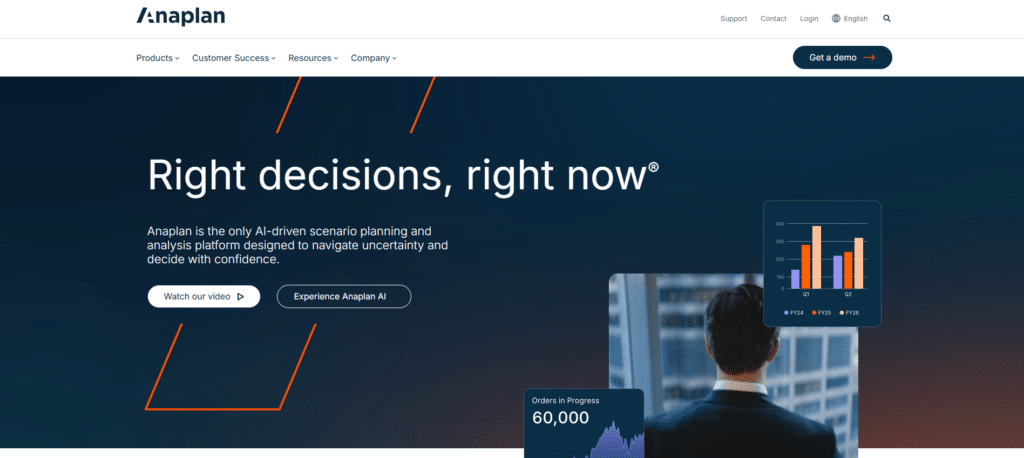
Anaplan is what I recommend when someone needs to plan across sales, finance, supply chain, and workforce in one unified model and has the budget and internal resources to do it properly.
Main Features
Multi-Dimensional Planning
Anaplan’s core strength is handling complex, interconnected planning scenarios. You can model sales territories, see the financial implications immediately, adjust headcount plans, and recalculate quotas, all while maintaining dependencies across the full model. This level of complexity breaks Excel. Anaplan handles it.
Scenario Planning
Create unlimited what-if scenarios, aggressive growth, conservative hiring, market downturn, acquisition scenarios, and compare them side-by-side with full P&L implications. For companies doing sophisticated planning across business units, this is genuinely valuable.
Territory and Quota Management
Design territories based on geography, account segmentation, industry verticals, or any custom logic. Assign reps, set quotas, model coverage ratios, and ensure balanced workloads. Anaplan handles the kind of complexity that would destroy spreadsheet-based approaches.
Sales Capacity Planning
Model hiring plans with realistic ramp curves, attrition assumptions, and productivity cohorts. Understand exactly when new hires become productive and how that affects revenue targets quarter by quarter.
App Hub (Pre-Built Templates)
Pre-built applications for common use cases like sales planning, workforce planning, and financial consolidation accelerate implementation. You’ll still need to customise them for your specific business, but they provide a useful starting point.
Real-Time Collaboration
Multiple stakeholders can work on the same model simultaneously. Sales operations updates territory assignments, finance adjusts budget assumptions, HR modifies hiring plans, and changes propagate across connected models instantly.
Pricing
Anaplan pricing is at the high end of this category:
- Basic implementations: $20,000 to $30,000 annually
- Realistic mid-market deployment: $75,000 to $150,000 annually
- Large enterprise with multiple use cases: $200,000 to $500,000+ annually
- Implementation consulting: often equals or exceeds annual licensing
If you’re paying $200,000 for licenses, budget another $200,000 to $400,000 for consulting to implement it properly. This is not a self-implementation platform.
My Personal Review
The power and flexibility are unmatched. If you can conceptualise a planning scenario, you can model it in Anaplan. The calculation engine handles complexity that breaks other tools.
When sales, finance, and HR all work in the same planning environment, you eliminate version control chaos and conflicting assumptions across departments. This cross-functional alignment is significant at scale.
CFOs and boards understand and trust Anaplan. It carries real credibility as a serious enterprise tool.
What makes it challenging: the learning curve is steeper than any other aspect of this review. Anaplan has its own proprietary modelling language that takes real investment to master. Implementation requires dedicated consultants or in-house Anaplan administrators. This is not configure-and-run software. The user experience feels dated compared to modern SaaS, which creates friction for non-technical sales users. There’s also a significant over-engineering risk. It’s easy to build models so complex that actual users can’t operate them independently.
One practical note: the Excel add-in only works on Windows. If you’re a Mac-centric organisation, you’ll need workarounds just to connect Anaplan and Excel.
Anaplan makes sense for large enterprises with 1,000+ employees, a genuine need for unified planning across multiple business functions, dedicated planning analysts on staff, and genuinely complex scenarios such as matrix organisations, global operations, or multiple business units.
When to avoid it: under 500 employees, if you only need sales-specific planning (Lative or BoostUp will serve you better at a fraction of the cost), or if you don’t have technical resources to build and maintain models.
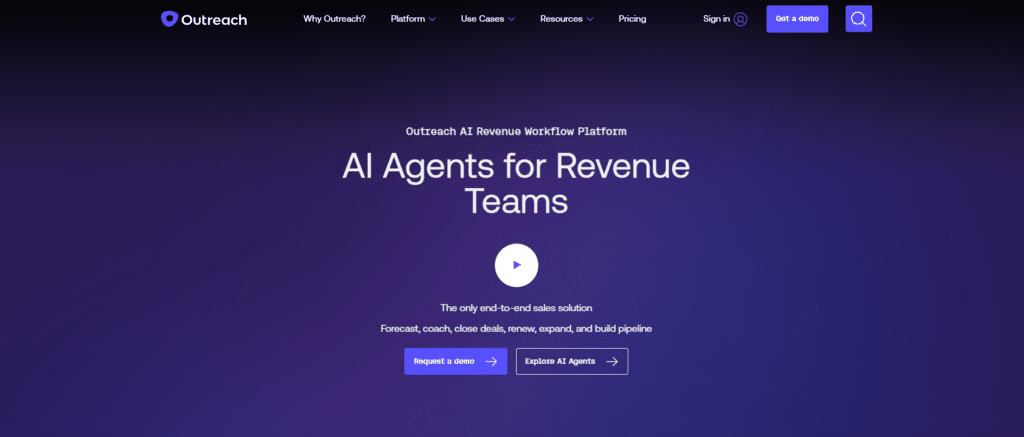
Outreach makes sense when your revenue strategy extends beyond forecasting and you need to help reps actually execute and close deals, with engagement automation built into the workflow.
Main Features
Sales Engagement
Multi-channel sequences spanning email, phone, and LinkedIn. Automate follow-ups, track engagement, and optimize cadences based on what’s working. This is Outreach’s most mature functionality and where the platform clearly excels.
Smart Deal Assist
Analyses engagement signals across emails, calls, and meetings to predict deal outcomes and flag at-risk deals. It suggests next actions and helps prioritise where reps should invest time. The value is that deal intelligence is built into the workflow rather than sitting in a separate dashboard.
Kaia (Conversation Intelligence)
Provides real-time meeting assistance, transcription, and post-call summaries. During calls, it can surface relevant content or competitive battle cards. After calls, insights feed into deal health scoring and CRM updates. Functional, though not as sophisticated as Gong for deep call analysis.
Unified Forecasting
Combines pipeline coverage analysis with AI projections. The forecasting connects to engagement data, so you can see which deals have the underlying activity to support optimistic projections, which is more honest than stage-based forecasts alone.
Revenue Signals and Workflows
Monitors buying signals like email opens, content downloads, and meeting acceptances, then triggers automated workflows. When configured properly, this automation is powerful for high-volume outbound motions.
Pricing
Outreach uses quote-based modular pricing:
- Engage (core sales engagement): quote-based per user
- Deal (deal management and Smart Deal Assist): quote-based per user
- Meet (Kaia conversation intelligence): quote-based per user
- Bundled pricing available with better rates for multiple modules
Estimated costs: a mid-market team of 50 with the full platform runs $100,000 to $175,000 annually. Enterprise deployment of 200+ users runs $400,000 to $750,000+ annually.
My Personal Review
The execution focus is what differentiates Outreach from pure intelligence platforms. It helps reps do the work rather than just analyse it. The workflow automation is robust and well-tested.
With a large body of interaction data informing the AI, Outreach’s recommendations are grounded in what actually works across industries and segments rather than theoretical best practices.
For organisations building their sales tech stack from scratch, having engagement, intelligence, and deal management from a single vendor simplifies things considerably.
What’s challenging: the platform is expensive, particularly with bundled modules. Mid-market teams often get better ROI with focused point solutions. Feature breadth creates real complexity, and reps typically use a fraction of what’s available, which means you’re paying for features that go unused. Outreach competes with Salesloft for engagement, Gong for conversation intelligence, and BoostUp for forecasting. They do all three reasonably well but aren’t best-in-class in any single area. User reviews also consistently mention dialer reliability issues, which matters significantly for teams doing substantial outbound calling.
Outreach makes sense when you need sales engagement and revenue intelligence from a single vendor, team size justifies enterprise pricing, and you have a heavy outbound motion that requires sophisticated sequencing.
Consider alternatives if you only need forecasting or pipeline management (BoostUp or Lative are more cost-effective), if conversation intelligence is your priority (Gong goes deeper), or if you already have a sales engagement tool you like and adding dedicated revenue intelligence separately might be more economical.
Final Thoughts
After years of implementing these platforms, I’ve come to believe that tool selection matters less than most people think. Implementation quality and actual adoption matter more.
Choose the right-sized tool for your company stage. Budget realistically with a buffer for implementation and training. Assign an executive sponsor who genuinely cares about the outcome. Train people properly rather than assuming they’ll figure it out. Measure adoption regularly and address issues before they become entrenched.
The companies succeeding with revenue intelligence aren’t necessarily using the most expensive tools. They’re the ones who’ve embedded these platforms into their actual workflows and decision-making processes.
And eliminate the spreadsheets. We have better options in 2026.