

If your tenure as CMO averages 4 years against a CEO’s 8, the explanation is structural: the gap between how marketing measures its own performance and how the rest of the business measures revenue has never been wider.
Lative surveyed more than 500 executives across marketing, sales, finance, revenue operations, and CEO roles to understand the scale of this disconnect. The results are direct and difficult to argue with.
Key findings at a glance:
- 85.3%: of GTM teams cannot consistently map marketing spend to revenue
- 73.5%: of marketing executives still use spreadsheets to create GTM alignment
- 62%: of enterprises spend over $100,000 building custom marketing analytics
- 88.8%: of executives say marketing and sales must align on common success metrics
- 74.9%: say marketing must become opportunity-centric rather than lead-centric
85.3% of go-to-market teams cannot consistently map marketing spend to revenue
The most fundamental question in marketing, how much did we spend, and what revenue did it produce, goes unanswered for the overwhelming majority of GTM teams. Lative’s research found that 85.3% of go-to-market teams cannot consistently map the value of marketing spend to revenue outcomes.
Marketing leaders are failing to connect the data they collect to the model that finance and sales actually use to track business performance.
The root cause is structural. Most marketing teams build their metrics and systems around leads, a fundamentally different unit of measurement from the opportunities and revenue that the rest of the business tracks.
When marketing reports in MQLs and sales reports in pipeline coverage, the same customer journey produces two incompatible scorecards. This is the marketing credibility gap, and the survey data confirms it is widespread, not exceptional.
73.5% of marketing executives still use spreadsheets to create alignment
Despite the availability of more than 14,106 marketing technology solutions, 73.5% of marketing executives still rely primarily on spreadsheets to create alignment on marketing initiatives. The alternatives, CRM dashboards, marketing automation dashboards, business intelligence tools, and custom data warehouses, were all designed for maximum flexibility, which means maximum customization effort.
Without a clear blueprint for building world-class marketing operations infrastructure, most teams default to the tool that requires zero implementation: a spreadsheet.
Spreadsheets represent a snapshot of data from a single point in time. They go stale immediately, they do not connect data across systems, and they make collaboration with finance and sales structurally difficult.
They also cannot support the time-series analysis that reveals how pipeline builds, converts, and closes over a quarter or a year. The continued dominance of spreadsheets is not a technology problem: it is a consequence of marketing systems being built around a lead-centric model that is disconnected from the rest of the business by design.
62% of enterprises spend over $100,000 building custom marketing analytics
For teams that do invest in better infrastructure, the cost is significant. Segment’s 2022 State of CDP report found that 62% of enterprises spend over $100,000 building custom data platforms to support marketing analytics.
That investment buys a solution that is rigid by the time it is finished, requires ongoing maintenance by specialists, and still does not produce the real-time, revenue-connected view that executive decision-making requires.
It also represents budget that is not going toward demand generation, campaigns, or the programs that actually produce revenue.
80.6% of businesses still run lead-centric marketing strategies
The vast majority of B2B organizations, 80.6%, operate lead-centric marketing strategies. This is the structural source of the measurement problem.
Lead-centric metrics prevent CMOs from connecting at the system level with the revenue-centric models used by sales, finance, and the CEO. As a direct consequence, 69% of organizations have entirely different terms and metrics to describe the same customer journey across departments.
Marketing calls it an MQL. Sales calls it an opportunity. Finance calls it pipeline. All three are describing the same prospect moving through the same funnel, but the incompatible terminology makes it nearly impossible to build a shared view of GTM performance.
This is why the hybrid demand engine model matters: it tracks both leads and accounts in the same funnel, using opportunity-centric metrics that translate across marketing, sales, and finance without requiring translation.
88.8% of executives say marketing and sales must align on common success metrics
The survey produced near-consensus on this point: 88.8% of executives, across marketing, sales, finance, RevOps, and CEO roles, agree that marketing and sales must align on common success metrics. What the data clarifies is that the misalignment is a systems problem. Without a shared model, marketing-sourced pipeline numbers, attribution accuracy claims, and pipeline coverage ratios end up calculated three different ways, and GTM productivity becomes a debate rather than a metric.
Marketing systems are optimized around lead-centric metrics that shape daily user behavior away from revenue outcomes. Until the underlying data model changes, alignment remains a goal that organizational effort alone cannot achieve.
The survey also found that 76.3% of executives believe their business needs a fundamentally better approach for marketing to generate quality opportunities for sales. The need is a model change, not incremental improvement to current tools.
Forrester’s B2B Revenue Waterfall made the same argument: optimizing B2B performance around lead-centric processes is no longer viable. The next generation of GTM operations is built around opportunities and revenue as the common currency across every function.
75% of the highest-growth companies will operate a revenue operations model by 2026
Gartner projects that 75% of the highest-growth companies will run a revenue operations model by 2026, up from less than 30% at the time of the forecast. The adoption curve is steep because the alternative, sales and marketing each defending their own metrics, has stopped producing reliable pipeline coverage at the rate boards now expect. RevOps adoption is no longer a structural experiment for high-growth B2B. It is the default operating model for companies that want marketing-sourced pipeline, sales execution, and finance reporting to add up to the same revenue number.
What this means: If three out of four high-growth peers are restructuring around a single revenue model, the cost of staying in the lead-centric, departmentally-aligned model is no longer hypothetical. It is competitive ground already being conceded.
Source: Gartner’s 2024 Revenue Operations Guide.
Companies with formal RevOps functions report 36% higher revenue growth
Forrester research found that organizations with a formal RevOps function report 36% higher revenue growth than those without one. The lift does not come from new headcount. It comes from removing the structural friction between marketing-sourced pipeline, sales-owned opportunities, and finance-owned revenue. When attribution accuracy, GTM productivity, and pipeline coverage are calculated against the same opportunity records, the time leadership previously spent reconciling departmental numbers is redirected into executing the GTM motion.
What this means: A 36% growth delta is not a marketing efficiency story. It is what happens when marketing stops translating its work into a different scorecard and starts reporting in the same opportunity-centric model the rest of the business already uses.
Source: Forrester’s 2024 B2B Revenue Operations research.
74.9% of executives say marketing must become opportunity-centric
The survey’s most actionable finding: 74.9% of executives, including those in sales, finance, RevOps, and CEO roles, believe marketing must shift from a lead-centric to an opportunity-centric model. An opportunity-centric approach makes it possible to trace the unbroken progression of an account from the first marketing touchpoint to a closed deal,
quantify how specific activities moved that opportunity forward, and report on marketing’s contribution in the same terms that the rest of the business uses to track revenue.
Lative is built specifically for this shift: an AI-native platform where marketing, sales, finance, and revenue operations work from the same opportunity-level data from first touch to close.
Building the Data Infrastructure for the Shift
The path to opportunity-centric marketing runs through data infrastructure. The demand engine architecture that produces reliable pipeline forecasts and defensible attribution is built on a single shared data model, one where marketing, sales, and finance are not just looking at the same company’s numbers, but looking at them through the same lens.
For the full survey methodology and complete data set, see B2B Marketing Statistics: GTM Alignment Survey. For how Lative’s platform operationalizes the shift from lead-centric to opportunity-centric marketing, see the Marketing Intelligence platform overview.
Closing that gap takes one model across marketing and sales, which is why Lative connects marketing intelligence to sales capacity planning on a single foundation.
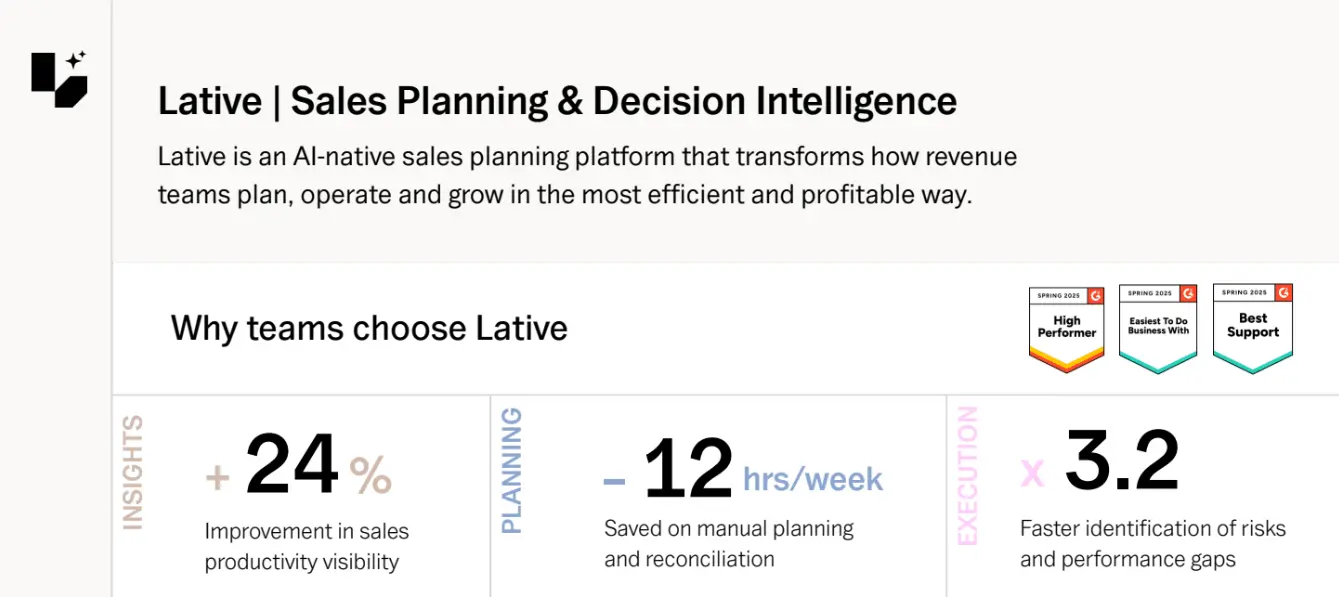
If 85% of GTM teams cannot map marketing spend to revenue and your team is in that group, the problem is the data model, not the effort. See how Lative connects marketing data to the revenue-centric model your CFO, CRO, and board are already using.
Key Takeaways
- 85.3% of GTM teams cannot map marketing spend to revenue. The cause is the lead-centric data model, not effort or technology budget.
- Gartner expects 75% of high-growth companies to operate a revenue operations model by 2026. The default has shifted from departmental scorecards to a single opportunity-centric data model.
- Forrester’s 36% revenue growth lift for formal RevOps functions is a structural outcome of removing the reconciliation tax between marketing-sourced pipeline, sales opportunities, and finance reporting.
- 73.5% of marketing executives still rely on spreadsheets to create alignment because their underlying systems were built around leads, not opportunities. New tools layered on a lead-centric foundation produce the same gap in a different format.
- 74.9% of executives across sales, finance, RevOps, and CEO roles say marketing must become opportunity-centric. Until the data model changes, attribution accuracy and pipeline coverage remain departmental claims rather than shared facts.
FAQ
What is marketing revenue operations?
Marketing revenue operations is the discipline of running marketing as a revenue function, not a lead-generation function. It connects marketing planning, attribution, and pipeline insights to the same opportunity records that sales and finance use, so marketing-sourced pipeline, conversion rate by stage, and contribution to closed revenue are calculated once against a single data model rather than reported in three incompatible formats.
How does marketing revenue operations differ from sales operations?
Sales operations optimizes execution inside the sales team: territory design, quota setting, CRM workflows, pipeline coverage hygiene. Marketing revenue operations sits one layer above and owns the end-to-end customer journey from first marketing touchpoint to closed revenue. Forrester’s research showing 36% higher revenue growth for formal RevOps functions reflects the value of operating both layers in a single framework rather than as separate silos.
What metrics define a mature marketing revenue operations function?
The defensible metrics are opportunity-centric, not lead-centric: marketing-sourced pipeline by quarter, conversion rate by stage and segment, pipeline coverage against the next-quarter target, attribution accuracy measured against closed revenue, and GTM productivity per dollar of go-to-market spend. If any of those still require a quarterly spreadsheet rebuild, the underlying data model has not yet shifted.
Lative Team — Lative is the AI-native GTM platform that connects marketing intelligence to sales capacity planning on one shared data foundation.