

85% of executive teams cannot clearly map marketing spend to revenue. Not a niche problem. Not a minority of underfunded companies. The overwhelming majority of B2B organizations, including well-resourced ones, operate without a reliable way to connect what marketing invests to what revenue results.
Lative surveyed more than 500 executives across marketing, sales, finance, revenue operations, and C-level roles to understand how widespread this problem actually is. The findings reveal something structural, not incidental.
An April 2025 analysis of 1.8 million deals provides independent context: 81% of revenue leaders say deals are more complex today than three years ago. More stakeholders and longer sales cycles mean that the measurement gap between marketing activity and revenue outcome has more places to widen. The findings below describe how far it has widened across organizations today.
- 85% of executives cannot clearly map marketing spend to revenue.
- 48% of organizations report their marketing and sales teams are only somewhat aligned for identifying and winning opportunities.
- 72% of marketing teams still measure success with metrics their CFO cannot directly tie to revenue growth.
- 67% of CMOs say budget decisions would be easier if marketing and finance shared a common data model.
B2B marketing statistics on the credibility gap
These statistics come from Lative’s survey of more than 500 GTM executives across marketing, sales, and finance. The credibility gap between marketing and the rest of the revenue team is the most consistent finding across every company size and sector surveyed.
85%
of executives cannot clearly map marketing spend to revenue. This number comes from an organization-wide survey, not a marketing-only audience. Finance leaders answered this question. CEOs answered it.
The 15% who say they can make this connection are outliers, not the standard. If you have walked into a budget review and faced skepticism about marketing’s contribution, you are operating inside the 85%.
31%
of respondents identified marketing’s use of separate metrics as the primary reason their organizations cannot establish cause-and-effect between marketing activity and revenue outcomes. MQLs, impressions, engagement rates: internally coherent, externally incompatible with the language finance uses to evaluate spend.
The root cause is a translation problem between two measurement systems that were never designed to speak to each other.
69%
of respondents said different departments in their company use different terms and metrics to describe the customer journey. Marketing calls it a lead. Sales calls it an opportunity. Finance calls it ARR potential. The same account, at the same moment, described in three incompatible frames.
Pipeline reviews get contentious not because the data is bad but because no one agreed on what the data means before the meeting started.
B2B marketing statistics on GTM alignment
Sales-marketing alignment is the most cited GTM priority and the least achieved one. These numbers come from Lative’s survey of 500+ GTM executives. The gap between what leaders say they want and what their organizations actually do has held constant across every company size and segment surveyed.
48%
of respondents said their marketing and sales teams are only somewhat aligned for the purpose of identifying, engaging, qualifying, and winning opportunities. Nearly half of organizations are operating with a structural misalignment between the two functions most directly responsible for revenue generation.
The root cause is operational: two teams measuring success in ways that do not reinforce each other.
88.8%
of respondents believe marketing and sales should align on the same success metrics. The consensus that alignment is necessary is close to unanimous. The gap between belief and implementation is where years of revenue get lost. Organizations know the answer. Most have not built the infrastructure to execute it.
76.3%
of respondents think there must be a better way for marketing to generate quality opportunities for sales. This is a cross-functional assessment, including the CRO and CFO, that the current lead handoff process is broken and that a better model for generating marketing-sourced pipeline exists.
When three out of four executives in a company believe the current approach is wrong, the gap is activation.
B2B marketing statistics on tools and operational infrastructure
Tool sprawl is real, but the infrastructure problem runs deeper than the number of tools. RevOps maturity, not tool count, is the variable that separates organizations that can answer the alignment question from those that cannot. These statistics describe how the current marketing technology landscape creates operational gaps that no single tool solves.
73.5%
of respondents still use spreadsheets to create alignment on demand generation initiatives across functions. Despite years of investment in CRM, marketing automation, and business intelligence platforms, the primary cross-functional alignment tool for most organizations is a shared spreadsheet that someone manually updates before each planning meeting.
The underlying gap is infrastructure: no single system maintains the cross-functional view, so spreadsheets fill it.
20%
of finance executives say their company’s tools clearly establish the cause-and-effect relationship between marketing activities and revenue outcomes. One in five. That number explains every hard budget conversation you have ever had with your CFO.
The CFO pushes back on marketing’s attribution claims because attribution accuracy depends on a shared data set that, for most organizations, does not exist in a verifiable form.
45.9%
of respondents are only somewhat satisfied with the tools their company uses to create alignment between marketing, sales, customer success, and finance. The dissatisfaction is broad enough that it is not a segment-specific complaint. Almost half of all respondents, across functions and company sizes, believe their current tooling is not solving the alignment problem.
The market knew this before the AI-native GTM category existed. The category exists because of it.
B2B marketing statistics on lead-centric vs. opportunity-centric models
The shift from lead-centric to opportunity-centric marketing is measurable. These statistics describe both the scale of the remaining gap and the performance difference between organizations that have made the shift and those that have not.
74.9%
of respondents believe marketing should shift from lead-centric to opportunity-centric. Including 74.4% of non-marketers. The desire to move from individual lead tracking to account-level, opportunity-centric GTM is a cross-functional consensus, not a marketing preference. The CRO and CFO in this survey want the same shift the CMO wants.
The disagreement is about who builds the infrastructure to get there.
41.4%
of respondents identified a key shortcoming of lead-centric marketing: opportunities are created with just a single person associated with them, ignoring the buying committee that actually drives B2B purchase decisions.
A deal that involves five stakeholders from legal, finance, IT, and two business unit leaders is tracked as one contact’s journey. The attribution model misses four of the five people who influenced the outcome.
22.7%
of respondents are not confident in the accuracy of the metrics marketing uses to articulate its revenue contribution. Nearly one in four executives, including marketers themselves, does not trust the numbers marketing reports. That is the credibility gap in its most direct form: the marketing team’s own stakeholders do not believe their own output.
The gap is the data model underneath the presentation.
B2B marketing statistics on AI adoption and revenue accountability
AI is reshaping the measurement conversation faster than the underlying data foundations are maturing. These statistics, drawn from named third-party research, describe how the gap between AI capability and revenue accountability is widening across B2B organizations.
64%
HubSpot’s 2025 State of Marketing Report found that 64% of marketers are already using AI in their roles, and another 38% planned to start in 2025. Adoption is no longer the bottleneck. The bottleneck is whether the output of AI-assisted activity can be tied back to revenue in a way the CFO will accept.
For a CMO defending budget, AI usage by itself is not the proof point. The proof point is whether AI-assisted programs are producing measurable lift in marketing-sourced pipeline relative to programs that did not use it.
71%
Gartner’s 2024 CMO Spend Survey found that 71% of CMOs believe they lack sufficient budget to fully execute their 2024 strategy, the highest reading in the survey’s history. The same survey recorded marketing budgets falling to 7.7% of total company revenue, down from 9.1% the prior year. Budgets are shrinking while expectations for revenue contribution are rising.
For the CMO, that compression is the operating reality. Budget defense now requires attribution accuracy down to the program and segment level, not aggregate impression and engagement metrics that the CFO has already discounted.
21%
McKinsey’s 2024 State of AI report found that just 21% of organizations adopting generative AI have fundamentally redesigned at least some workflows to capture its value. The other 79% layered AI onto processes that were not built to use it. In B2B marketing, that gap shows up as AI-generated content and AI-scored leads feeding the same lead-centric data model that the survey above shows is already failing the alignment test.
For RevOps maturity, the implication is that adding AI to an unfixed data foundation does not produce attribution accuracy. It produces faster output at the same level of executive distrust. The reset has to happen at the data layer first.
What these numbers mean in 2026
This survey was fielded in 2021. The structural problems it identified have not been solved by incremental tool upgrades in the years since. Misaligned metrics, spreadsheet-dependent alignment, and CFO distrust of marketing data are not getting better on their own.
They require a different architecture: a unified GTM data foundation where marketing, sales, and finance operate from the same numbers, maintained automatically, auditable down to the opportunity level.
When you, your CRO, and your CFO walk into a planning conversation from the same data source, you are not having a debate about whose numbers are right. You are making decisions. For the principles that define this operating model, see the nine principles of revenue-first GTM. That is the conversation Lative’s Marketing Intelligence and sales capacity planning platform is built to enable.
Still Defending Your Numbers in Budget Reviews?
The shared model these numbers show is missing spans both sides of GTM: Lative connects marketing intelligence to sales capacity planning on one foundation.
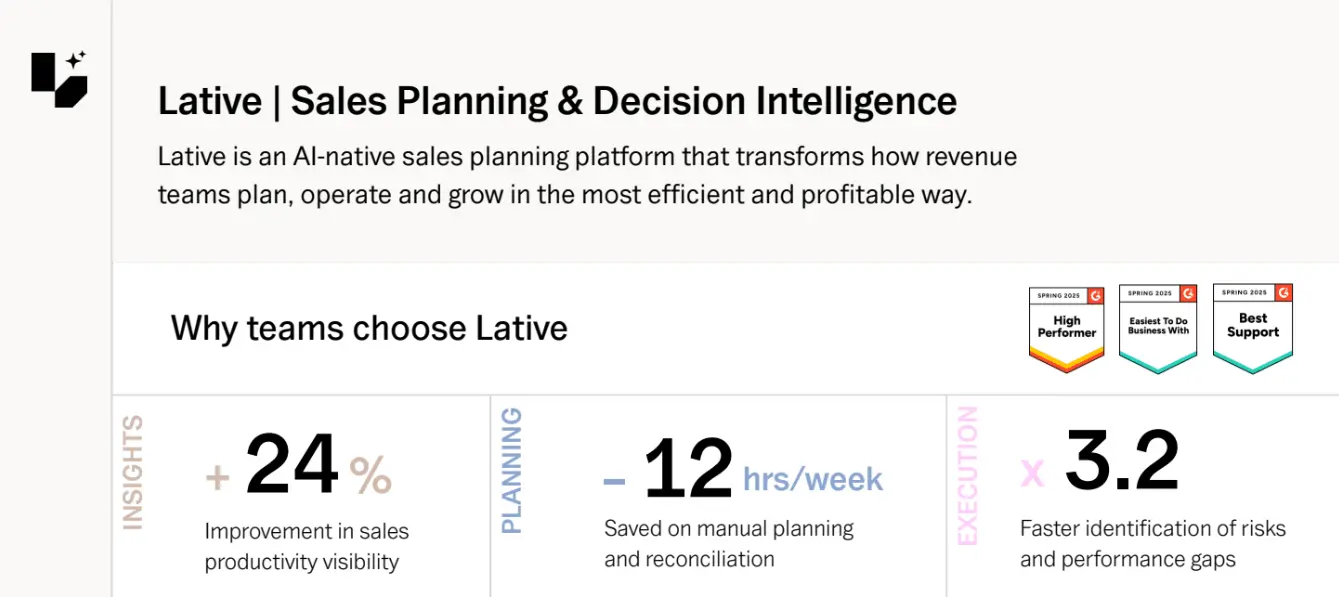
If your last budget review reopened the debate about whether marketing’s numbers can be trusted, you are inside the 85%. See how Lative’s platform gives your GTM team the shared revenue model these numbers show is missing.
Key takeaways
- The credibility gap is structural. 85% of executives cannot map marketing spend to revenue, and 20% of finance leaders trust their current attribution data. That is the operating environment every B2B marketing statistic in 2026 sits inside.
- Sales-marketing alignment is a measurement problem before it is a relationship problem. 88.8% of executives agree marketing and sales should share success metrics, yet 73.5% still align in spreadsheets. The infrastructure has not caught up with the consensus.
- Marketing-sourced pipeline numbers only carry weight when they are calculated against shared stage definitions. As long as 69% of organizations use different terms for the customer journey across functions, the same activity gets reported as success or failure depending on which framework you apply.
- AI adoption alone does not close the revenue accountability gap. HubSpot reports 64% of marketers use AI, but McKinsey finds only 21% have redesigned the workflows around it. AI-assisted output on top of a lead-centric data model produces the same CFO skepticism faster.
- RevOps maturity is the variable that separates organizations that can defend a marketing budget from those that cannot. Gartner shows marketing budgets falling to 7.7% of revenue while 71% of CMOs say they cannot execute their plan. Attribution accuracy at the opportunity level is the prerequisite for reversing that compression.
Frequently asked
Which B2B marketing statistics matter most for budget defense?
The statistics that matter most for budget defense are the ones a CFO can verify against the system of record: marketing-sourced pipeline at the opportunity level, pipeline coverage by segment, sales cycle length by stage, and win rate by source. Reach, impressions, and MQL volume are useful for diagnostics but rarely survive a budget review on their own. The 20% finding above, that just one in five finance leaders trusts their company’s current attribution data, is why the operational shift toward opportunity-level reporting has become a budget defense requirement, not an analytics preference.
How do B2B marketing statistics on sales-marketing alignment translate to operating model changes?
The 48% somewhat-aligned figure and the 88.8% agreement on shared success metrics together describe an organization that knows what it should do and has not built the infrastructure to do it. The operating model change has three components: a shared opportunity-centric data model accessible to marketing, sales, and finance from the same source, stage definitions written once and applied across functions, and a weekly cadence where the three functions review the same coverage and conversion numbers. Without those three components in place, the alignment statistic does not move regardless of how often the leadership team commits to it.
Are B2B marketing statistics on AI adoption changing how CMOs report on marketing impact?
AI adoption statistics are changing what gets reported faster than they are changing the underlying revenue accountability question. HubSpot and McKinsey both show that adoption is at majority levels while systematic workflow redesign sits below a quarter of organizations. For CMOs, the reporting shift that matters is moving from program-level AI usage metrics, which the CFO does not weight heavily, to AI-attributable revenue lift at the opportunity level. That second framing only becomes possible once the underlying data model already produces accurate opportunity-level attribution without AI in the mix.
Lative Team — Lative is the AI-native GTM platform that connects marketing intelligence to sales capacity planning on one shared data foundation.