
After 20 years in RevOps, here is what I’ve stopped finding surprising: CMOs getting fired for not showing revenue impact. What still surprises me is how many teams plan against targets that were never grounded in actual data. They start with the number they want and work backwards. They never start with the truth.
Start with the truth, not the target. That is the first principle on this list, and every other one follows from it.
Revenue marketing is an operating principle: your team is accountable for its contribution to revenue, not just leads, impressions, or engagement. The nine principles below define what it takes to close that gap in 2026, when AI-native platforms make full revenue accountability achievable without a 10-person RevOps team or six months of data engineering.
Revenue marketing vs traditional demand generation
Demand generation hands sales a volume of leads and measures its own success by how many it produced. Revenue marketing hands the business marketing-sourced revenue and measures its own success by what closed. The activities can look identical from the outside, the same campaigns, the same channels, the same content. The accountability is not the same.
The shift is structural, not semantic. A demand generation org reports MQL volume, cost per lead, and channel engagement. A revenue marketing org reports marketing-influenced pipeline, marketing-sourced revenue, pipeline coverage by segment, and the variance between the planned program mix and what the closed deal data says actually worked. The data foundation is wider, the reporting cadence is faster, and the conversation with finance is different.
CMO accountability is the second structural difference. In the demand gen model, a CMO can hit the lead target and still miss the revenue plan, and the boundary of responsibility ends at lead handoff. In the revenue marketing model, lead quality is a sales problem only after marketing has been measured on closed-revenue contribution by segment. The board target is shared. The forecast is shared. The pipeline number is shared. GTM alignment stops being a quarterly ritual and starts being a weekly cadence.
Nine principles of revenue marketing in 2026
Nine is not an arbitrary number. These are the nine dimensions where revenue marketing consistently diverges from the lead-centric model that most B2B teams inherited.
Each one reflects a specific decision point where marketing has historically optimized for the wrong thing: top-of-funnel activity instead of closed revenue, individual leads instead of account engagement, attribution credit instead of business impact.
Each one also represents a specific capability that AI-native platforms now make achievable without a data engineering team or a six-month integration project. Marketing-influenced pipeline, segment-level forecast accuracy, and account engagement scoring are the three capabilities most teams previously deferred because the infrastructure cost did not pencil.
When AI Features Fail to Compound
OpenView’s 2023 SaaS Benchmarks report, based on 710 operators, found that AI-native companies are 3.3 times more likely to be growth outliers than their non-AI-native peers. The gap is not in having AI features: 77% of SaaS companies launched AI capabilities in 2023. Only 15% monetized them.
The difference between feature launch and competitive advantage is whether the AI runs on unified GTM data, where revenue attribution traces every campaign back to a closed opportunity, or on another siloed system.
| We value… | Over… | Why it matters in 2026 |
|---|---|---|
| Full-funnel GTM accountability | Top-of-funnel focus | AI-native platforms now connect marketing investment to closed revenue without manual reconciliation. Optimizing only for MQLs leaves the most valuable signal, what actually closed, off the table. |
| Revenue impact | Lead counts | A CMO who reports in lead counts is speaking a language the CFO does not use. Revenue impact, pipeline influenced, deals accelerated, revenue contribution, is the only currency that gets budget approved. |
| Account engagement | Individual leads | B2B buying is a committee decision. Marketing that tracks individual lead scores while ignoring account-level engagement is optimizing for the wrong unit of measure. |
| AI-native forecasting | Historical reporting | AI-native GTM forecasting is now standard infrastructure, not a differentiator. Marketing teams still explaining last quarter’s results without forecasting next quarter’s outcomes are operating one quarter behind. |
| Story-driven insights | Data tables | Executives do not act on tables. They act on explanations. The CMO’s job is to explain what the data means and what should happen next. |
| Buyer journey intelligence | Single-touchpoint attribution | Multivariate attribution that maps the full account journey from first touch to closed-won is now achievable without a data science team. Last-touch attribution has no defense in 2026. |
| Business impact over attribution credit | Attribution politics | Whether a deal was marketing-sourced or sales-sourced is a distraction. The question is whether marketing’s program mix is generating the revenue the business needs. |
| Credible, finance-grade metrics | Vanity numbers | Impressions, clicks, and open rates do not survive CFO scrutiny. Marketing’s metrics need to live in the same model as sales forecasts and financial projections. |
| Unified GTM execution | Disconnected marketing plans | The CMO, CRO, and CFO operating from separate dashboards is the single biggest driver of GTM misalignment. One data foundation, one shared model, one set of numbers. |
What changed that makes revenue marketing achievable in 2026
Gartner research found that 54% of marketing decisions are still made without the data, insights, or analytics needed to make them confidently. The problem is measurement philosophy, not data availability. Spencer Stuart found that more than two-thirds of CMOs now face direct CEO and CFO pressure to deliver measurable cost savings from AI investments within two years.
The CFO is no longer a downstream audience for marketing metrics. The CFO is in the room at annual planning, and the budget conversation is different.
Lative’s Marketing Intelligence module was built specifically to answer the questions that room asks: which programs drove closed revenue, what the pipeline coverage is by segment, and whether the current plan will get the business to the board target.
These principles are not new. What changed is that executing against them no longer requires a six-month data engineering project. Three structural shifts made 2026 the year these principles become operational for the median B2B marketing team:
- analytical bottleneck In prior years, connecting marketing activity to revenue outcomes required a RevOps analyst, a BI tool, and a standing weekly report. AI-native platforms generate the narrative automatically, surface the anomalies in real time, and flag the pipeline signals that would have gone unnoticed until the quarterly post-mortem. The bottleneck was always human capacity for synthesis, not data availability.
- continuous planning Annual planning produces a plan that is wrong by February. The teams executing these principles have replaced the annual plan with a continuous cadence: bottoms-up from actuals, compared to top-down targets as a constraint, reviewed weekly so the plan breathes with the business instead of going stale. A plan that cannot update when assumptions change is a guess that gets locked in.
- CMO-CRO relationship In high-performing GTM organizations, the CMO and CRO operate from the same pipeline model. Marketing is part of the revenue engine, and the data infrastructure needs to reflect that.
When Benchling‘s marketing team applied this model, the quarterly debate about whose pipeline number was right stopped. The CMO, CRO, and CFO moved to a single shared view of opportunity records.
Marketing’s attribution data came from the same Salesforce data that finance used to build the revenue forecast, which made CMO accountability for revenue contribution structurally clear rather than negotiated each quarter. The budget conversation changed from defending a marketing attribution claim to walking through what the program mix had actually produced in closed revenue.
Why Shared Data Makes Version Conflicts Impossible
Two versions of the truth became structurally impossible.
That is the practical outcome of these three structural shifts, not an abstraction.
Lative’s Marketing Intelligence module is built on these principles. Every planning, attribution, and forecasting layer maps to the operating model described here, not a legacy lead-centric model bolted onto the wrong framework.
The infrastructure these principles require
A manifesto without a platform is a poster. Executing against these nine principles requires infrastructure that connects marketing activity to revenue outcomes in real time, not a quarterly reporting exercise.
Look, I have watched this same gap play out at companies across every size and sector for two decades. The nine principles exist as a manifesto and not a reality at most companies because the data infrastructure to execute against them was too expensive and too slow to build.
RevOps teams spent their capacity on data plumbing instead of analysis. Marketing and finance reconciled pipeline numbers in separate spreadsheets at quarter-end. That has changed. The infrastructure cost dropped from eighteen months of engineering to a week of field mappings.
The Data Infrastructure Revenue Marketing Requires
That means a GTM data foundation that unifies marketing signals (engagement, attribution, campaign performance), sales signals (pipeline coverage, opportunity movement, capacity), and financial signals (revenue plan, bookings pace, forecast variance) in one place.
It means AI-native forecasting that tells you not just what happened last quarter but what is likely to happen next quarter if current trends hold. And it means executive narratives that translate all of it into language the CEO, CFO, and board can act on without requiring a data team to build a slide deck first.
The CMOs who execute these principles most effectively are the ones who have already closed the marketing credibility gap with their CFO and CRO, building trust through shared data before they need to ask for budget.
Lative’s Unified GTM Data Foundation
Lative’s Marketing Intelligence and sales capacity planning platform is built on exactly this foundation: two modules, one data layer, the same opportunity records feeding marketing attribution and sales capacity decisions simultaneously.
Operationalizing these principles means one platform, not two: Lative connects marketing intelligence to sales capacity planning on a single data foundation.
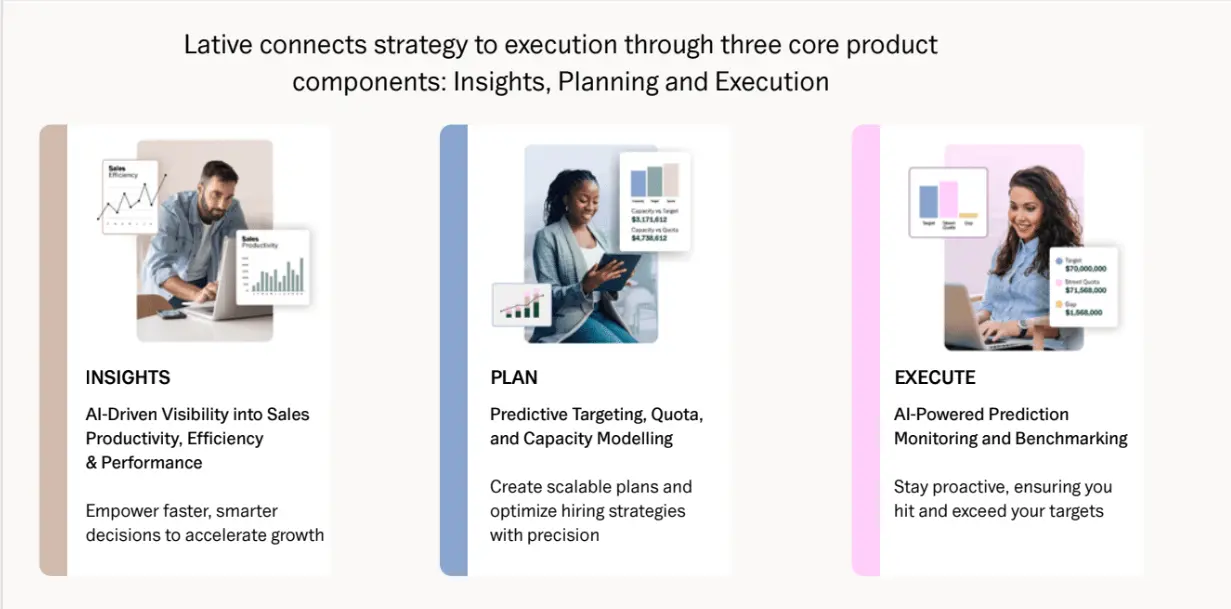
If your team believes in full-funnel accountability but still reports to the CFO in MQL counts, the gap is infrastructure. See how Lative makes these nine principles operational.
Key takeaways
- Revenue marketing is an accountability model, not a tactic. The team is measured on contribution to closed revenue, not on lead volume, impression count, or engagement score.
- Start with the truth, not the target. Plans built backwards from a desired number rather than forwards from actual pipeline data are how CMOs lose credibility with the CFO before the first quarterly review.
- Account engagement is the unit of measurement in B2B. Tracking individual lead scores while ignoring committee-level account signals is optimizing for the wrong level of resolution.
- AI-native forecasting is now baseline infrastructure for revenue marketing, not a differentiator. Reporting last quarter’s results without forecasting next quarter’s outcomes is operating one quarter behind every peer with a current GTM data foundation.
- CMO, CRO, and CFO operating from one shared data foundation is the practical definition of GTM alignment. Three dashboards is three versions of the truth, and the budget conversation reflects that every time.
Frequently asked
What is revenue marketing in B2B?
Revenue marketing is a B2B operating model in which the marketing team is accountable for its contribution to closed revenue, not for lead volume or top-of-funnel activity. It rests on three structural shifts: a shared pipeline model with sales and finance, revenue attribution that traces program spend to closed opportunities, and a planning cadence that updates with actuals rather than locking in an annual guess. The activities and channels often look similar to demand generation. The measurement, accountability, and conversation with the CFO are different.
How is marketing-sourced revenue measured?
Marketing-sourced revenue is the closed revenue from opportunities where marketing produced the first qualifying touch, measured against the same opportunity records that finance uses for the forecast. The standard report shows marketing-sourced revenue by segment, marketing-influenced pipeline by segment, and the variance between planned program contribution and actual contribution at quarter close. The credibility of the number depends on whether marketing attribution and the sales forecast read the same opportunity table. If they do not, the quarterly debate is about which spreadsheet is right rather than what the program mix should be next quarter.
What does pipeline coverage look like for a revenue marketing team?
The standard target is three times forward-quarter coverage, calculated as open pipeline divided by quarterly bookings target by segment. Revenue marketing teams report coverage by segment and by source rather than as a single company number, because the coverage gap that matters is the one in the segment with the largest planned contribution. Marketing-influenced pipeline counts toward coverage when there is an auditable first or last touch tied to the opportunity record. Forecast accuracy by segment is the credibility metric on top of coverage. A team running healthy coverage with a forecast that misses by 20 percent every quarter has a measurement problem, not a pipeline problem.
Werner Schmidt — Werner Schmidt is the CEO and Co-founder of Lative, with over 20 years of experience in Revenue Operations with companies including Forcepoint, Aruba Networks, Citrix, and Sage.