

Your team generated 400 MQLs last quarter. Your CRO said pipeline quality was down. Both were probably true.
The MQL volume looked right. The pipeline quality problem was upstream: lead source misattribution in the CRM, stage dates that were never populated, and a handoff SLA that three different reps were interpreting differently. The 400 MQLs were real. What they represented in the pipeline was not.
Lative’s Marketing Intelligence platform reads your CRM data directly, same Salesforce instance, no middleware export, and reconstructs the demand engine view from stage transitions, not from form fills and MQL counts. The 400 MQLs and the pipeline quality problem appear in the same model.
What the marketing intelligence platform is built on
When Lative acquired Mperativ’s Marketing Intelligence capabilities, the goal was integration: not just adding marketing analytics to the platform, but building a single GTM data foundation where the CMO, CRO, and CFO operate from the same records. That integration is what separates a dashboard that produces marketing metrics from a platform that produces revenue insights.
Lative brings four interconnected capabilities into one data foundation:
- Marketing Intelligence: campaign attribution, pipeline coverage, ICP analysis, and AI-generated executive narratives
- Sales Capacity Planning: bottoms-up pipeline models, headcount planning, and territory coverage
- Revenue Supply Chain: a single continuous measurement chain from first marketing touch to closed revenue
- Demand Council: a weekly cross-functional cadence connecting marketing, sales, and finance to the same pipeline model
Most marketing analytics platforms produce snapshots. They show what the pipeline looks like today, what campaigns ran last month, and which channels had the highest MQL volume. The failure mode: you cannot forecast from a snapshot.
You cannot explain to a CFO why Q3 will miss plan based on a chart that shows current pipeline. And you cannot build a credible budget case on data that cannot be traced to individual opportunity records.
OpenView’s 2023 SaaS Benchmarks report, surveying 710 B2B software operators, found that 77% of SaaS companies launched AI features in 2023, yet only 15% successfully monetized them.
The Traceability Gap Snapshot Tools Cannot Close
That gap is a data infrastructure problem: teams that cannot connect AI feature adoption to pipeline quality and closed revenue have no way to demonstrate whether the investment is working. That is the traceability gap Lative was built to close.
Lative’s Marketing Intelligence platform is built on a bi-temporal data architecture, which records both what was true at any point in time and when that fact was recorded.
Every pipeline figure, every conversion rate calculation, and every attribution claim is traceable back to the underlying opportunity records that produced it. An executive who questions a pipeline coverage number can drill to the individual deals behind it and verify the calculation.
Serverless Architecture, Same-Day CRM Connection
There is no black-box aggregation layer.
The platform runs on a serverless data warehouse, which means no infrastructure provisioning, no data engineering project to stand up, and same-day connection to your existing CRM and marketing automation stack.
For enterprises that have historically spent $100K or more annually on custom analytics build-outs to connect marketing and revenue data, this is the architecture difference that changes the build-vs-buy calculation.
The Revenue Supply Chain: replacing the funnel
The traditional sales funnel hands off at the MQL stage and marketing loses visibility. What happens between first touch and closed revenue becomes sales territory, invisible to the CMO, and unattributable in the budget conversation.
When Trulioo brought on its first CMO, Dawn Crew, the company needed marketing influence to be visible across the full account journey, not just at the MQL handoff.
Lative’s Marketing Intelligence platform replaced the traditional funnel view with a revenue supply chain model: a continuous view that tracks every opportunity from first engagement to close, showing exactly how programs influence opportunity progression, at which funnel stages, and with which accounts.
Marketing gets traceable evidence of influence across the full account journey, not credit for every deal that touched a campaign, which is what the CFO needs to evaluate program ROI and what the CRO needs to align coverage with marketing activity.
Opportunity Cards and the Account Quality Index
Every target account in Lative’s Marketing Intelligence platform has an Opportunity Card: a single-view summary of the account’s pipeline status, engagement history, marketing touch coverage, and an Account Quality Index (AQI) score that synthesizes engagement breadth, recency, and depth into a single number you and your CRO can act on.
The AQI solves a specific failure mode: the situation where marketing reports strong MQL volume while your CRO simultaneously reports that pipeline quality is deteriorating. Both can be true, and without account-level scoring that combines marketing signals with pipeline data, neither side can prove its point or diagnose the cause.
AQI provides a single shared quality signal, computed from both functions’ data, that ends that dispute with evidence rather than competing narratives.
AI-native analysis: data journalism applied to GTM
Most BI tools produce data tables and expect humans to extract insights. The failure mode is well-documented: the table gets emailed, the recipient forms their own interpretation, and the meeting starts with two people who read the same numbers differently.
Lative’s AI GTM Analyst applies data journalism principles to the GTM data set: the insight is in the story the data tells over time, not in any single snapshot.
Ask it what is driving pipeline decline, which channels are generating quality account-level engagement, or how the current program mix tracks against the revenue plan. The AI reads the data, identifies the patterns, and writes the narrative in terms you, your CRO, and your CFO can act on, without a separate interpretation step.
Time-series intelligence: forecasting, not just reporting
The failure mode with snapshot-based marketing analytics: by the time a trend is visible in a quarterly review, the decisions that would have addressed it were due six weeks ago.
Lative’s Marketing Intelligence platform captures continuous time-series data, tracking how pipeline, engagement, and conversion metrics evolve over time, enabling the question the CFO actually wants answered: not what happened last quarter, but what is likely to happen next quarter if current trends hold, and what would need to change to hit plan.
What changes when your CRO and CFO are on the same data
The strategic value of Lative’s Marketing Intelligence is the shared data foundation. When you, your CRO, and your CFO operate from the same GTM platform, the conversations change.
You do not translate marketing metrics into finance terms. Your CRO does not reconcile a different pipeline number against what you reported. Your CFO does not arrive at the planning meeting with a separate revenue model that contradicts both.
Same data. Same definitions. Same attribution logic.
When Marketing, Sales, and Finance Run Three Different Numbers
That single shared foundation extends beyond marketing into sales capacity planning, so marketing’s pipeline and the capacity to close it read from one model.
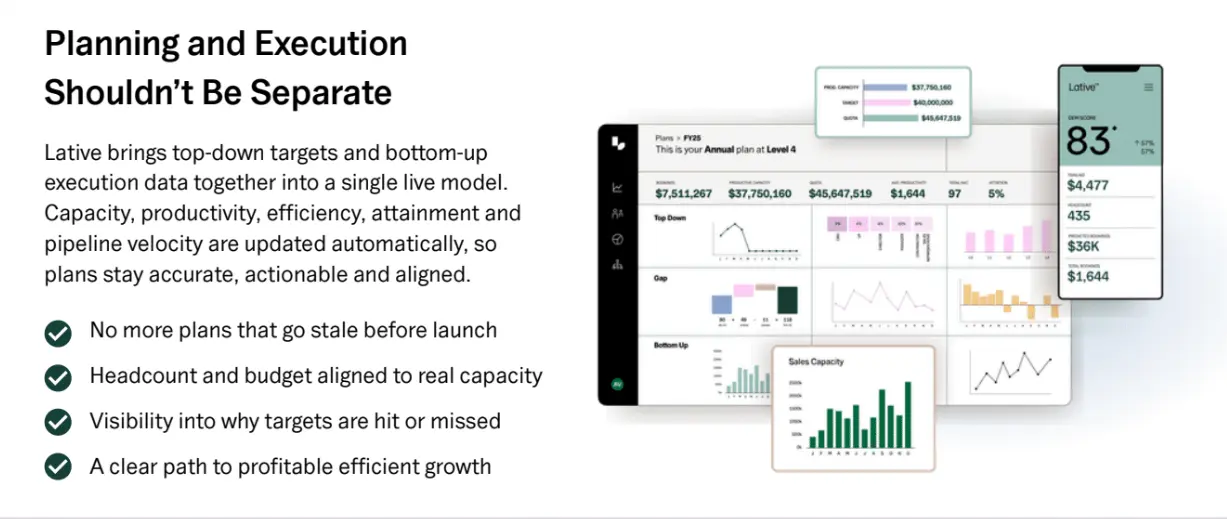
If your last planning meeting had marketing, sales, and finance working from three different pipeline numbers, that is the architecture problem Lative was built to solve. Request a demo and see your own GTM data on a single shared foundation.
Key takeaways
- An AI-native marketing intelligence platform is defined by its data model, not by the chat layer on top of it. Remove the AI and the platform should still expose opportunity-level records traceable to the source CRM.
- Bolted-on analytics inherit the fidelity of the lowest-resolution layer underneath. A coverage number that already lost precision in a BI cube does not regain it when an LLM summarizes the cube.
- Bi-temporal storage is the structural reason an AI-native platform can answer “what did we believe on August 14th” with the same fidelity as “what do we believe today.” Retrofit stacks cannot reconstruct prior states.
- Same-day connection to the source CRM is an architectural property of serverless, event-driven platforms. Custom analytics build-outs in the $100K+ range exist to compensate for stacks that do not have it.
- The right test for a marketing intelligence platform is not “does it have AI.” It is “can the CMO, CRO, and CFO drill from a single executive number to the underlying opportunity records in one session, without leaving the platform.”
Frequently asked questions
What is the difference between an AI-native marketing intelligence platform and a legacy BI tool with AI features added on top?
An AI-native marketing intelligence platform is built so that AI agents read opportunity-level records directly from the source CRM, with a bi-temporal data model that preserves both the value and the as-of date of every field. A legacy BI tool with AI features added on top can only read the aggregated dashboard layer, which means the AI inherits whatever fidelity was lost in the ETL and cubing steps upstream. The difference shows up the first time a CFO asks for the math behind a pipeline coverage number.
How does an event-driven data model change what a marketing intelligence platform can do?
An event-driven data model means that when a stage date changes in your CRM, the next coverage calculation, the next Account Quality Index score, and the next AI-generated narrative all reflect that change immediately, with no batch refresh in between. That is what makes weekly Demand Council reviews possible. Batch-oriented stacks force the cadence to match the refresh window, which is usually weekly at best and monthly in practice.
When does a custom analytics build-out make more sense than an AI-native marketing intelligence platform?
Almost never, at the price points enterprises actually pay. Custom analytics build-outs in the $100K to $500K range exist to reconcile a CRM, a marketing automation tool, and a BI cube into a single marketing-to-revenue view. An AI-native marketing intelligence platform with a serverless data warehouse and same-day CRM connection collapses that build-out into a configuration exercise. The build-vs-buy calculation has shifted, and the only remaining case for the custom build is when the data foundation must live inside a regulated environment that the platform vendor does not yet support.
Lative Team — Lative is the AI-native GTM platform that connects marketing intelligence to sales capacity planning on one shared data foundation.
AI-native architecture versus bolted-on analytics: why retrofit attribution stacks fail
The phrase “AI-native marketing intelligence platform” gets used to describe two very different things. One is genuinely AI-native: the data model, the storage layer, and the query engine were designed from the start to support agent-grade reasoning, traceable evidence, and continuous learning. The other is a legacy reporting stack with an LLM-powered chat layer bolted on top. The two architectures produce different results on the same question, and the difference shows up the first time a CFO asks for the math behind a coverage number.
The failure mode with bolted-on analytics is structural, not cosmetic. The underlying schema was designed for human-authored reports, batch ETL refreshes, and dashboard-level aggregation. When an AI feature is added on top, it can summarize the dashboard, but it cannot reach the opportunity records that produced the dashboard, cannot reconstruct the stage transitions that occurred between refreshes, and cannot tell you which assumptions in the attribution model are stale. The chat layer is fluent. The system underneath is still a snapshot.
An AI-native marketing intelligence platform inverts that stack. The bi-temporal data model captures both the value and the as-of date for every field, so the AI GTM analyst can answer “what was pipeline coverage on August 14th, before the September re-segmentation” with the same fidelity as “what is coverage today.” The serverless data warehouse processes opportunity-level records natively rather than aggregating them upstream into a reporting cube. The event-driven data model means that when a stage date changes in your CRM, the next coverage calculation, the next AQI score, and the next AI-generated narrative all reflect that change without a batch job in between. That is what makes the platform suitable for a Demand Council that meets weekly, not quarterly.
The retrofit alternative is what most enterprise GTM stacks look like today: a marketing automation tool, a CRM, a separate BI tool, and a recent layer of generative AI summarization on top. Each layer was built for a different question. Pipeline coverage in the BI tool does not reconcile to pipeline coverage in the CRM, and the AI summary inherits the lower-fidelity number. A marketing intelligence platform that is genuinely AI-native solves that reconciliation at the data layer, not at the slide layer. That is the difference between an analytics product that helps you describe what happened and a platform that helps you change what happens next.