

When Lative acquired Mperativ, the thesis was this: marketing intelligence and sales capacity planning belong on the same data foundation, not connected by a weekly export, not reconciled in a spreadsheet before the joint operating review, but running on the same model, with the same definitions, so the CMO and CRO are working from the same numbers before they walk into the same room.
Lative’s survey of more than 500 executives across marketing, sales, finance, and C-level roles found that 85% of executive teams cannot consistently map marketing spend to revenue outcomes, a structural consequence of marketing and revenue data living in separate systems. Marketing Intelligence is now a module inside Lative’s AI-native GTM platform. Here is what it contains.
The difference between a feature and a competitive advantage is whether the AI runs on unified GTM data or on another isolated system.
The Revenue Supply Chain
The traditional sales funnel divides marketing and sales at the lead-to-opportunity handoff. Marketing tracks leads. Sales tracks opportunities. Neither function has a continuous view of the customer journey from first engagement to close, and neither can easily connect their contribution to the revenue outcome at the end of the chain.
The Revenue Supply Chain replaces that divided view with a single model that measures every stage around revenue. Every point of engagement, from the first marketing touch through SDR acceptance, qualification, and close, is tracked as part of one continuous chain.
Velocity is measured from the first point of engagement, not from when sales accepts the opportunity. Marketing can value its contribution in the same revenue-centric terms the CRO and CFO use, because the model is built around revenue from the start.
Revenue Insights
Revenue Insights applies a data-journalism approach to the KPI narratives that matter most to the executive team. The visualizations are interactive and built for the board deck, the QBR, and the CFO conversation where marketing’s contribution needs to be expressed in language finance recognizes. The module covers:
- Revenue momentum: Marketing spend versus pipeline and closed-won revenue generated, updated in real time.
- Customer cohort retention: Marketing contribution to renewal and expansion, not just new pipeline.
- Pipeline growth and coverage: Current coverage ratio by segment against the quarterly target threshold.
- Revenue objectives progress: Marketing plan versus actual, tracked across the current quarter with trend lines.
CRMs and marketing automation systems capture snapshots. Revenue Insights captures time-series data: not just where the pipeline stands today, but how it has been moving, when it moved, and what the trend implies for the remainder of the quarter. That time-series foundation is what separates a marketing intelligence view from a CRM dashboard.
Opportunity Cards and Account Quality Index
Every metric in Marketing Intelligence drills through to the individual opportunities that make it up. Opportunity Cards surface five data points in a single view:
- Company and opportunity details: deal value, stage, and account firmographics
- Marketing campaigns that influenced the opportunity: which programs touched it and when
- Associated contacts: the buying committee members who engaged
- Account activity: engagement history across all touchpoints
- Opportunity owner: the sales rep responsible for the deal
The Account Quality Index scores companies against a scale based on target location, target industries, revenue range, headcount, and target account status, giving marketing and sales a shared framework for evaluating account fit.
Technical foundation: bi-temporal data and serverless architecture
OpenView’s 2023 SaaS Benchmarks report, based on 710 operators, found that AI-native companies are 3.3 times more likely to be growth outliers than their non-AI-native peers. The architectural reason is clear: AI running on unified GTM data produces different outputs than AI running on another isolated system.
Lative’s Marketing Intelligence module is bi-temporal: it records data as it actually was, in combination with when it was recorded. This means users can track how a value changed over time and understand both what was known and when it was known.
That extra context is essential for accurate trend analysis and predictive forecasts, particularly for pipeline coverage forecasting, where knowing when a value was recorded is as important as knowing what the value was.
The serverless data warehouse means there is no hardware provisioning, no custom data model to build, no complex architecture to maintain. A CRM connection is all that is required to get the platform running. Setup takes a day.
The 62% of enterprises that have historically spent over $100,000 building custom marketing analytics platforms spend that money because the alternative did not exist. Marketing Intelligence is the alternative.
Marketing Intelligence inside the Lative platform
What changes when Marketing Intelligence sits on the same data foundation as Lative’s sales capacity planning module is the operating model. The CMO’s pipeline coverage forecast and the CRO’s capacity plan draw from the same opportunity data. When marketing’s AI predicts that enterprise pipeline coverage will come in 0.3x below target, the CRO’s capacity model sees the same signal.
The question, do we have enough reps to cover the pipeline that is actually going to materialize, gets answered from one platform rather than from two separate planning processes that are reconciled after the fact.
When AskNicely reset its entire GTM engine on this foundation, their quarterly pipeline reviews stopped being a dispute about whose number was right and became a calibration conversation against shared data. The full story is in the AskNicely case study.
How AskNicely Ended the Disputed Pipeline Number
Marketing Intelligence is one half of that foundation; the other is sales capacity planning, and Lative runs both on the same model.
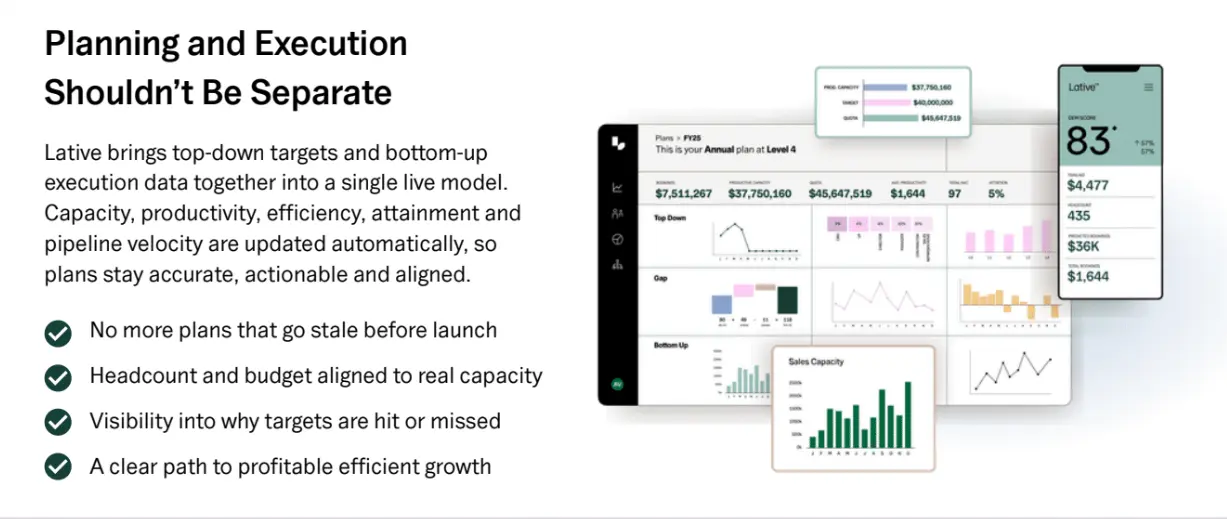
If your marketing and revenue data currently live in separate systems and your last joint planning meeting required someone to reconcile them manually, that is the architecture problem Marketing Intelligence was built to solve. See Lative’s Marketing Intelligence module in action.
How a revenue marketing platform aligns CMO and CRO planning
A revenue marketing platform earns its name when the marketing-sourced pipeline number the CMO defends and the pipeline coverage number the CRO commits to are derived from the same underlying model. When those two numbers come from separate systems, joint planning becomes reconciliation theater. The CMO presents a slide, the CRO presents a slide, and the gap between them is closed by the person in the room with the most political capital, not by the data.
Marketing Intelligence inside Lative removes the reconciliation step. Marketing-influenced revenue, pipeline coverage by segment, and capacity-to-coverage ratio all read from one Revenue Supply Chain. The joint operating review starts from agreement on the inputs and spends its time on the decisions: where to add capacity, where to redirect spend, and which segment needs an intervention before the quarter closes.
From marketing-sourced pipeline to GTM platform accountability
Marketing-sourced pipeline is a useful metric only when it is calculated the same way as every other pipeline metric the executive team reviews. A GTM platform built on a shared data foundation calculates marketing-sourced pipeline, sales-sourced pipeline, and expansion pipeline from one definition of opportunity stage and one definition of stage entry. The CMO can defend the marketing-sourced number because it is not a parallel calculation, it is a slice of the same pipeline the CRO is forecasting against.
Revenue attribution that the CFO will sign off on
Revenue attribution only becomes credible at the finance table when the touch model and the revenue model live in the same system. Marketing Intelligence captures every touchpoint as part of the Revenue Supply Chain rather than as a parallel attribution layer. When marketing argues that a campaign influenced $1.2M in closed-won revenue, the CFO can trace that figure back to the same opportunity records the controller reconciles at quarter close.
Marketing-influenced revenue versus marketing-sourced pipeline
The two metrics answer different questions. Marketing-sourced pipeline measures origination, the deals that would not exist without marketing. Marketing-influenced revenue measures contribution, the deals that closed faster, larger, or at a higher win rate because of marketing engagement. A serious revenue marketing platform tracks both in the same view, so the CMO can defend the sourcing number to the board and the influence number to the CRO without switching tools or rebuilding the slide.
Key takeaways
- A revenue marketing platform earns the name only when marketing intelligence and sales capacity planning run on the same model, not when they are connected by a weekly export reconciled before the QBR.
- The Revenue Supply Chain replaces the divided funnel with one continuous chain from first marketing touch through close, so velocity is measured against revenue rather than against arbitrary stage transitions.
- Pipeline coverage calculated on the same model the CRO uses for capacity removes the parallel-calculation problem that turns joint planning into a reconciliation meeting.
- Bi-temporal data records both what was true and when it was known, which is what separates accurate trend forecasting from snapshot reporting that cannot explain why a number moved.
- One-day setup on a serverless data foundation replaces the multi-quarter custom build that 62% of enterprises have historically funded to get this view, and the alternative did not exist until now.
Frequently asked questions
What is a revenue marketing platform and how is it different from a marketing automation system?
A revenue marketing platform measures marketing activity against revenue outcomes on the same data foundation the CRO and CFO use for pipeline and capacity. A marketing automation system orchestrates campaigns and captures engagement. The difference is the data layer underneath. Lative Marketing Intelligence reads the same Revenue Supply Chain that the sales capacity module reads, so marketing-sourced pipeline reconciles to forecast pipeline by construction.
Why does a revenue marketing platform need bi-temporal data?
Forecasting and trend analysis require knowing not only the current value of a metric but when that value was recorded. Bi-temporal data captures both dimensions, so the platform can answer questions like “what did we know about Q4 coverage on October 1 versus November 1.” Without that history, a revenue marketing platform can only describe the present, not explain how the present arrived or where the next quarter is heading.
Can a revenue marketing platform replace a custom-built BI stack for GTM reporting?
Yes, in most cases. The custom-built BI stack exists because, until recently, no off-the-shelf system unified marketing intelligence and sales capacity planning on one model. Lative ships that unified model on a serverless data warehouse, with setup measured in a day rather than a quarter. Most teams that historically funded a custom build can retire it once a revenue marketing platform is in place.
Lative Team — Lative is the AI-native GTM platform that connects marketing intelligence to sales capacity planning on one shared data foundation.