

Set a quota too high and reps disengage by February. Set it too low and you leave revenue on the table and overpay on comp.
Most SaaS companies miss in the first direction, and the data shows how badly: The Bridge Group’s 2024 SaaS AE Metrics Report (170+ B2B SaaS companies) found only 51% of AEs hit quota in 2024, down from 66% in 2022, and RepVue’s Q2 2025 Cloud Sales Index put average quota attainment at 42.69% across roughly 47,000 rep ratings. When the average rep closes barely 40% of their number, the quotas were wrong, not the people.
This guide covers how to set quotas for SaaS sales reps from capacity up: the five-step process, the benchmarks that sanity-check the output, a worked example, and the mistakes that quietly guarantee a missed year.
Why most quota-setting fails
The standard method is arithmetic, not analysis: take the revenue target, divide by headcount, add 10 to 20% for “over-assignment,” and distribute. Nothing in that sequence touches ramp position, territory quality, segment mix, or what each rep has historically attained.
The quota is an allocation of hope. When it misses, the post-mortem blames execution, the next cycle adds more cushion to the same broken math, and attainment declines another few points. Breaking the loop requires starting from the other end: what can this roster actually produce?
One scoping note before the steps: this guide assumes revenue (bookings) quotas, the standard for SaaS AEs because they map directly to the capacity model.
Activity quotas suit SDRs and brand-new outbound motions; combination quotas, a revenue number with an activity floor, help where a single metric drives the wrong behavior. Whatever the type, the method below is the same: derive the number from capacity, never from division.
Step 1: Establish each rep’s productive capacity
For every ramped rep, capacity = quota carried last period x trailing four-quarter attainment. A rep who carried $1M and attained 65% is a $650K producer until evidence says otherwise. For reps still ramping, apply your cohort ramp curve, what your last two hiring classes actually produced by month, not a flat 50%.
The full math is in how to calculate sales capacity. This bottoms-up number is the floor the entire quota plan stands on.
Step 2: Account for ramp explicitly
New hires need ramped quotas that step up with the curve: for a six-month mid-market ramp, something like 25% of full quota in months one to three, 60% in months four to six, full quota from month seven. Gong’s 2025 onboarding research found new-hire productivity paths are measurable and repeatable when tracked, which means a flat quota from day one is a choice to mismeasure your own people.
An enterprise rep on a nine-month cycle physically cannot close meaningful revenue in month three; a quota that pretends otherwise teaches the rep to ignore the number. For segment benchmarks, see sales ramp time.
Step 3: Segment by role, motion, and territory
An SMB rep running 30-day cycles and an enterprise rep running 270-day cycles should not carry the same quota type, let alone the same number. Set revenue quotas by segment, and balance them against territory potential: a patch that holds $800K of winnable pipeline cannot support a $1.2M quota no matter who works it.
Territory-quota mismatch is the most common hidden cause of “underperformance,” and it is invisible in any model that treats territories as interchangeable.
Step 4: Build in the attainment buffer deliberately
If the team must average 100% attainment for the company to hit plan, the plan fails on normal variance alone. Sum the capacity-based quotas and check coverage: total assigned quota should typically run 10 to 25% above the revenue target, so that realistic attainment, with some reps over and some under, still clears the number.
The buffer is a designed quantity, not an arbitrary uplift, and it should reflect your actual attainment distribution, which is usually skewed: a few reps far above 100%, the median below it.
Step 5: Pressure-test, publish, and revisit quarterly
Before quotas go out: do they roll up to target plus buffer? Does each rep’s number clear the credibility test against their trailing attainment, would a reasonable person believe this rep can hit this number? Does the highest quota-to-OTE ratio stay inside sane bounds?
Then publish with the logic attached, because reps who understand how the number was derived contest it less and chase it more. Revisit quarterly: territory changes, product launches, and team changes all move capacity, and a quota frozen in January describes a company that no longer exists by June.
Quota benchmarks worth knowing
Two sanity checks catch most bad quotas. First, the quota-to-OTE ratio: the traditional rule says quota should run roughly 5x on-target earnings, but the rule breaks at scale and by segment, which is why it is a check rather than a method; the full argument is in sales quota benchmarks by ARR stage.
Second, the attainment-rate target: healthy SaaS teams see 60 to 80% of ramped reps hit quota. Below 50% consistently signals a quota-setting problem, not a talent problem. Above 90% usually means quotas are set soft and the company is overpaying commissions for revenue it would have gotten anyway.
A worked example
A hypothetical Series B company needs $6M from its mid-market team next year. The roster: six ramped reps with 68% average trailing attainment, plus two reps starting in January on a six-month ramp.
Capacity first: to produce $6M, the ramped six need to close $1M each at realistic attainment. Working backward, $1M of expected production at 68% attainment implies a quota near $1.47M, which fails the credibility test against reps whose best year was $1.1M. So the gap cannot be closed by quota inflation alone.
The honest plan: set ramped-rep quotas at $1.2M (expected production about $816K each, $4.9M total), give the two January hires ramped quotas worth about $400K of combined expected production, and close the remaining $700K gap with named levers, a Q1 pipeline program and a ramp-compression effort, rather than by writing fiction into eight comp plans. That is the difference between quota-setting and target laundering.
Common quota-setting mistakes
Top-down division with no capacity check. The target divided by headcount ignores everything that determines what a rep can produce. It is fast, clean, and wrong.
Flat quotas for ramping reps. Charging a month-two rep a full quota does not motivate them; it teaches them the number is decorative.
Ignoring territory potential. Identical quotas on unequal territories convert territory design failures into attainment failures, and good reps into ex-employees.
Comp-plan distortion. Accelerators and cliffs shape behavior around thresholds. If attainment clusters at 78 to 85%, you are seeing comp design, not capacity, and feeding that number back into next year’s quotas bakes the distortion in.
Set-and-forget. Quotas reviewed once a year drift from reality within a quarter. Quarterly review against trailing attainment keeps the number connected to the business.
How Lative sets quotas from capacity
Everything above is a capacity model feeding a quota decision, which is exactly how Lative is built. The Productivity module establishes per-rep production from closed-won data, by segment and tenure-adjusted, so step one is computed rather than estimated. Average Ramping Time supplies real cohort ramp curves for step two.
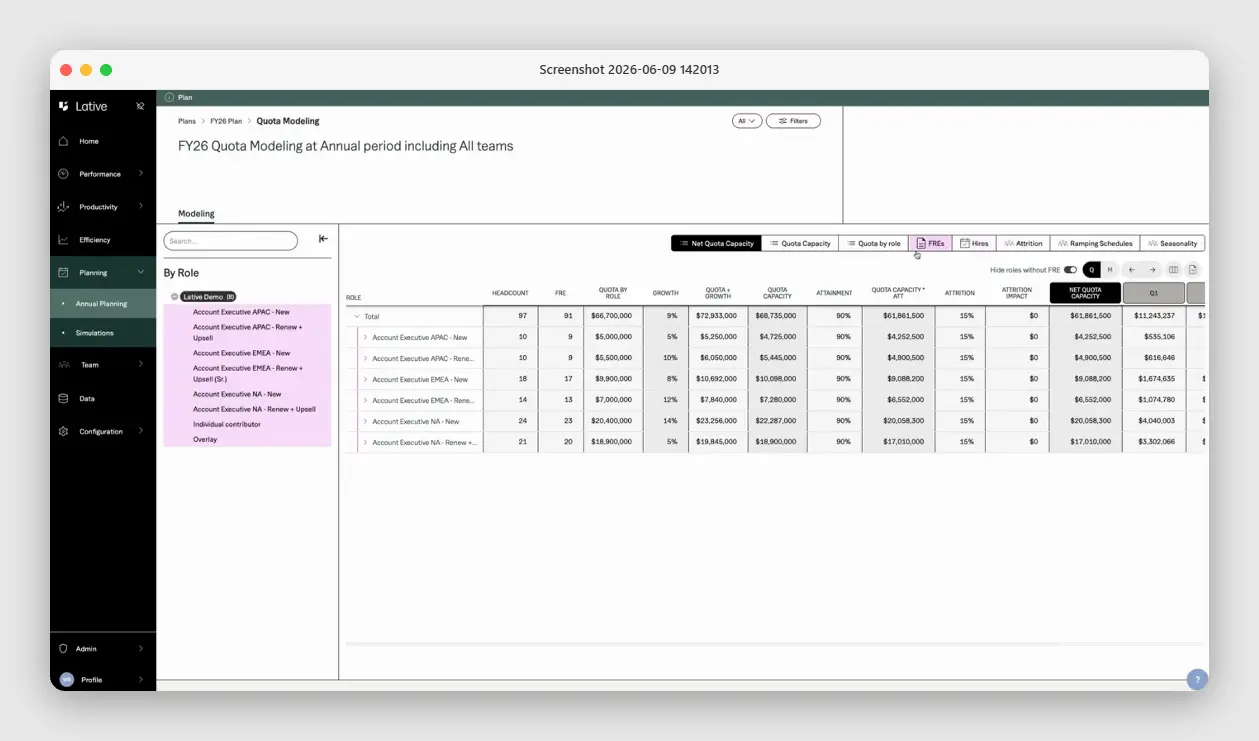
The Quota Modeling view rolls ramp schedules, seasonality, attrition, and quotas by role into net quota capacity, expressed in fully ramped equivalents, so you see what the assigned numbers actually deliver after ramp and attrition drag.
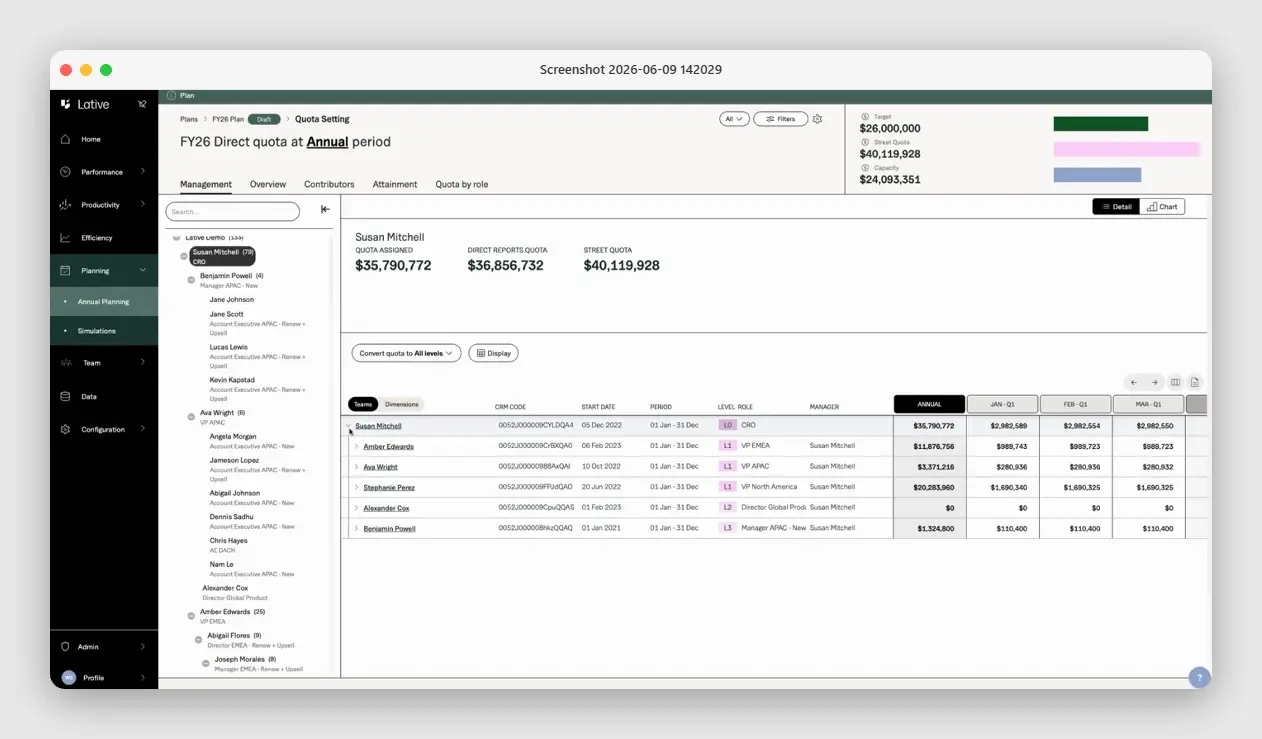
And Quota Setting automates the rollout, showing assigned quota versus direct-reports quota versus direct quota per leader, compared against capacity, so over-assignment is visible before the year starts instead of explained after it ends.
FAQ
How do you set a realistic sales quota?
Start from each rep’s productive capacity (trailing attainment times quota carried, ramp-adjusted), balance against territory potential, sum the roll-up against target plus a 10 to 25% buffer, and pressure-test against each rep’s history.
What is a good quota attainment rate?
60 to 80% of ramped reps hitting quota is healthy. Below 50% signals quotas set above capacity; above 90% usually means quotas are soft. See what is quota attainment.
Should new reps carry lower quotas?
Yes. Ramped quotas that step up with the cohort curve reflect real productivity, keep new hires engaged, and stop the capacity model from overstating early-quarter coverage.
What is the 5x OTE rule for quotas?
A heuristic that quota should be roughly five times on-target earnings. Useful as a sanity check, unreliable as a method, because it ignores segment economics, ramp, and territory quality.
How much should total quota exceed the revenue target?
Typically 10 to 25% over-assignment, sized from your actual attainment distribution so that normal variance still clears the target. More than that converts buffer into demoralization.
How often should quotas be revisited?
Quarterly, against trailing attainment and territory changes. Mid-year adjustments should be rare and rule-based, but the review itself should be routine.
Quota is the load-bearing beam of the revenue plan. Set it from capacity and the plan stands; set it from hope and the year is a slow-motion miss. See the full sales capacity planning guide, or book a demo to see quota modeling on your own roster.