
For many organizations, late July and August mark the start of one of the most important operating processes of the year: annual GTM planning.
Over the coming months, RevOps, Sales, Marketing, Customer Success, Product and Finance will make decisions that shape revenue targets, hiring plans, territories, quotas, budgets and strategic initiatives for the year ahead. Done well, annual planning creates alignment across the business and gives every team confidence in where the organization is heading. Done poorly, it leads to disconnected plans, missed deadlines, and constant course corrections throughout the year.
While no annual plan will survive the year unchanged, a well-structured planning process gives your organization the ability to respond to change with confidence. That’s why the planning process is more valuable than the plan itself. Planning is never truly finished; it’s a continuous discipline.
Start planning before planning season gets busy
One of the biggest mistakes organizations make is waiting until October to begin annual planning.
If your business operates on a calendar-year fiscal cycle, the planning process should begin in late July or early August. This gives teams enough time to align on objectives, validate assumptions, review different scenarios and make informed decisions before budgets, quotas and territories need to be finalized and signed off.
Starting early also reduces one of the biggest causes of planning delays: trying to build the strategy, capacity model and execution plan simultaneously.
Instead, begin by agreeing on how planning will work and who will lead each cross-functional workstream before deciding what the plan should be.
Align on the goals of the planning process
Before anyone starts building models or debating revenue targets, leadership should agree on what success looks like.
An initial planning discussion between GTM Leadership, RevOps and Finance should focus on four key questions:
- What are the objectives of this year’s annual planning process?
- What outcomes are we trying to achieve that are aligned to the corporate strategy?
- What challenges or risks could we face?
- How will we work together to keep planning on track and be ready in time?
Getting alignment at this stage creates a shared understanding of the work ahead and avoids unnecessary rework later in the process.
What does a great annual GTM planning process look like?
The strongest planning processes share a number of common characteristics.
They have clearly defined roles, responsibilities and deadlines, reducing confusion and helping teams move through planning efficiently.
They bring together subject matter experts from Sales, RevOps, Marketing, Customer Success, Product and Finance ensuring decisions are made collaboratively rather than in departmental silos.
Executive meetings are planned in advance, giving leadership structured checkpoints to review assumptions, approve decisions and keep planning moving without unnecessary modeling cycles.
Most importantly, they are grounded in data rather than opinion. Capacity, productivity expectations, hiring plans and growth targets should all be supported by bottom-up operating data, benchmarking and operational performance rather than intuition and assumptions alone.
Finally, the planning process doesn’t end when the executive team signs off. Communication is crucial. Every manager and employee should understand the GTM strategy, their objectives and how their role contributes to the plan before the new fiscal year begins. Set time with all stakeholders to brief them on planning decisions and outcomes that are relevant to their roles.
Build a shared GTM planning calendar
One of the most common challenges we see is every go-to-market function managing planning independently.
Finance has one calendar.
Marketing has another.
RevOps is working from a different timeline.
While every team has legitimate milestones to manage, separate planning calendars often create duplicated work, missed dependencies and confusion over ownership.
Instead, create one shared GTM planning calendar that encompasses a cross-functional planning process.
Working from one shared calendar helps every function understand what needs to happen, when decisions are required and where dependencies exist across the business.
Define ownership before the work begins
Annual planning involves stakeholders from almost every revenue function, making clear ownership essential.
Finance owns high-level targets, budgeting and ensuring the plan is financially viable. RevOps owns the GTM planning process, sales capacity and quota modeling. Sales leaders define territories and hiring requirements. Marketing contributes leads and MQLs to the pipeline assumptions and demand generation plans, Product owns the product roadmap, while executive leadership provides strategic direction and final approval.
Without clear ownership, planning slows down as teams wait for decisions, duplicate work or make conflicting assumptions.
Before detailed planning begins, agree who is:
- Responsible for completing each activity
- Accountable for the final decision
- Consulted throughout the process
- Informed once decisions have been made
Using a RACI framework keeps planning moving, improves accountability and makes cross-functional collaboration significantly easier.
Kick off the planning process
Once the planning calendar and ownership model are finalized, it’s time to formally kick off annual planning.
This meeting should take place in early August and include leaders from RevOps, Sales, Marketing, Customer Success, Finance and HR.
The objective isn’t to finalize the plan. It’s to align everyone on the process that will produce it.
Your kick-off meeting should cover:
- The goals of the annual planning process
- Key planning milestones and dependencies
- Initial planning assumptions
- Sales Capacity planning approach
- Success metrics for the year ahead
- Roles, responsibilities and governance
This meeting creates alignment before detailed modeling begins and helps ensure every function understands its role in the months ahead.
A typical annual planning timeline
Every organization is different, but a structured planning process typically follows a similar rhythm. Here’s an example of a company with a January 1 fiscal year start date.
| Timing | Milestone |
| Late July / Early August | Annual GTM planning kick-off and stakeholder alignment |
| September | First draft of the capacity model, productivity assumptions and hiring plan based on bottom-up operating data |
| Late September | Review GTM strategy and strategic initiatives |
| October | Executive review of the GTM plan, headcount and investment scenarios |
| November | Refine capacity model, territories, quotas and financial assumptions |
| December | Final executive approval and organizational alignment |
| January | Launch GTM strategy, territories, quotas and compensation plans |
Working backward from your January launch date ensures each milestone builds toward a coordinated GTM kickoff rather than becoming a last-minute scramble.
Make annual planning a continuous discipline
The organizations with the smoothest planning cycles don’t start from scratch every August.
Throughout the year, they continuously review the baseline performance metrics that drive next year’s plan, including productivity, ramp time, sales capacity, hiring progress, pipeline performance and efficiency.
As a result, annual planning becomes an evolution of existing decisions rather than a race to rebuild assumptions from scratch.
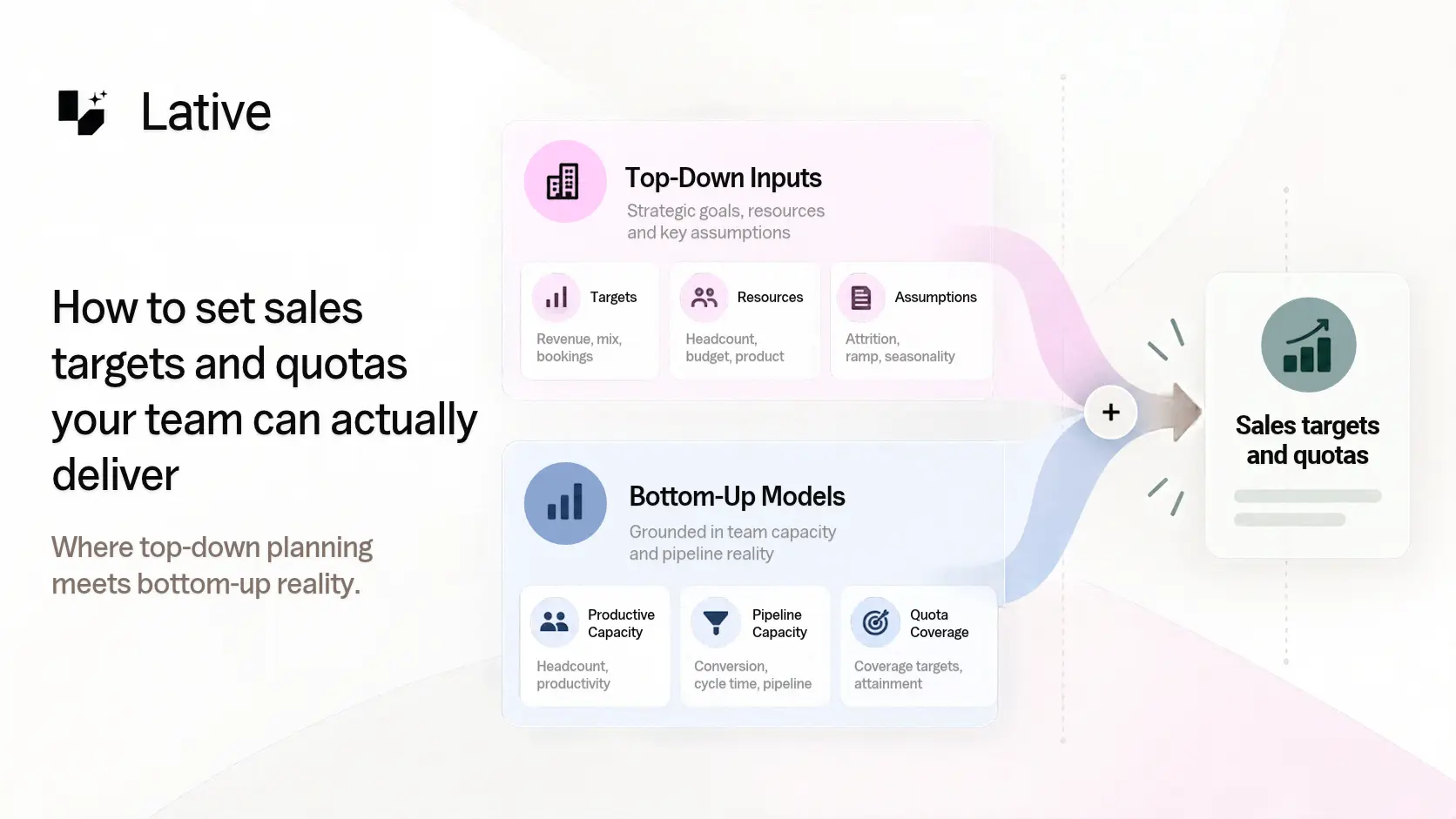
This is where modern GTM planning is innovating. Rather than relying on static spreadsheets that quickly become outdated, leading organizations are building a planning capability that connects strategy, operational performance and execution throughout the year.
At Lative, we believe annual planning shouldn’t be treated as a once-a-year exercise. It should be a connected, continuous, and dynamic discipline that links performance baselines, top-down strategy, bottom-up operational data, and performance outcomes, giving revenue leaders the confidence to adapt quickly as business conditions change.
Preparing for planning season
If you’re preparing for planning season, join Lative CEO and Co-founder, Werner Schmidt, and RevOps Solutions Leader, Stephanie Martin, for our GTM Annual Planning Masterclass: From Revenue Targets to Execution-Ready Plans.
In this practical session, they’ll walk through the right GTM Planning framework to use, operating rhythm and decision process behind world-class GTM planning. You’ll learn how to connect top-down revenue targets with bottom-up performance intelligence, pressure-test assumptions, identify plan gaps, and translate strategy into execution decisions.
Whether you’re leading planning for the first time or looking to improve an established process, you’ll leave with practical ideas you can apply immediately as planning season gets underway.