
Why measuring AI impact on sales is critical today
Measuring AI impact on sales is more important than ever. Every week, a shiny new tool promises to transform your sales process, automating emails, forecasting deals, analysing calls, or coaching reps in real time.
The value proposition is always the same: do more, faster, with fewer resources.
On the surface, it’s compelling. Sales leaders today are under pressure to hit aggressive targets with leaner teams and tighter budgets. Investing in AI feels like a strategic advantage.
But here’s the uncomfortable truth: most companies don’t know whether their AI tools are actually working.
The productivity illusion
It’s easy to fall for the optics of innovation. The rollout happens fast. Adoption looks solid. Internal champions sing its praises. Dashboards show usage. Leadership feels confident.
But none of that proves impact.
AI might be doing things faster, but is it doing the right things better?
That’s the core question. And it’s rarely answered clearly. Because too often, companies measure success by implementation alone: licenses purchased, teams onboarded, adoption tracked, positive anecdotal feedback.
What’s usually missing is evidence of outcomes.
If your AI tools aren’t materially changing rep behaviour, deal velocity, or revenue outcomes, the tech might just be cosmetic. And the cost compounds quietly. According to McKinsey, AI in sales can drive a 15 to 25% increase in ROI when measured against real outcomes. Most teams never collect the data to know whether they’re in that bucket.
Real-world example: AI without impact
A mid-market SaaS company rolls out a new AI tool that auto-generates follow-up emails. The vendor claims it saves each rep four hours per week. That sounds like a win.
After 90 days: usage is high, reps say it helps, management sees time savings in reporting.
But actual sales productivity (yield per rep per unit of time) hasn’t increased. Quota attainment remains flat. The time savings didn’t turn into business impact.
This isn’t unusual. SPOTIO’s 2026 State of Field Sales Survey found that tools with the highest strategic upside, including predictive forecasting and customer behaviour analysis, are being used by fewer than 20% of teams. Most AI adoption is concentrated in lower-value tasks like email generation and CRM data entry.
Efficiency without outcomes is just automation theatre.
How to effectively measure AI sales productivity increase
Measuring AI impact on sales requires more than activity logs. You need clear, outcome-based performance tracking:
- Output per rep before and after tool adoption
- Revenue contribution per team
- Productive Capacity increases
- Conversion rate shifts
If your analytics can’t answer those questions, you’re left with an expensive assumption.
Where Lative comes in
This is exactly what Lative solves. Ranked #2 on the G2 Sales Planning Grid (Spring 2025), Lative is the only platform that performs bottom-up capacity planning based on real productivity data. That means when you roll out an AI tool, you have a baseline to measure against, not just a vendor dashboard.
Lative gives Sales and RevOps leaders clear visibility into:
- What changed after AI tool adoption
- Whether sales rep capacity actually increased
- Whether overall sales productivity output changed
Lative connects AI initiatives to performance outcomes, so you can set your expected productivity lifts and track to them.
We help revenue leaders go beyond surface metrics like login rates or time saved, and get answers to high-impact questions:
- Did our Productive Capacity increase without adding headcount?
- Did our Sales Productivity increase after the AI rollout and by how much?
- Did our Sales Efficiency improve?
- Did we see more salespeople hitting target?
Lative doesn’t just aggregate data, we isolate change. We track pre- and post-rollout performance so you can see whether a tool made things better, or just made them look better.
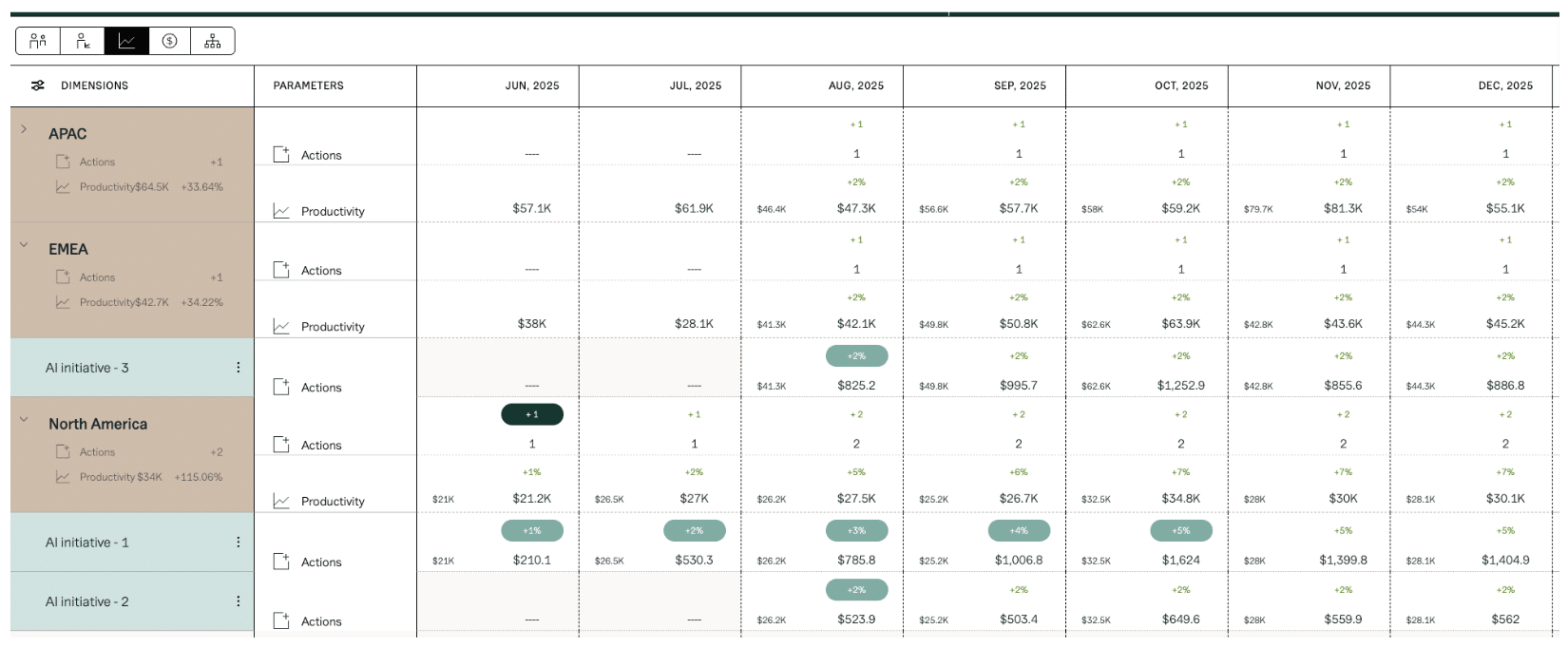
We help revenue leaders go beyond surface metrics like login rates or time saved, and get answers to high-impact questions:
- Did our Productive Capacity increase without adding headcount?
- Did our Sales Productivity increase after the AI rollout and by how much?
- Did our Sales Efficiency improve?
- Did we see more sales people hitting target?
Lative doesn’t just aggregate data, we isolate change. We track pre- and post-rollout performance so you can see whether a tool made things better, or just made them look better.
No more guesswork for sales capacity
In today’s market, revenue teams are expected to do more with less. More pipeline, more precision, more forecasting accuracy. And AI is often presented as the answer.
But every AI investment comes with a cost. Google Cloud’s 2025 ROI of AI Report found that 74% of executives report achieving ROI within the first year of AI deployment. The ones who don’t share a common failure mode: they measured adoption, not outcomes. If you can’t tie cost to measurable results, you’re burning budget on hope.
Lative removes that risk. That means:
- No more guessing which tools work or not
- No more gut-based decisions on enablement
- No more spreadsheets to prove impact
Just clear, actionable data that shows you what’s moving the needle and what’s not.
Looking ahead
AI is not a magic bullet. But when used intentionally and measured rigorously, it can be transformative. The key is making sure you’re not just adding tools, but adding value.
The next era of RevOps won’t be driven by how many AI products you deploy. It’ll be defined by how well you prove they work.
In an era where every investment needs to earn its keep, Lative gives you the confidence to know, not hope, that your tools are making a measurable difference.
Ready to find out if your AI investments are actually working? Schedule a demo